
Subscriber Benefit
As a subscriber you can listen to articles at work, in the car, or while you work out. Subscribe Now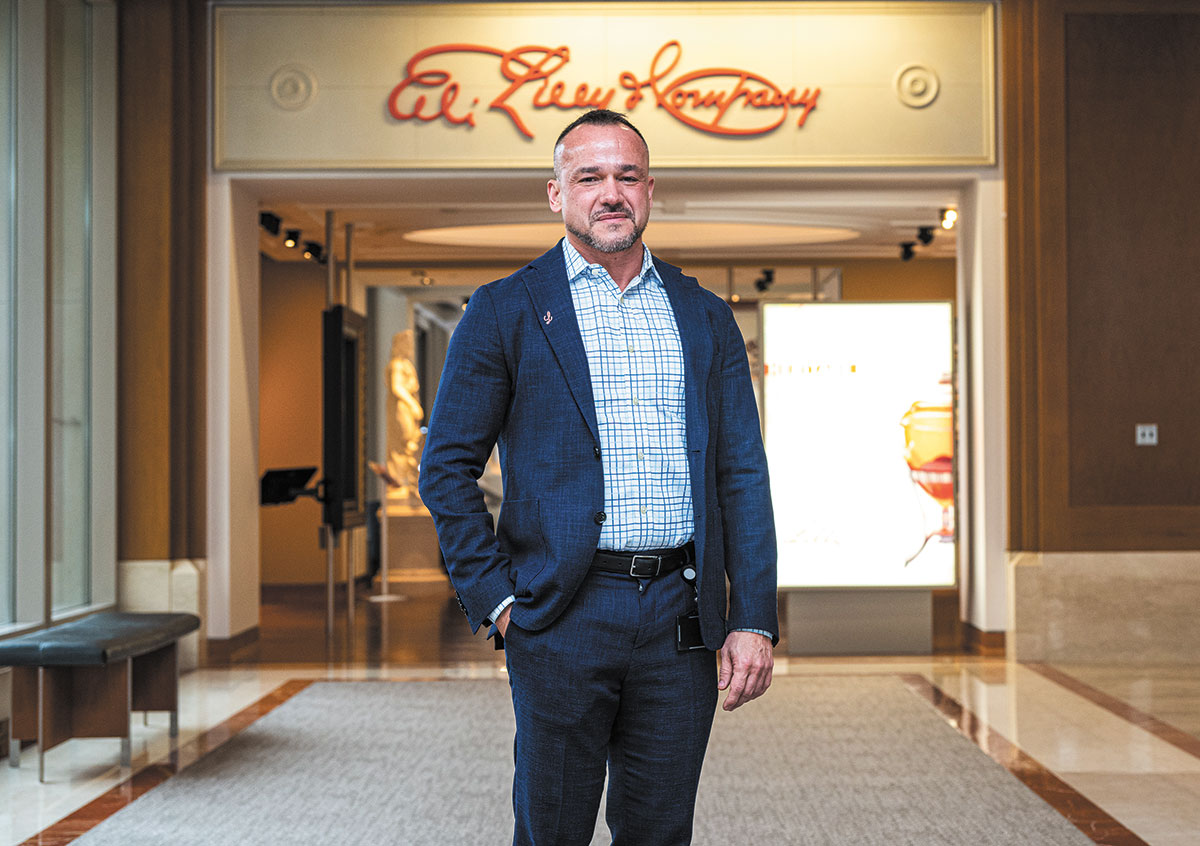
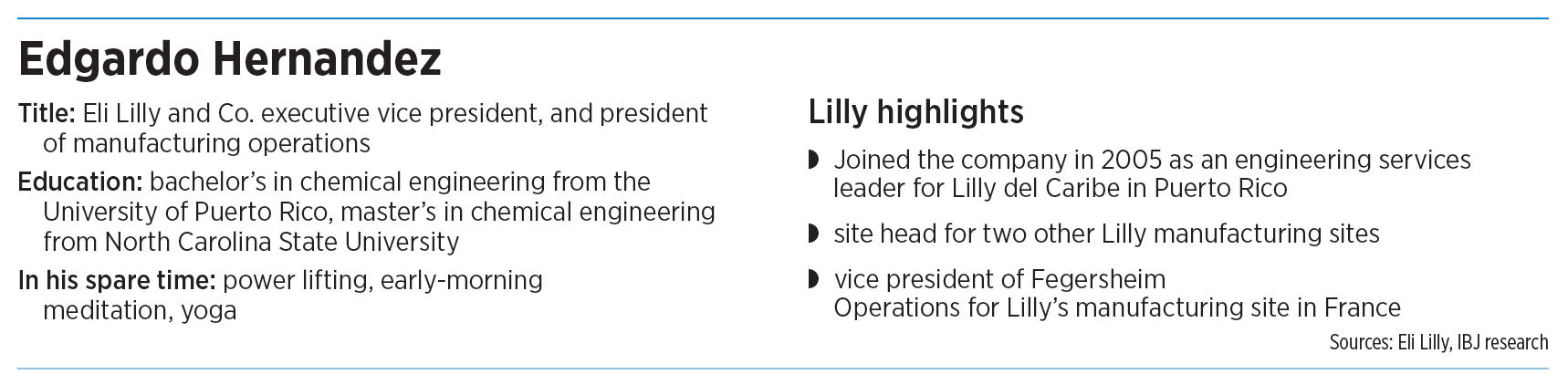
Edgardo Hernandez seeks a regimented life. He’s up at 4 a.m. for meditation. “I do my blessings and everything that I need to pray or whatever, and then I work out,” said Hernandez, executive vice president at Eli Lilly and Co. and president of manufacturing operations.
Power lifting, music in headphones, is his relaxation. Then it’s off to work, spending much of his time visiting Eli Lilly and Co. manufacturing sites and those under construction. Hernandez spoke with IBJ about Lilly’s approach to process improvement and his attraction to the pharmaceutical industry growing up in Puerto Rico. This conversation has been edited for length and clarity.
Lilly in February announced it is planning to invest $27 billion to expand U.S. manufacturing operations, adding four new manufacturing sites. Do you have an update on when we could learn the states and locations for those sites?
We received submissions from states until March 12. We will review all the submissions and make our final recommendations. There’s a lot of interest.
How much of Lilly’s workforce is now under manufacturing? You recently said manufacturing was adding about 200 employees a month.
We continue at that clip. We probably are going to wrap up the year with 14,000, a little bit more.
How is work progressing for sites at the LEAP Research and Innovation District in Lebanon?
We have hired probably more than 200 people already locally, which is great. There are two facilities. One is for chemical synthesis. The other one is for genetic medicine. The genetic medicine facility is already built; it’s close. So we are waiting for the equipment to arrive so we can start qualification on the facility. It’s moving fast.
How often do you visit these sites?
All the time! I spend two weeks out of the four weeks of the month visiting sites and construction sites. I like to do that. One of the things that I spend a lot of time on is safety because construction safety is important. And, of course, observing progress and talking with the local management team about obstacles and things.
Lilly has cut the time from breaking ground to producing medicine from five years to three or less. How did this happen?
RTP [Research Triangle Park] was the first site we built in North Carolina. We went from groundbreaking to making medicine in 2-1/2 years. We replicated that site in Concord, close to Charlotte in North Carolina. We went from groundbreaking to making medicine in two years there.
We’re not only doing it fast, we’re doing it faster and better every time. We do that through replication. We know our processes. We have partners that manufacture our equipment, so we work with them on lead times and make orders ahead of time so that we can reduce cycle times. We also have great design partners. They know our standards. We have a set of engineering and quality standards that we share with those partners. Then we’ll deal with a lot of good construction partners that we have known for very long, including here in Indiana.
With manufacturing or construction, does Lilly use any continuous improvement tools like Kaizen?
We use a number of Lean tools and Kaizen. Every time we face an issue, we generate an A3 [problem-solving tool], and we institutionalize the learning in sort of playbooks so the next [team] doesn’t have to deal with the same problem. That’s how you basically gain speed.
Do you have avenues for someone not in management, like a technician, to give suggestions for improvements?
Lean tools. People come together, operators, with their supervisors at 6 a.m. every morning, and they talk about what issues they have and how they propose to solve it. Those get escalated through all levels of management, depending on the nature of the problem. If it’s a big issue, it comes to me. If it’s smaller, it’s [solved] locally.
Do you try to create a feel when you walk into a Lilly facility that it seems much the same, wherever it is in the world?
Yes. It wasn’t like that in the past. We used to have a lot of popular designs! Now facilities are very standard, so we kind of institutionalize what’s best of all our designs.
With Lilly being such a complex company in multiple disease areas, how does manufacturing plan for volume to avoid shortfalls or surplus, especially with medications like Zepbound and Mounjaro?
We have very rigorous processes. It starts with demand-management forecasting that comes from the businesses into manufacturing … then that generates production plans, and we have inventory targets. Normal operations management 101, right?
Obesity was a fairly new market, so we knew little about it. Believe me, we did all the market research. We tried to prepare as best as we could. We did our first artificial intelligence model to try to predict demand for products like Mounjaro and Zepbound. But they were wrong.
We didn’t have the good input that we needed into those systems. That’s the beauty of artificial intelligence: You make them better and better and better, and now we have come to a point in which I feel good [about] our capacity to predict demand, translate that into production planning.
What is an example of a strategic partnership for developing Lilly manufacturing workers in Indiana?
We made an agreement with Ivy Tech [Community College] for 1,000 Lilly scholarships—basically paying for people to study biopharmaceutical processing, lab techs, mechanics, instrument tech, whatever we need in our workforce. They have been helping us develop the programs to upskill not only new talent but also upskill in our workforce internally.
How long does it take for a new Lilly manufacturing employee, like an operator, to be trained?
It takes anything from six to 12 months for an operator to be able to run the production line. They start by training on gowning—how do you gown up to enter production areas to how do you make the medicine and understand the equipment, the processes?
With Ivy Tech, they basically replicate our facilities. So, an operator can go there, get a certificate in biopharmaceutical manufacturing. They get trained on gowning up. They get trained on what operations we have here. When they walk through the door, they have an advantage.
Lilly makes active pharmaceutical ingredients, APIs, and finished medications. What are some examples of how that whole process works?
It all starts with raw materials. When you’re making a peptide, you need amino acids. Amino acids are added sequentially to a growing peptide chain that form the molecule. The molecule is then purified to ensure that the medicine has the right potency and purity at the end of the process.
We have hundreds of in-process controls to make sure the medicine is right. Then it goes from there to the formulation side, in which you basically formulate the final product.
You fill the product in the production lines sterile. It goes from there to visual inspection, because we want to make sure, 100% sure, that there’s no physical defect. We have tested the chemical, the microbial properties, so now we make sure that there’s no defects in the unit. Every unit has 70 to 80 pictures taken of them through high-speed automatic visual inspections to make sure they’re completely right.
Every unit, every vial or injection pen, 70 or 80 pictures?
Yes. We keep all that data of all the medicines we make to make sure that there’s no defects. We use artificial intelligence to look at the pictures, use all the machine learning to make sure every unit is perfect before it leaves our facility.
You grew up in Puerto Rico. What drew you to the pharmaceutical industry?
My grandfather was a coffee farmer, and the first thing that I did when I was probably 8 to 9 was to pick coffee, which is difficult. You do that under the sun, there’s insects. I was saying, like, “Huh, I don’t want to be a farmer!”
But the same grandfather, when I was involved in high school, he got lung cancer, and he didn’t get access to good treatment, so he passed really quickly. It was a very treatable disease had he had access to the right medicines. That’s what drew me to medicines and to the pharmaceuticals, the opportunity to have an impact.
Do you have any kind of escapes or hobbies that you enjoy away from work to recharge?
I’m a very structural, regimented person. I like power lifting. I know I don’t look the part, but, yeah, I do a lot of power lifting! I do everything, from clean and jerks, to squats, to dead lifting. There’s something about that. It’s extremely relaxing. You see progress. Every week, I say I want to do, like, 0.5 pounds more.•
—Daniel Lee
Please enable JavaScript to view this content.
Editor's note: You can comment on IBJ stories by signing in to your IBJ account. If you have not registered, please sign up for a free account now. Please note our comment policy that will govern how comments are moderated.