
Subscriber Benefit
As a subscriber you can listen to articles at work, in the car, or while you work out. Subscribe Now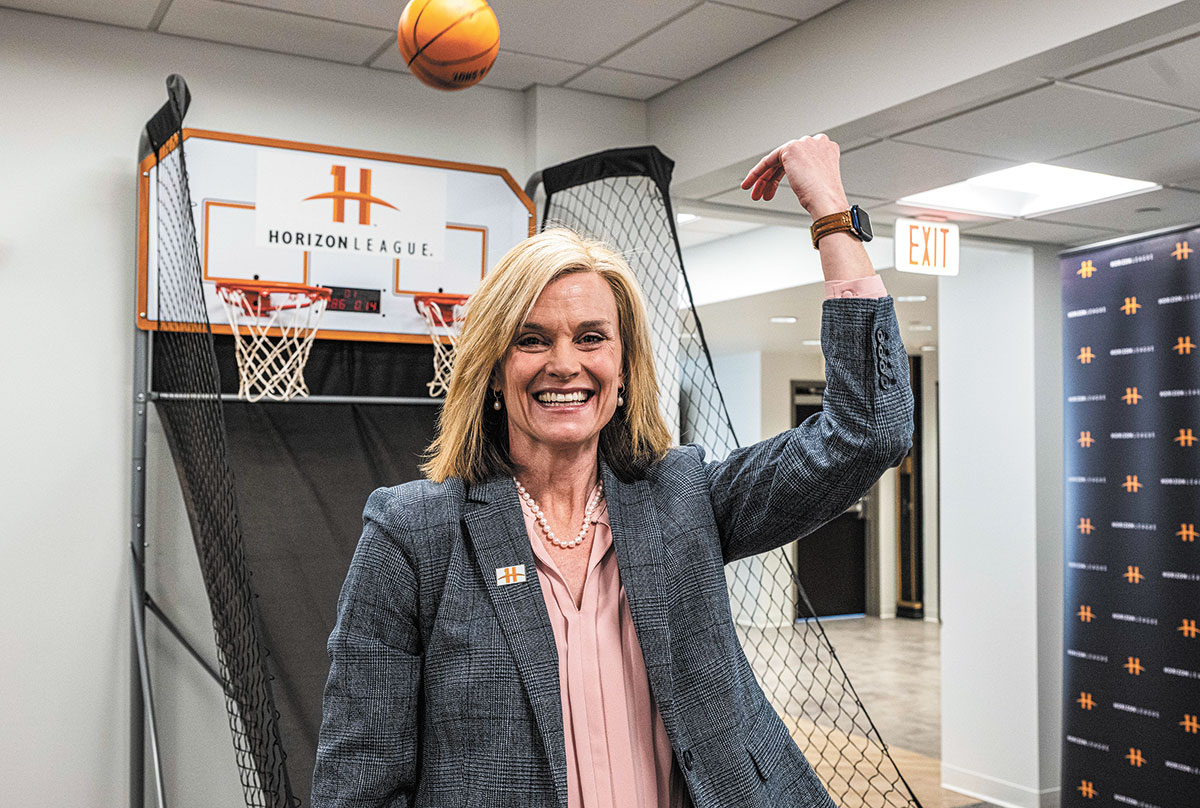
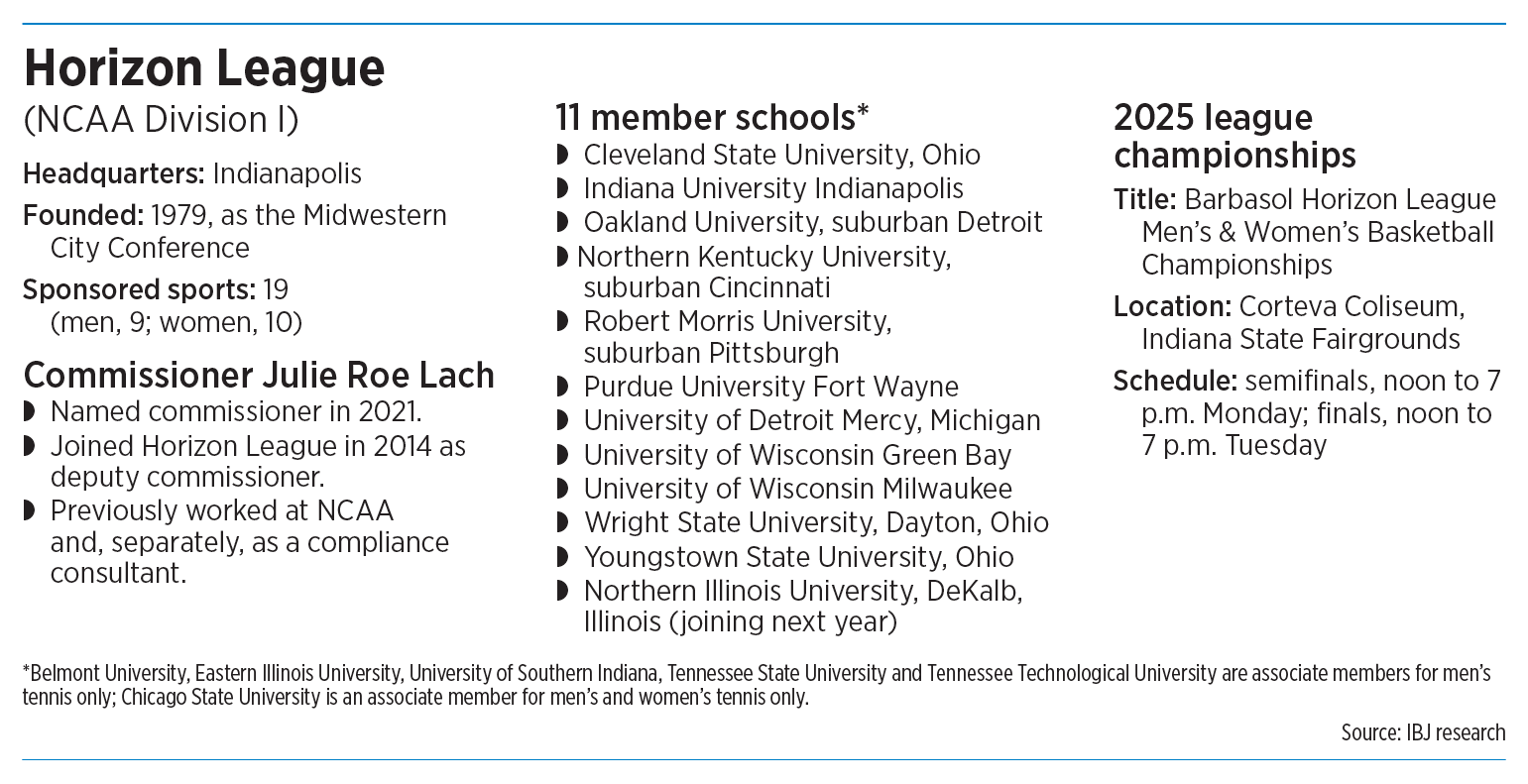
The Indianapolis-based Horizon League is set to wrap up its men’s and women’s basketball tournament at the Indiana State Fairgrounds next week, with semifinal games on Monday and the championship games on Tuesday at Corteva Coliseum.
The champions will receive automatic bids to their respective NCAA tournaments.
IBJ talked with Commissioner Julie Roe Lach about opportunities for the conference, whose 11 members include Indiana University Indianapolis and Purdue University Fort Wayne, and the announcement that Northern Illinois University will join the league in 2026.
Lach, a member of IBJ Media’s Indiana 250, a list of the state’s most influential business and community leaders, also talked about a potential expansion of the NCAA basketball tournaments and what the Horizon League is doing to support its female athletes.
Northern Illinois University is returning to the Horizon League in 2026 for all sports except football, which will be in the Mountain West Conference, and wrestling and gymnastics, which will remain part of the Mid-American Conference. What’s the significance of bringing NIU into the fold?
We really look at it as a major move for us, and I think there are a few big categories of impact.
The first is, frankly, just alignment from a values and priority standpoint. [NIU is] bringing 14 sports, but we’re also mostly known as a basketball league. Through our conversations over the last several months, it’s been clear they want to move the needle in basketball, and they believe that by joining the Horizon League, they’ll be able to do that.
NIU has made a financial commitment to build up its basketball programs through significant upgrades to its facilities and really increasing their operational budgets. They also recognize the name, image and likeness commitment that needs to come next.
The other big piece is that they are in a major market, being part of Chicagoland, so when they join the league, we’ll be in six of the top 30 television markets. It’s really significant from an exposure standpoint, and I think our league is starting to really take advantage of our major city footprint.
What do opportunities for league growth look like?
It’s interesting. When I joined the Horizon League 10 years ago, we had nine members, then we grew to 10, to 11, to 12—not all at once, but over time. With each new member, it was really a matter of an institution that really had that alignment, in terms of sports and competitive philosophy, willing to invest and prioritize basketball, and obviously a geographical fit, all with that holistic commitment to the true student-athlete concept.
It’s never been about, “We need to get to 10, 11 or 12,” because with [the University of Illinois-Chicago departure], we were 11 for a couple [of] years but moved the needle from a national basketball competitive standpoint, going from being the 27th-ranked conference for men’s basketball in the country to 20th in two years, and now we’re knocking on No. 19.
We’ve made some league investments very intentionally, and we’ve had some major personnel changes—with a philosophy of having to get better, ourselves—but our campuses have also stepped up. All that, while also keeping an eye on who in the landscape might be a good fit.
But does that mean that we’re looking to expand beyond 12? I think in this dynamic, fluid environment, there’s no ultimatum or cap in terms of where we might go. But on the other hand, for right now, our membership is really committed to being an incredibly strong, nationally competitive, 12-member league.
For years, the Horizon League has leaned into diversity, equity and inclusion initiatives. Given the many moving pieces in the political sphere and the charged sentiments surrounding those concepts, do you still see that as core to the values of the Horizon League?
I appreciate you asking that. As a league, we have four core values, and one of those is respect. That includes a holistic commitment to diverse views and diverse backgrounds with a commitment to being inclusive in how we approach opportunities and challenges.
Our league just lifted up the legacy of John McLendon—who was the first Black coach at a historically white institution in Cleveland State University and a Naismith Hall of Famer—through a weeklong celebration at our 11 campuses. We really were able to amplify who coach McLendon is from a legacy standpoint to our league but then more importantly to the game of basketball. And perhaps even more importantly, from the perspective of being a social-justice warrior and advocate.
That is something we are going to continue to do, and one way of doing that is to use our platform to carry forth these inspirational messages. So are we going to remain committed to these initiatives that I think contribute to impact and belonging? Absolutely, because that’s a core value of who we are.
How do you have a dialogue with member institutions—many of which are public universities—and state officials in geographic areas where DEI has become something of a political hot potato?
When we’ve talked about our commitment to respect, impact and belonging with our presidents, chancellors and athletics directors and the league initiatives that support that, we have really emphasized that it is about ensuring opportunities and access, not just from an athletic standpoint but also for those then that want to go on and work in athletics administration.
I think sometimes people get caught up in the semantics. But at the end of the day … we are collectively committed to impact and ensuring belonging across our campuses. And that’s what I’ve heard from our presidents and chancellors—that they understand there’s some legislation that’s been proposed, adopted in some places and being contemplated in others, but we remain committed to ensuring that we are providing these strong, inclusive environments and that we’re ensuring impact.
Have you seen member schools change their approach to women’s sports over the past decade? Has it become more important in recent years than perhaps it was in the past?
Fortunately, our league has a strong tradition of investing in and supporting women’s sports—we’ve literally been doing it for decades. And we’ve had success in the postseason, in particular in women’s basketball and volleyball, with multiple teams in the NCAA tournament in both of those sports. We’ve also had success with softball in the post-season.
But in order to position our student athletes to perform at that level, there’s got to be investment on the campus—and not just financial but also culturally—and recognizing that women’s sports adds incredible value to your campus community and the larger community.
From a league standpoint, we have recently launched the Women’s Basketball Excellence Fund. I think we’re the only conference to have done this. We’ve taken money from our league savings, put it in a pot and established criteria to reward women’s competitive excellence for our teams that are achieving certain competitive metrics with the expectation they’re going to take that money and invest it back in their programs.
We launched this a couple [of] years ago on the men’s side, and now we’re doing it on the women’s side. We’re looking at $200,000 a year for at least two years. Then we’ll assess it. On top of that, about three years ago, we provided each school $25,000 for their men’s program and another $25,000 for their women’s program in the form of an improvement grant, where they had to be really clear about how they were going to do something above and beyond their current strategy to move the needle in basketball and really elevate their program to that next level.
So we’re continuing that commitment and, frankly, I think the sky’s the limit in terms of how and where our women’s programs are going to continue to perform and excel.
There are a few big basketball games coming up for the league. What can you share about this year’s Horizon League championships?
It came down to the wire in terms of how the bracket was seeded, but by the end of this week, we’ll have the teams on the men’s and women’s side punch their ticket to come to the semifinals here in Indianapolis. On March 10 and 11 at the newly named Corteva Coliseum at the Indiana State Fairgrounds, our teams will be competing. We’ve had year-over-year growth in both attendance and sponsorships as well as community support. So, we’re looking to continue to set records this year.
There has been talk about whether the men’s and women’s NCAA basketball tournaments might expand in the future—with some speculation that they might grow to 96 teams. What do you make of that concept? And how do you weigh the potential exposure it might give the league with the impact it could have on perceptions of the tournament product itself?
That is a review that’s been underway for a bit. What I’ve been told is, the [NCAA] committees are taking a look at it, but there’s no guarantee of expansion. There’s some due diligence to do here as we’re looking across the growth opportunities for the sport. I think the NCAA also recognizes there’s some pretty clear markers that aren’t going to move, especially relative to the championship needing to happen when it does on the calendar to avoid Masters weekend. So, when you look at that window, if there’s any sort of expansion, it would have to be pretty modest.
But then the question is, what does that mean for the Horizon League and other strong mid-to-high majors?
I think that any opportunity that we have needs to be meaningful so that we have teams that, with a seed path they’ve earned—like Oakland did last year against Kentucky—have a reasonable chance to pull out an exciting win and advance in the tournament.
What we don’t want to see if expansion happens is that, as the bracket starts to take shape, you have strong mid-majors like us relegated to the play-in games. That, to me, would be a major miss and diminish what we all love about March Madness, which is that everybody starts at the same starting line on relatively the same day, and then they’ve got a shot at going all the way.
That is something that those of us that work in college sports need to really take some strong steps to keep in place.
It’s worth noting, if only for our readers, that two teams that have played in the NCAA Men’s Tournament’s First Four games have gone on to reach the Final Four since the First Four began in 2011.
You’re right, and I think with the First Four featuring No. 11 seeds playing each other and No. 16 seeds playing each other, it doesn’t really constitute a play-in game situation—that’s just part of that trade-off to expand the bracket to 68. I thought that was a really smart way to do it, both for fan interest but also to still provide a strong competitive experience in those games.
Typically, Horizon League teams are seeded 12th or lower in the men’s and women’s tournament brackets, along the same lines as some of the other mid-major conferences. As commissioner, do you feel like your conference gets the respect you think it deserves from the selection committees?
In recent years, candidly, I’ve thought our seed path was about where it needed to be. If there’s any debate we have with the committee representatives, it’s whether we should have slid up one spot. We have frequent communication with our committee representatives—members of the selection committee are all assigned multiple conferences, and they get on videoconferences with us at least once a month before they go into what feels like a conclave to create the tournament bracket.
They know our teams; they know our league. They are watching our top teams down the stretch, and they are way in the metrics with us, where if a team has some losses or some student athletes injured, they are tracking the ins and outs of the strength of our league from top to bottom.
I’ve been impressed that with their day jobs, which are athletics directors and commissioners, they’re also committing the time to do their homework and know the leagues that they’re assigned. So do I advocate? Yes, very strongly our league champion. Our goal is to move to where we’ve got a fighting shot to have an at-large bid. We’re not there now, but that’s obviously part of this pursuit of excellence and our strategy. But when we get to that point, I’m sure there’ll be even more intense dialogue, but I respect the way they go about the work they do.
I think that our league does get respect as they are really trying to figure out where our league champion should be on these brackets.•
Please enable JavaScript to view this content.
Editor's note: You can comment on IBJ stories by signing in to your IBJ account. If you have not registered, please sign up for a free account now. Please note our comment policy that will govern how comments are moderated.