
Subscriber Benefit
As a subscriber you can listen to articles at work, in the car, or while you work out. Subscribe NowOrforglipron (pronounced or-for-GLIP-ron) might be a mouthful to say, but Indianapolis-based Eli Lilly and Co. sees this experimental weight loss pill as a potential global breakthrough treatment for weight loss and other conditions because of its simple appeal: Patients prefer swallowing pills to using needles for injections.
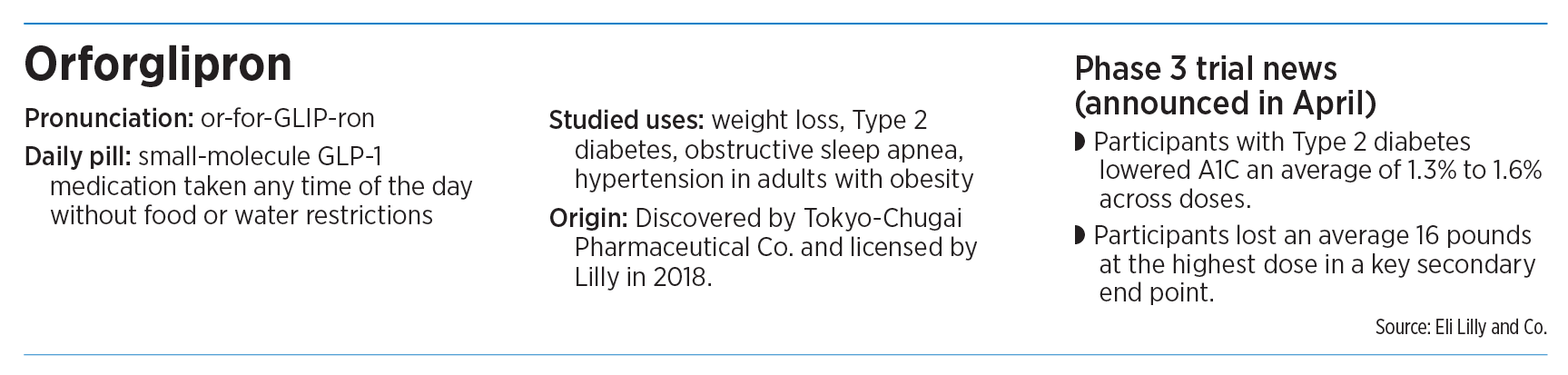
Orforglipron is the active glucagon-like peptide-1, or GLP-1, ingredient in a pill taken once a day. Lilly’s current GLP-1 medications—Zepbound for weight loss and Mounjaro for Type 2 diabetes—use the active ingredient tirzepatide and are injected weekly.

“This scientific breakthrough has the potential to eventually impact hundreds of millions of people around the world with chronic diseases,” Lilly CEO David Ricks said during the company’s earnings conference call with analysts last month.
Orforglipron is not yet approved by the FDA, but Lilly said regulatory submission for treatment of obesity is likely late this year, with Type 2 diabetes to follow. Lilly said it also is studying orforglipron for obstructive sleep apnea and hypertension in adults with obesity.
The medication works by mimicking the body’s GLP-1 hormone, which helps regulate blood sugar, appetite and digestion when it triggers insulin release from the pancreas that slows stomach emptying.
Usage of GLP-1 medications has exploded in recent years as they have proven effective at significant weight loss in addition to treating Type 2 diabetes and obstructive sleep apnea.
Lilly said its goal with orforglipron was to create a medicine that offers the efficacy, safety and tolerability of injectable GLP-1 drugs with the convenience of a daily pill that could be manufactured at a huge scale to meet massive demand.

GLP-1 drugs have proven effective at lowering A1C (a test that measures the average amount of sugar in the blood over the past three months) and curbing hunger cravings, according to Dr. Shaun Grannis, vice president of data and analytics at Indianapolis-based Regenstrief Institute.
“It is showing results for those people who stay on the medication, use it appropriately and combine that with dietary change and physical exercise,” he said, adding: “These are not magic pills. You will not be successful with long-term weight loss if you don’t achieve lifestyle modifications, as well.”
An alternative
For now, sales of Lilly’s injectable drugs with tirzepatide are driving the company’s growth.
In the first quarter of 2025, Mounjaro had $3.84 billion in revenue and Zepbound $2.31 billion, almost half of Lilly’s overall quarterly revenue of $12.73 billion.
Manufacturing injectable medications is complex. The medicine must be filled into a vial or syringe and kept refrigerated. Injected medicines often come with an injection device that also must be manufactured.
Patients also must store the medicine properly and typically must self-inject.
Grannis said many patients do not stay on prescribed GLP-1 medications. He said of those using the drugs for weight loss alone, about 50% stop within a year and about 30% of overall GLP-1 users stop within a year.
“We do see a significant drop-off, and there’s a variety of reasons,” said Grannis, who also is a professor of family medicine at the Indiana University School of Medicine.
He said those factors include cost, which can be hundreds of dollars a month without insurance coverage. Grannis also cited side effects like nausea, vomiting and general gastrointestinal discomfort or needle aversion.
Orforglipron can be taken any time of the day without restrictions on food and water intake.
Ricks said the company expects to release results from seven phase 3 global studies looking at orforglipron used to treat Type 2 diabetes and obesity. “We also expect potential regulatory submissions for obesity to begin worldwide by the end of 2025,” he said in the May 1 Lilly earnings call.
The first phase 3 clinical trial results, though, are for treatment of diabetes. In its April release of study data, Lilly said orforglipron demonstrated “statistically significant” efficacy results for Type 2 diabetes.
Lilly said patients with Type 2 diabetes taking orforglipron saw their A1C lowered an average of 1.3% to 1.6% across doses and lost an average 16 pounds at the highest dose, 36 milligrams.
The company also said more than 65% of participants taking the highest dose of orforglipron achieved an A1C less than or equal to 6.5%, which is below the American Diabetes Association’s defined threshold for diabetes.
Lilly said if orforglipron is approved by regulators, the FDA in the United States, the company is confident it can launch the medication worldwide without supply constraints.
Reaching more
Orforglipron is the drug’s scientific name; it will be marketed by Lilly under a yet-to-be-released brand name if it receives FDA approval.
And the potential market is enormous.
“Just in the United States, it’s probably 100 million people that could benefit from medicines like these, and around the world a billion people,” Lilly Chief Scientific Officer Dr. Dan Skovronsky said.
That’s not a scale that’s addressable with injectable medicines. Health problems that common are typically treated with oral medicines.
“I hope that we can use this medicine to bring the benefits that [a smaller number of patients] are getting from injectables … to a lot more people,” Skovronsky said.
Based on the upcoming releases of clinical trials, he said, Lilly plans to submit orforglipron to regulators for approval for obesity treatment late this year and Type 2 diabetes next year.
In a May 1 research note, JP Morgan analyst Chris Schott wrote that orforglipron, with results from obesity phase 3 trials coming soon, represented a major potential growth driver for Lilly in 2026.
“And in the U.S., we anticipate orforglipron to likely be priced at a discount relative to Zepbound, which could help further open up access among more employers,” he wrote.
Now, many health insurance policies do not cover GLP-1 medications prescribed for weight loss for patients with obesity. Lilly has not commented directly on pricing for orforglipron.
In addition, the JP Morgan note added that orforglipron could be used in the “maintenance market” once patients have reached their weight goals or weight loss has plateaued on injectables.
Lilly faces competition from rivals, including Danish pharmaceutical maker Novo Nordisk, which offers three of its own GLP-1 medications, all using the active ingredient semaglutide: Wegovy for weight loss and Ozempic for Type 2 diabetes, both injectables, and Rybelsus, a pill.
Lilly is testing its orforglipron pill for multiple chronic conditions. Rybelsus is approved only for Type 2 diabetes, to lower blood sugar and A1C, although Novo Nordisk said it might help patients lose some weight.
Orforglipron has been years in the making.
In 2018, Lilly entered into a license agreement with Tokyo-based Chugai Pharmaceutical Co. for worldwide development and commercialization rights to OWL833, as orforglipron was then called. Chugai will be eligible for royalty payments if the molecule is successfully commercialized.
Chief Scientific Officer Skovronsky said thousands of people at Lilly have worked on orforglipron, with the main tasks being to develop the processes to make the medication with high quality at high scale and to conduct the clinical trials.
“Pills are made by chemical reactions, and depending on how complicated the molecule is, you may have more or fewer chemical reactions,” he said. “This, I think, is the most complicated chemical that we’ve made at Lilly.”
Skovronsky said Lilly already has taken an “extremely unusual” step as it anticipates orforglipron’s entry into the market.
“We started manufacturing before we had the clinical trial results, optimistic that we would get good data,” he said, “taking a calculated risk that we thought was worth taking so that we wouldn’t disappoint patients, in case it is successful, by not having supply.”•
Please enable JavaScript to view this content.
Editor's note: You can comment on IBJ stories by signing in to your IBJ account. If you have not registered, please sign up for a free account now. Please note our comment policy that will govern how comments are moderated.