
Subscriber Benefit
As a subscriber you can listen to articles at work, in the car, or while you work out. Subscribe Now Racers and Pacers. They fit together around these parts despite their obvious differences—and for reasons beyond rhyming. They have been mingling for 58 years now and remain mutual admirers—not of the distant variety, but from the mere 7.6 miles that separates the Indianapolis Motor Speedway and Gainbridge Fieldhouse.
One side displays incredible calm and bravery.
The other displays incredible energy and athleticism.
Both display elite skill and endurance.
On Sunday, the neighbors will combine forces for a rare doubleheader that will send a jolt of adrenaline throughout central Indiana and capture the attention of the nation and beyond. The green flag for the Indianapolis 500 drops at 12:45 p.m. The opening tip for Game 3 of the Pacers’ Eastern Conference finals playoff series against New York goes up about 8 p.m. Barring a rain delay, there’s time enough between the two for fans and even drivers to attend both if they have the desire, money and stamina.
The Indy 500 has been run since 1911, and the Pacers have been in business since 1967, but this scheduling quirk has occurred just three times previously—in 1999, 2004 and 2013. The relationship between the two events and their participants goes well beyond the few times they have performed on the same day, however.
The Pacers owe their nickname to the 500—sort of. It connects more with harness racing, which once was a popular feature on the dirt track across from the Fairgrounds Coliseum where the team first played its home games. Harness races feature two types of horses with different running styles: pacers and trotters. The word “pacer” is not associated with auto racing but at least relates to the pace cars. Mike Storen, the Pacers’ original general manager, declared, “We will set the pace in the ABA,” when he announced the team name on June 16, 1967.
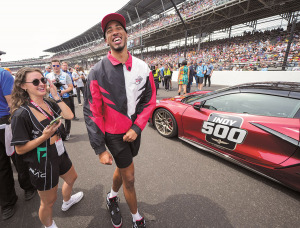
Drivers are seen frequently at Pacers games, usually in the four seats the Indianapolis Motor Speedway purchases in the end zone section in the front row around the corner from the Pacers bench. A few sat in a mock race car and participated in the “rev up the crowd” pre-game bit in the 2022-2023 and 2023-2024 seasons. Mario Andretti was the first to do it, and Tony Kanaan, Al Unser Jr., Christian Lundgaard, Sarah Fisher, Colton Herta and Pato O’Ward followed. A.J. Foyt once tossed out the game ball before tipoff in the 1990s, and other drivers have participated in various ways, as well.
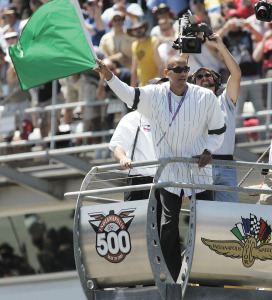
(AP Photo/Michael Conroy)
Pacers players have returned the favor, conspicuously and otherwise. Most noticeably, Reggie Miller, having just finished his 18-season career, waved the green flag to start the 2005 race. Victor Oladipo was the honorary pace car driver in 2018, which meant he led the field for the start of the race and then pitted and turned over the task to a professional driver. Tyrese Haliburton was the honorary driver in 2023.
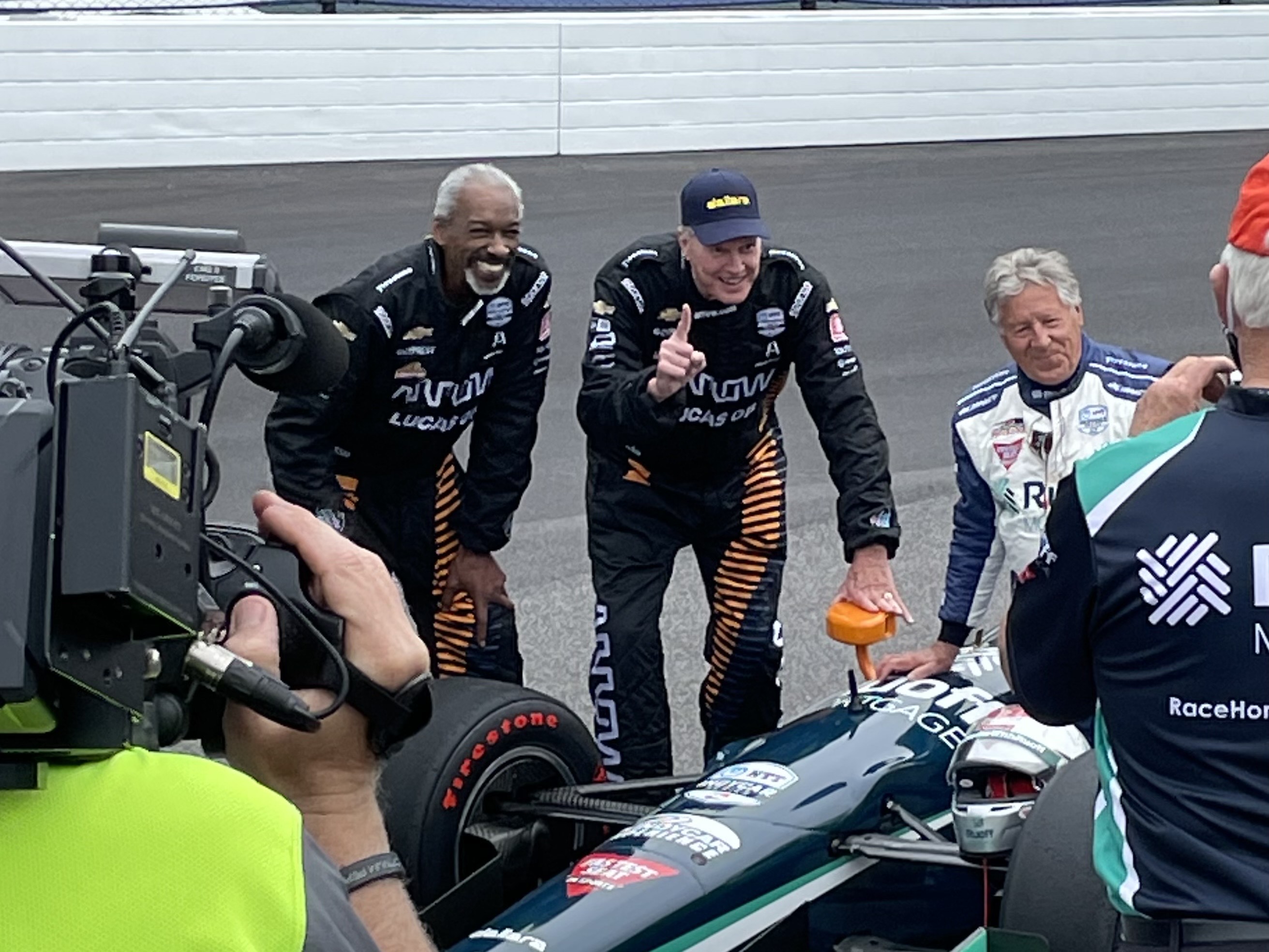
Two vintage Pacers took memorable laps around the speedway’s track that year when Andretti took Darnell Hillman and Bob Netolicky on two-seater rides. It was challenge enough for them to get into the back end of the car—Netolicky’s playing height was 6 feet, 8 inches. Hillman’s was 6 feet, 9.
Hillman has loved speed since he was old enough to drive. He drove to Indianapolis to begin his Pacers career in 1971 in a muscle car, a Firebird Formula 350, and later bought a 1973 Corvette that he still owns. He confesses to once driving it 165 miles per hour on a lonely desert highway.
Hillman didn’t realize the identity of his chauffeur in the two-seater ride until it ended.
“As I’m unwinding to get out of the car, the driver gets out and takes his helmet off. I said, ‘Oh, —-, that’s Mario Andretti! Mario Andretti just took me around the track in a two-seater!’”
Andretti drove without a governor that limited the car’s speed. How fast did they go? Let’s just say Hillman and Netolicky nearly joined the ranks of those who have circled the speedway’s track at 200 mph.
Netolicky loved Rutherford
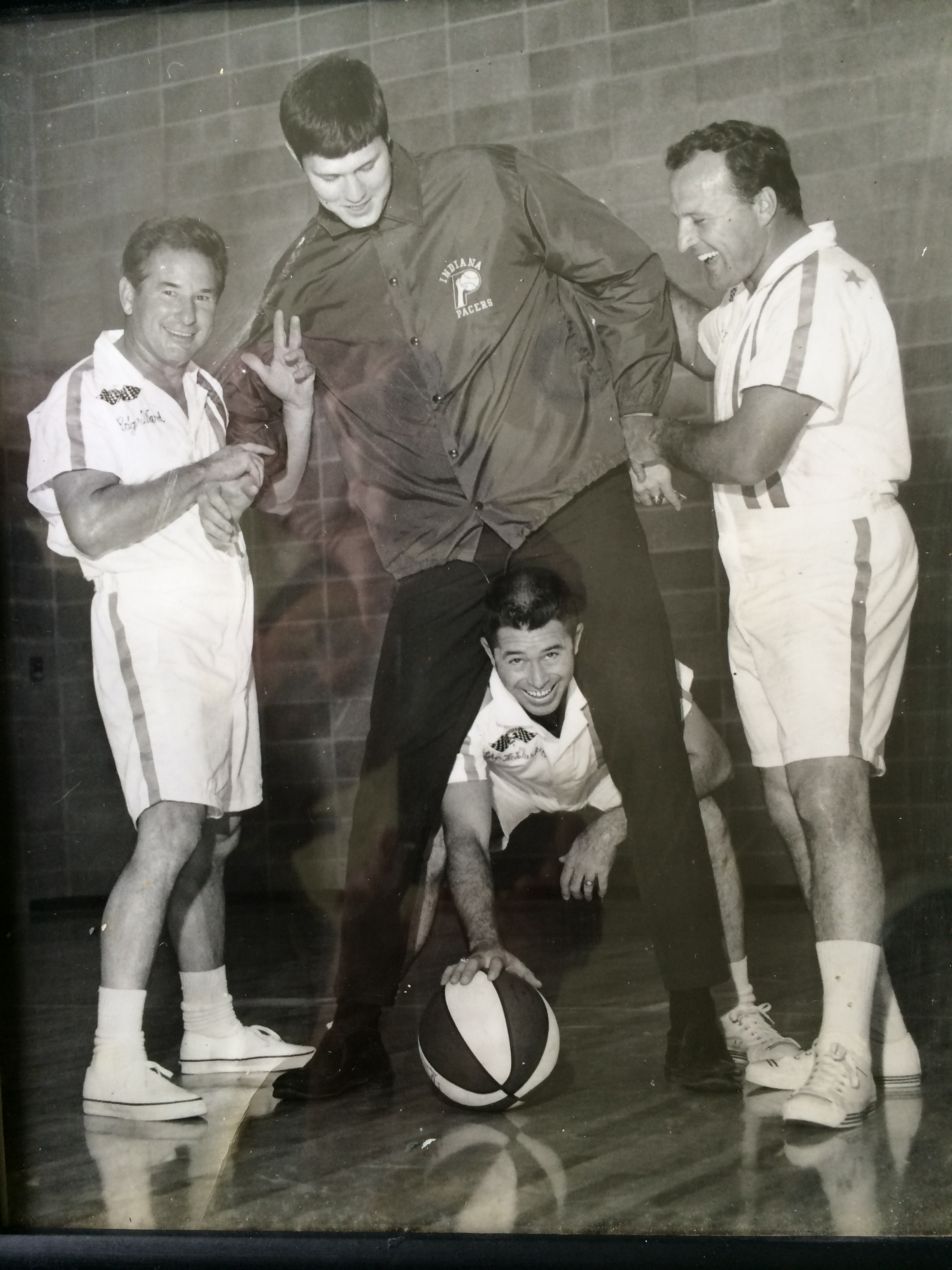
The first publicized account of a Pacer at the track came when the franchise acquired future Hall of Fame center Mel Daniels via trade in May 1968, after the team’s inaugural season. He was flown into Indianapolis on May 25, the day before the start of the second weekend of qualifications, and was taken directly to the speedway because most of the local media members were already assembled there. He was photographed holding a red, white and blue ABA ball with an STP sticker on it high above the outreached arms of pole-sitter Joe Leonard and Pacers President Joe Bannon.
Netolicky, an original Pacer, became a devoted fan of the race that month, the first in which he was living in Indianapolis. Netolicky would go on to attend the next 52 500s without a miss until COVID broke his streak in 2020. He has befriended several drivers along the way.
That was evident after he scored 32 points and grabbed 15 rebounds in a nationally televised (a big deal at the time) playoff victory over the Los Angeles Stars at the Coliseum on May 17, 1970.
“I played that way for my man Johnny Rutherford,” Netolicky said afterward. “He inspired me yesterday when he almost got the pole for the 500-mile race.”
The ultimate merger of Pacers and racers took place in October 1968. Bill Marvel, the Pacers’ original publicist, came from the auto racing world and returned to it after the first season as an officer for the U.S. Auto Club. He arranged for a team of drivers to play a group of local media representatives before a Pacers preseason game as a fundraiser for driver Bob Hurt, who had been paralyzed from the neck down in a first-turn crash on a practice lap the previous May.
Tickets for the sold-out doubleheader—the Pacers played the Oakland Oaks with Rick Barry in the main event—cost $2 each, with proceeds earmarked for Hurt’s medical expenses. The J.B. Hinchman Uniform Co. made and donated uniforms for the participants. Imagine the likes of A.J. Foyt, Andretti, Johnny Rutherford, Rodger Ward, Bobby and Al Unser, and Parnelli Jones wearing short pants and short-sleeved jerseys with racing stripes down the sides and trying to play basketball. They did.
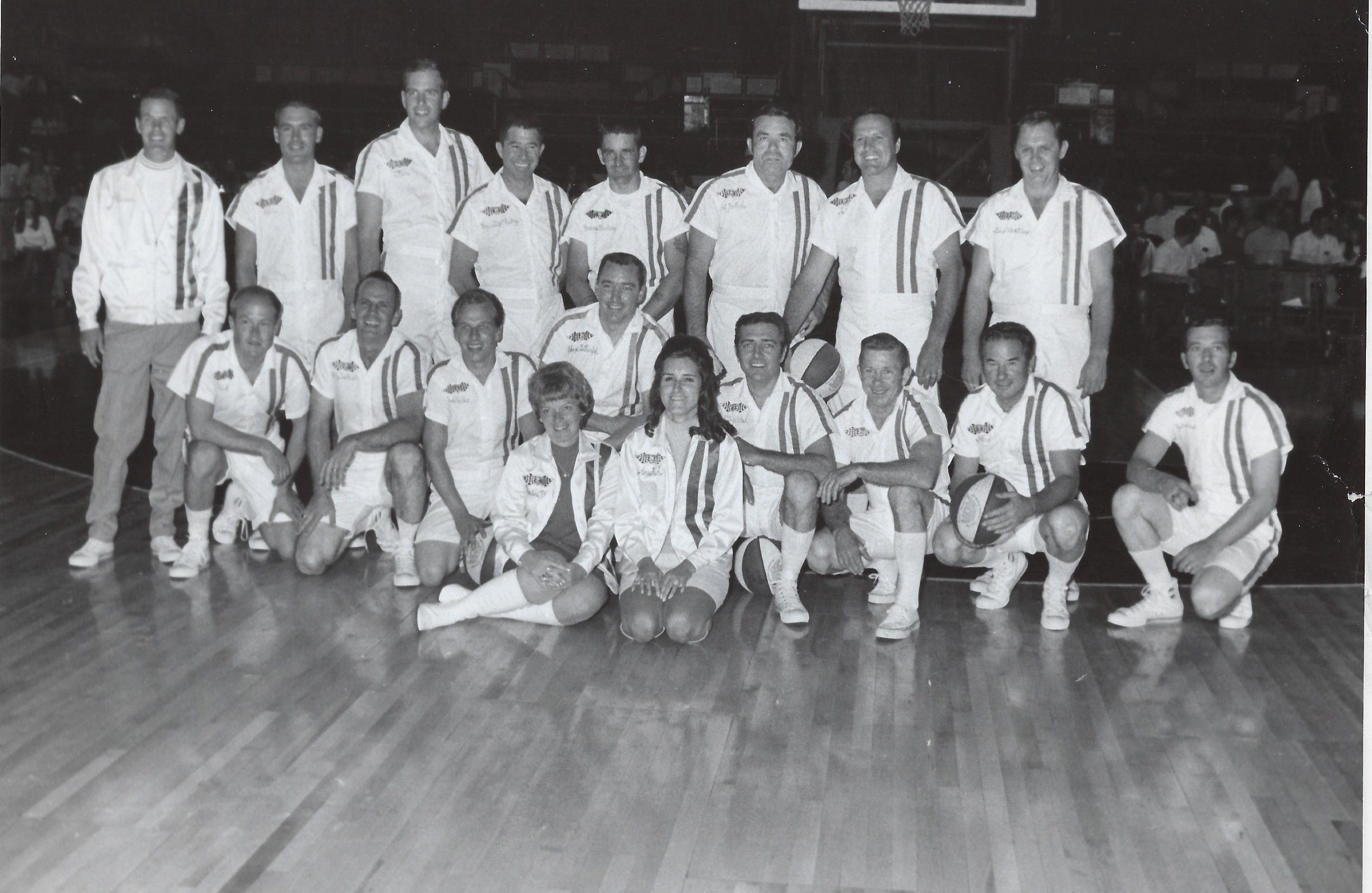
Indianapolis Motor Speedway owner Tony Hulman began the affair by announcing, “Gentlemen, start your game!” Sid Collins, the “Voice of the 500,” handled the public address duties. The “game” ended with a shaving cream pie fight but raised nearly $14,000 for Hurt, who watched in a wheelchair from the sideline.
The spectacle was repeated the following year before another preseason game. Some of the star drivers did not participate the second time around, but Foyt, Rutherford and Ward did.
Gathering that many drivers for such a potentially embarrassing event seems impossible today, but some of the Indy 500 drivers follow the Pacers closely. Conor Daly and Ed Carpenter, both of whom grew up in the Indianapolis area, appear to be the most devoted fans, with collections of Pacers jerseys and other memorabilia to prove it.
Daly, born in Noblesville in 1991, happens to have grown up in a Morse Reservoir area house his racing father, Derek, and mother purchased from Pacer Austin Croshere. “I thought that was supercool,” he said.
So was the rest of his childhood following the team.
“The Reggie Miller days were the coolest thing ever,” he said. “To have a player of that magnitude … I’ve lived through so many eras. The giant fight [at the Palace of Auburn Hills in 2004], the Jermaine O’Neal era, the Paul George era … so many different eras.”
He’s enjoying this one, too. He drove Haliburton in a two-seater to the opening ceremony for the NBA All-Star Game last year, and he once appeared at an event with Georges Niang, who played his rookie season with the Pacers.
“I’d love to hang out with T.J. McConnell sometime,” Daly added.
As the stepson of speedway President Doug Boles, Daly has more access than most drivers to the IMS Pacers tickets. He also has friends with suite tickets. Bottom line, he’ll take whatever he can get.
“I will never say no to a ticket offer,” he said.
Carpenter sees similarities
Carpenter moved to Indianapolis in 1989 at age 8. The stepson of former speedway President Tony George, he attended several Pacers games in the Market Square Arena era, sitting behind the visiting team bench amid a group of fans that was notoriously rowdy.
Not him, though.
“I was too polite back then, but I got a kick out of watching other people doing the heckling,” he said. “I was behaving—and I was well under the drinking age.”
Carpenter is a close friend of Pacers Senior Vice President of Player Personnel Ryan Carr, who provides him with occasional comp tickets and insider info—nothing dramatic, just hints on what the team is seeking in the draft and its strategy for building the roster.
That resonates with Carpenter as a racing team owner.
“Things like that intrigue me,” he said. “How they’re building the culture. … We deal with similar things, finding the right people for the organization. I love the games and the on-court product, but I’m intrigued by the back-end team-building side of it.”
Not every 500 driver is a Pacers fan, of course. Those from other countries have no reason to be. Scott McLaughlin, born in New Zealand, became a New York Knicks fan after marrying Long Island resident Karly Paone. He said earlier this month he hoped to win the race and then attend Game 3 of the Pacers-Knicks series. Not only that, but get a front row seat for the Borg-Warner trophy as well and watch the game with his arm around it.
“I’m going to embrace the booing,” he said.
McLaughlin later backed off that notion—a good thing, because last year’s pole-sitter suffered a major blow on Sunday when he crash ed during practice and destroyed his Team Penske car. He will start the race in the 10th spot.
Perhaps Indiana’s basketball gods didn’t see the humor in his plan and had a word with the racing gods.•
__________
Montieth, an Indianapolis native, is a longtime newspaper reporter and freelance writer. He is the author of three books: “Passion Play: Coach Gene Keady and the Purdue Boilermakers,” “Reborn: The Pacers and the Return of Pro Basketball to Indianapolis,” and “Extra Innings: My Life in Baseball.”
Please enable JavaScript to view this content.
Editor's note: You can comment on IBJ stories by signing in to your IBJ account. If you have not registered, please sign up for a free account now. Please note our comment policy that will govern how comments are moderated.