
Subscriber Benefit
As a subscriber you can listen to articles at work, in the car, or while you work out. Subscribe Now
Only one Pacers team had reached the NBA Finals in all the years since the franchise transitioned from the ABA in 1976 before this season. It feels strange, then, to have to take a stand on its behalf.
The team that reached the Eastern Conference finals and took Chicago to seven games in 1998 is the sexier team. It was Larry Bird’s first season as coach and Michael Jordan’s last with the Bulls, and the Pacers won a then-NBA franchise record 58 games and nearly pulled off the upset. Many if not most veteran Pacer fans will tell you that team was better than the one that reached the Finals two years later.
A deep dive into statistics, logic and mindsets can refute that claim. The argument for the 1998 team usually focuses on the contributions of power forward Antonio Davis, who was traded to Toronto in the summer of 1999 for the draft pick used to take Jonanthan Bender. Davis became an all-star with the Raptors in the 1999-2000 season while Bender, straight out of high school, wasn’t ready to contribute.
That ignores the fact that removing Antonio Davis from the equation freed more playing time for Dale Davis and Austin Croshere at the power forward position. Dale Davis, who had voiced his frustration with his playing time in 1999, became an all-star for the only time in his career in 2000, raising his scoring average by two points to 10. His backup, Croshere, averaged 10.3 points, surpassing Antonio’s average of 9.6 in 1998 and brought the added dimension of a three-point threat. He averaged 15.2 points in the Finals and then signed a $52 million contract in the off-season.
Jalen Rose, replacing Chris Mullin as the starting small forward, and Travis Best, who usually played the second and fourth quarters, also were far more productive in the 2000 playoffs than in 1998. Even Reggie Miller, at 34 years old, averaged four more points in the 2000 playoffs than two years prior.
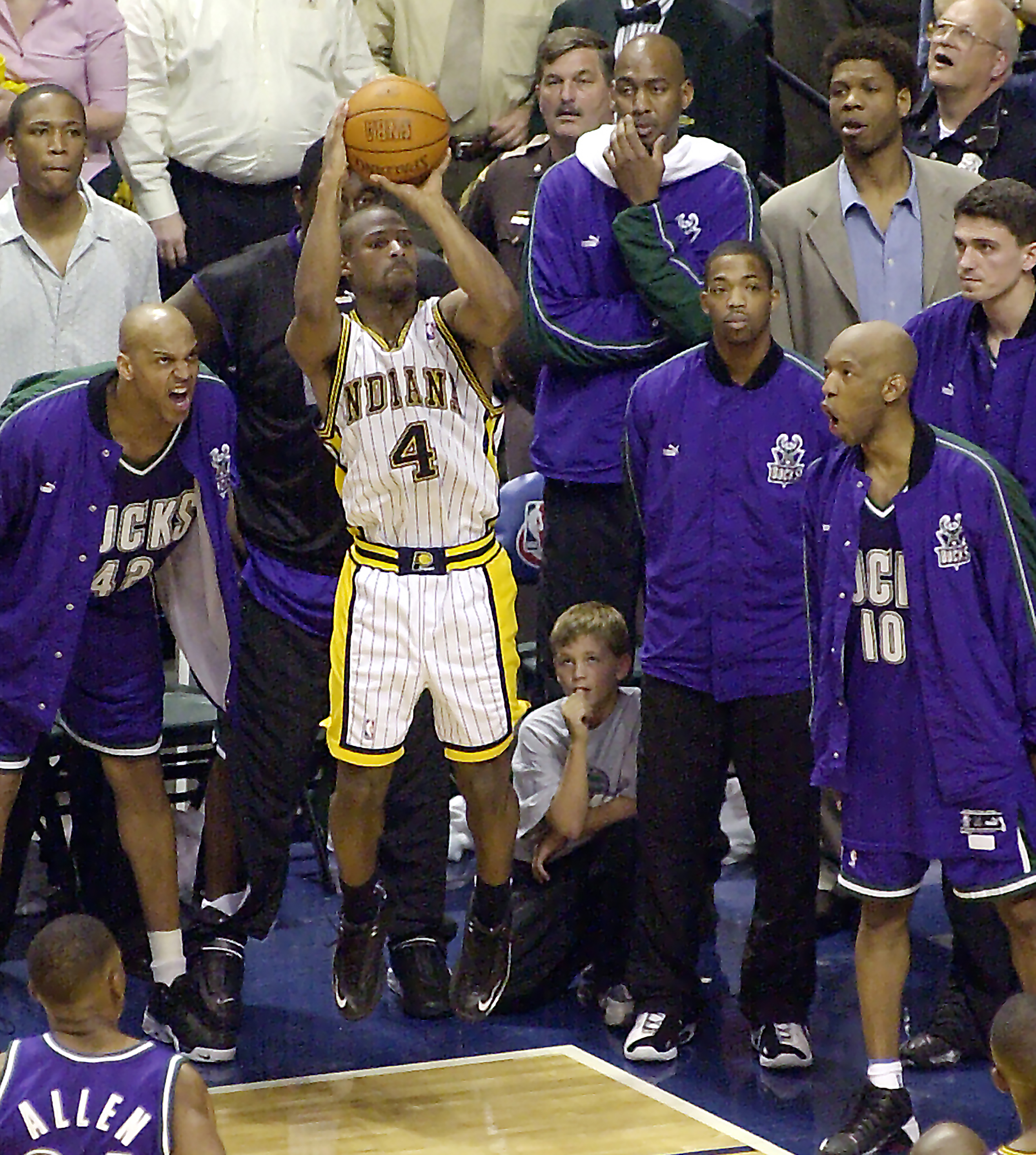
Travis Best cemented the Pacers’ first-round playoff win in 2000 with a three-pointed made in Milwaukee with the Bucks’ bench trying to distract him. (Photo courtesy of Randy Baughn)
But no matter which team you favor, give the 2000 Pacers their due. They handed a Los Angeles Lakers team headed for three consecutive championships all it could handle and were perhaps an on-time arrival, a three-pointer or a healthy shoulder away from winning it all.
Here’s how it played out.
The challenge
By the 1999-2000 season, Pacers fans frankly were becoming bored, even frustrated, with trips to the Eastern Conference finals. They had watched teams get there in 1994, ’95, ’98 and ’99, arousing hopes for a championship each time, only to fall short.
“That gets to you,” says general manager Donnie Walsh, who had constructed those teams piece by piece.
The Pacers were widely predicted to win the championship in 1999 after taking Michael Jordan and the Bulls to seven games in the conference finals the previous season. But they lost to New York in six games. It was a controversial series, featuring Larry Johnson’s infamous game-winning four-point play in Game 3 that referee Jess Kersey later admitted he had whistled incorrectly. But the tide of public opinion shifted. Many fans turned on the team and agreed with those media members who declared it time to break up the team and begin a rebuild.
Larry Bird added more cloud cover over the summer when he made official his plan to step down after the season, as outlined by his three-year contract.
The players, however, remained optimistic within their cocoon. Rather than feel betrayed by Bird, they felt honored that he had wanted to coach them for three years.
“There was zero letdown,” Travis Best recalls. “We were overjoyed playing for Larry Bird. Every last one of us. We would have run through a brick wall for the man.”
Rik Smits also liked playing for Bird, but recognized he was out of his natural environment as a coach.
“Larry was a great guy,” Smits says. “But he obviously knew coaching wasn’t for him. He was put in the right position and did his thing, and it worked for us. If he had enjoyed coaching, he could still be doing it.
“You could tell coaching was not really his thing.”
The only obviously positive undercurrent at the start of the season was the move to Conseco Fieldhouse. The Pacers played their final preseason game at Market Square Arena and then moved to their new, $183 million facility. Its primary amenity had become a necessity by then: suites.
The struggle
Of the eight preseason publications that predicted NBA standings, three picked the Pacers to finish first in their division, but two had them finishing fifth. They supported the muddled preseason outlook by starting 7-7, with one of the losses a nationally televised Thanksgiving Day home game against Detroit.
“The Pacers, in their current form, will be lucky to contend for the playoffs, let alone a championship,” one columnist wrote after the 107-99 defeat.
Reggie Miller’s stumble out of the gate was a primary reason for the faltering start. Despite scoring 29 points in the home opener, a solid win over Boston, he averaged 16.4 points on 38.5 percent shooting over those 14 games. He hit just 2-of-11 shots against the Pistons and 1-of-9 shots in the 14th game at Seattle.
The Pacers bounced back to win all but two games in December, including a Christmas Day homecourt victory over New York. They lost just two games in February as well but slipped again in March. Their 9-7 record that month included losses by 31 points at Phoenix, 15 to the Lakers in Los Angeles, 21 at Dallas, 21 at home to Milwaukee, and 10 at home to Philadelphia.
The last loss of the month came on the road to a 29-40 New Jersey team. The margin was just five points, but the Pacers trailed by as many as 21. It was their third consecutive defeat, and they hardly resembled a title contender.
They rebounded to win nine of their last 11 games, with both losses coming on the road, and finished with 56 victories to earn the No. 1 seed heading into the playoffs. Order was restored but the struggles would continue.
The shot
They were nearly eliminated in the best-of-five first round series by eighth-seeded Milwaukee. Playing Game 5 at the fieldhouse, they needed every bit of their homecourt advantage and the biggest shot in franchise history at the end of the greatest halfcourt possession in franchise history to advance.
It came in the final minute, when Travis Best missed a shot from the left wing, just inside the three-point line. Davis grabbed the long rebound on the opposite side and handed off to Reggie Miller. With no shot available, he drove the baseline to the left side, barely avoiding stepping out of bounds, and passed to Best, who immediately passed out front to Jalen Rose at the three-point line. Rose faked a shot and took three hard left-handed dribbles toward the basket, drawing a second defender. Rather than passing to Miller standing off to his left at the three-point line, Rose sent the ball to Best, who was standing in the corner in front of Milwaukee’s bench.
With Bucks players shouting in his ear, Best—who had hit just 2-of-14 shots to that point—swished a three-pointer with 16.5 seconds left that turned out to be the decisive points in the Pacers’ 96-95 victory.
No shot in franchise history has been as crucial as that one. Had Best missed and the Pacers lost, the reputations of Bird and Walsh would be drastically different today and the team would be regarded as a failure.
Best didn’t miss, though. That shot follows him to this day. He considers it the singular highlight of his career, and it’s replayed on the video board in the fieldhouse whenever he returns for a game and is introduced to the fans.
“I hear about it quite a bit,” he says. “It’s fun. I get a lot of love from the fans and friends.”
The superhero
Best’s shot nearly outshined another classic playoff performance from Miller, who finished with 41 points and scored 18 in a 7½-minute stretch in the fourth quarter. It wasn’t the first, nor last, time Miller swooped in to save the day in that postseason.
After the Pacers narrowly won Game 1 and lost Game 2 to Milwaukee in the first round, giving up homecourt advantage, Miller had the audacity to wear a Superman T-shirt during pregame warmups for Game 3 in Milwaukee. He had bought it the previous day while killing time at a Milwaukee mall with Mark Jackson, his backcourt partner and best friend on the team. Jackson had egged him on, but it wasn’t difficult. “I was feeling Superman-ish,” Miller said later.
He lived up to billing with 34 points, 12 coming consecutively in the third quarter, to lead a 109-96 victory.
“I don’t think anyone knew [about the T-shirt] until we got into the warmups and he took his jacket off,” Austin Croshere recalls. “It was like, ‘OK, here we go!’ Reggie’s going to bring it, and we need to match his level of play. It was not something he did lightly.”
Two days after the Game 5 victory over Milwaukee, Miller scored 40 points to open the second-round series with Philadelphia. Jalen Rose pitched in another 40, and the revived Pacers went on to take a 3-0 lead in the series. With the Sixers growing desperate in Game 4, Philly center Matt Geiger knocked down Miller twice with moving screens in the third quarter. Miller jumped up and took a swing at Geiger the second time. He was ejected from the game and suspended for Game 5. Geiger was suspended for Games 5 and 6.
The Sixers won the next two games to pull within 3-2, setting up Game 6 in Philadelphia. Miller, hyperfocused, scored 13 of his 25 points in the first quarter of what turned out to be a 16-point victory.
That brought on New York, which had ruined the Pacers’ dream of a championship the previous season. Miller led them to a 4-2 series win, scoring 34 points in Game 6 at Madison Square Garden. The game was tied entering the fourth period, but Miller hit all three three-point attempts and scored 17 points to lead a 93-80 victory. Given the disheartening loss in the previous season’s series with New York, it was the perfect place to clinch the franchise’s first trip to the NBA Finals.
“As much as we hated the Knicks it felt good to beat them in their own place and quiet down the city,” Smits says today. “It was pretty phenomenal. They were in shock. I remember thinking, this is pretty awesome.”
The Finals
Miller followed that glorious evening in New York City with the worst playoff performance of his career in Los Angeles. He hit just 1-of-16 field goal attempts and scored seven points in the Game 1 loss at Staples Center, and it wasn’t difficult to figure out why. The Pacers’ team bus had been stuck in L.A. traffic and arrived at the arena with barely enough time for the players to dress and get up a few shots before the tip-off.
That was a sucker punch for Miller, who always arrived early and executed a disciplined warmup routine to prepare himself for every game.
“It throws you off because you didn’t have the opportunity to do your pregame rituals and really get loose,” Davis says. “Reggie was a stickler, getting his shots up and everything. You want to do what you’re accustomed to.”
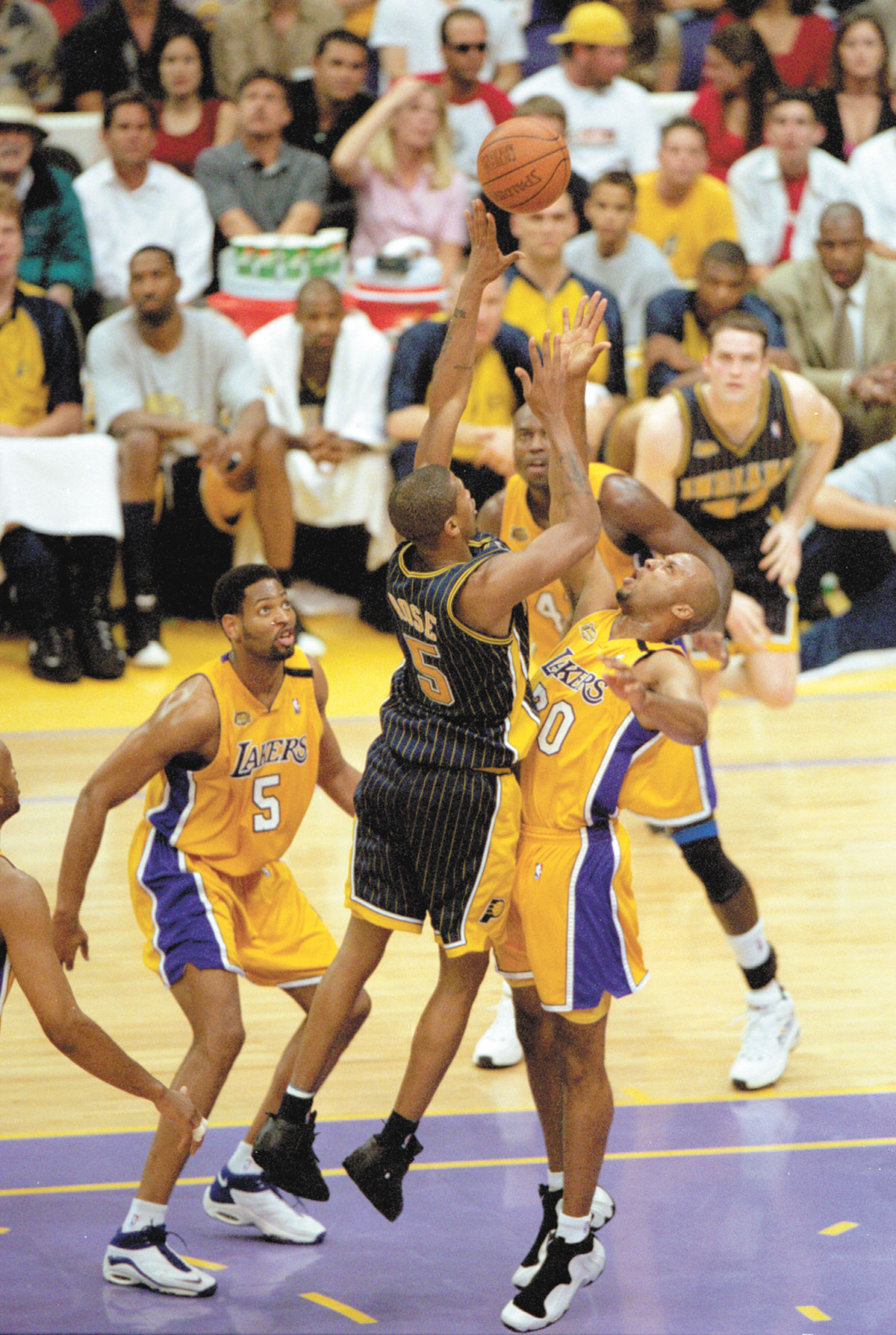
Miller averaged 27.8 points over the next five games, but the Pacers’ hopes of upsetting the heavily favored Lakers essentially ended with Game 4 at the fieldhouse. Trailing 2-1, they had a chance to win in regulation but Best’s 15-footer over Shaquille O’Neal fell well short of the rim with 2.3 seconds left.
There was a reason for that, too. He had jumped on O’Neal’s back to prevent a dunk with 7 minutes, 41 seconds remaining and was flipped hard to the floor, landing on his left shoulder. He continued to play, hitting two mid-range shots and assisting on three-pointers by Miller and Sam Perkins, but the pain grew worse. He could be seen rubbing it during dead balls.
“I didn’t realize how badly I was hurt,” he says today. “My adrenaline was pumping, and I played through it. I’ve never shot a ball like the one I shot over Shaq.”
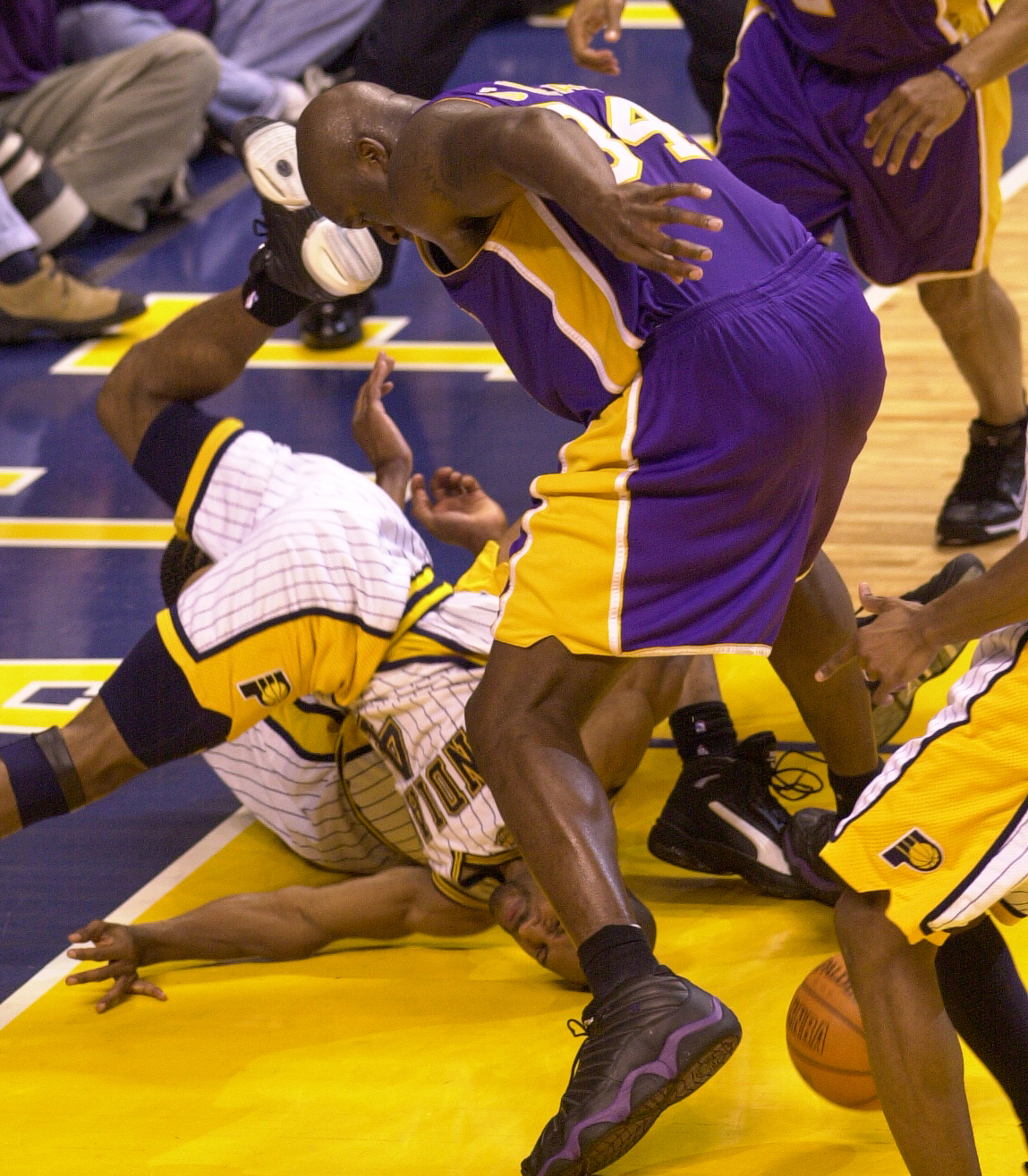
Although a backup to Jackson, Best had played the second and fourth quarters throughout most of the playoffs and usually played well. Jackson, however, replaced him in the overtime period, which Best watched with his shoulder on ice. O’Neal, who finished with 36 points and 21 rebounds, fouled out in that period, but that created an opening for Bryant to emerge. Just 21 and in his fourth NBA season, Bryant scored eight points in overtime, capped off by a game-breaking tip-in, and finished with 28 points. Miller had a three-point shot that could have won the game but his attempt over Robert Horry’s outstretched hand fell just short.
“It was just fun for me,” Bryant said afterward. “I just played relaxed like I was in the backyard.”
The Pacers bounced back to win Game 5 by 33 points as the Lakers relaxed on their 3-1 cushion, but L.A. wrapped up the series three nights later, on June 19, with a 116-111 victory in Los Angeles.
The Lakers were the better team, viewed objectively. O’Neal, 27, was both the regular season and Finals MVP that season. He had the Superman logo tattooed on a bicep and backed that up as well as Miller had with the T-shirt. He averaged 38 points and 16.7 rebounds against the Pacers, whose hack-a-Shaq strategy fell short of its intended goal despite the fact he hit only 39 percent of his foul shots.
“Michael Jordan’s the greatest player of all time … but there’s never been a more dominant player than Shaq from 1999 to ’02,” Croshere says. “I think back on what we could have done different, and I don’t have an answer.”
All 14 of the players who played for the Pacers that season are alive and well today, and while most stay in touch with only a few of the others they quickly gel when they get together again. Eleven of them attended at least one of the current team’s games in the Finals this month and the adrenaline and stories were flowing again.
“Oh, man, it was just like old times!” Dale Davis says. “Like, we haven’t missed a beat. Some guys you haven’t talked to in a while, but that connection is real, you know?
“To be so close for so many years … we don’t have regrets, but I do feel we should have got one or two out of there while we were together. That’s all part of the game, the whistle blows and all. It’s such a fine line. We just wish we were on the other side of it sometime.”•
__________
Montieth, an Indianapolis native, is a longtime newspaper reporter and freelance writer. He is the author of three books: “Passion Play: Coach Gene Keady and the Purdue Boilermakers,” “Reborn: The Pacers and the Return of Pro Basketball to Indianapolis,” and “Extra Innings: My Life in Baseball,” with former Indianapolis Indians President Max Schumacher.
Please enable JavaScript to view this content.
Well, two specific bad breaks to be sure: one named Shaq, and one named Kobe.