
Subscriber Benefit
As a subscriber you can listen to articles at work, in the car, or while you work out. Subscribe Now Jerry Seinfeld was an aspiring 20-year-old comic, just a couple of weeks into a career that would make him a billionaire. After performing his fledgling standup act in a New York restaurant/bar one evening, Jackie Mason, a highly regarded practitioner of the laugh trade, took him aside.
“You’re going to be so successful at this it makes me sick,” Mason said.
Today, Seinfeld recalls the impact of that one sentence: “It carried me for five years.”
That kind of thing happens in all professions but probably most often in sports. A few words from an accomplished veteran or coach can give the young player enough confidence to carry him or her through the thickets of the early stages of a career, no matter what level.
What, you think these pros and major college athletes you see on television were confident sliding out of the womb? The athletic world breeds fear and anxiety. Others are better than you, coaches are yelling at you, and opponents are trying to make you fail. A sincere and well-timed compliment can shift a train of thought, alter a career and perhaps indirectly bring about a championship.
It makes one wonder about all the athletes who could have made it big if they had heard the right thing from the right person at the right time.
One of the all-time greatest examples of a boost that changed everything belonged to former Pacers guard Jerry Harkness. Growing up in Harlem, he loved basketball and played it well on the summer playgrounds and in intramural leagues, but he was afraid to go out for the school teams. His father had left home, and his mother struggled financially. The shoes he wore to school had holes in the soles, and his soul had holes, as well.
That began to change the summer before his senior year of high school. He was shooting around by himself one Saturday morning at the YMCA when a voice from behind shouted something like, “Hey, kid, you’re not bad!” He turned around and saw baseball legend Jackie Robinson walking through the gym.
Robinson might have added another sentence or two, perhaps something about getting a scholarship someday. Harkness didn’t recall every detail in later years, but he never forgot the impact of his hero’s words.
“Just for him to give me those words of encouragement,” he said, “… I had so many disappointments in my life. He was the one who pushed it over the top.”
An inspired and hopeful Harkness went out for the team his senior year. He made it, eventually won a starting position, earned all-city recognition and in a roundabout way wound up with a scholarship to Loyola of Chicago. He finished his career there in 1963 as captain of a national championship team and was a first-team All-America selection.
Four years later, while working a marketing job for Quaker Oats, he had the courage to write a letter requesting a tryout with the Pacers as they prepared for their first season in the ABA. He gave up his stable and promising position in the corporate world and made the final roster—barely. He lasted a season and a half before injuries forced him into retirement. In the meantime, he hit what remains the longest game-winning shot in basketball history, an 88-footer in Dallas.
He stayed in the city, worked for United Way and became the state’s first Black television sportscaster as the weekend anchor for Channel 13.
Almost certainly, none of that happens without Jackie Robinson’s offhand compliment.
Tolbert paid it forward
Ray Tolbert, like many tall boys, was awkward when he began playing—or tried to play—basketball around Anderson.
“I was one of those guys kids laughed at and talked about and made fun of,” he says. “There was a lot of verbal bullying. It was rough for me growing up, to be honest with you.”
Tolbert was kicked off the school team in fifth grade because his frustration caused him to act out. He didn’t complain. He wasn’t enjoying it, anyway.
The school principal, however, ordered the coach to bring him back.
“He saw something in me that I didn’t see in myself,” Tolbert says.
Most of the encouragement that sustained Tolbert came from his family, starting with his parents. They had a saying: “If you can take it, you can make it.”
Tolbert recalls being the last one picked for games at the park, if he was picked at all. Some “friends” clearly didn’t want him to succeed, but several others did. Aside from his extended family, some older established players in Anderson and mentors at the Boys Club saw something in him and kept him going.
As he developed, he eventually outgrew the games at the park. “It got to the point they wouldn’t pick me because I was killing everybody,” he laughs.
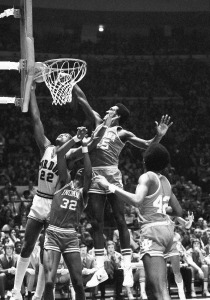
Tolbert was voted Mr. Basketball out of Madison Heights High School in 1977 and took Bob Knight’s scholarship offer at IU. He was the starting center on its NCAA championship team in 1981, was a first-round pick in the NBA Draft and played five seasons there and three more overseas.
He also executed a role reversal by becoming the mentor who saved Landon Turner’s career.
Turner, like Tolbert, had been an “uncoordinated tall guy” as a kid in Indianapolis. He heard about it, too. “My peers would talk about me and roughhouse me a little bit,” he says.
His parents and a few adults such as Ralph Dowe, longtime director of the Wheeler Boys and Girls Club, kept him going. He followed Tolbert to IU a year later after receiving All-America recognition at Arsenal Technical High School but lived mostly in Knight’s doghouse for two-plus seasons because he lacked the dedication needed to unleash his potential.
Tolbert, more than anyone, got through to him. And just in time.
“I would not let Landon leave,” he says. “I saw so much potential in Landon. He would get depressed, and I’d say, ‘Come on down to the room and jam.’ We liked the old-school funk. I would sing, ‘Landon, please don’t leave me.’”
Turner listened.
“Every year, I thought about quitting and going somewhere else,” he says. “But Ray knew how important I was to the team and accomplishing our goals. Because of his encouragement and being a friend, I decided to stay for three years.”
He would have stayed for a fourth, as a senior in the 1981-1982 season, if he hadn’t been paralyzed from injuries suffered in an automobile accident in July 1981. But he is remembered still for his contributions to IU’s championship. He scored in double figures in all but one of its five NCAA tournament games, reaching 20 twice, and was selected to the all-tournament team after IU defeated LSU and North Carolina in the Final Four.
All because Tolbert hit the right notes.
Bird helped Rose bloom
Sometimes older players need to hear a serenade, too.
Pacers coach Rick Carlisle was a third-round draft pick of the Boston Celtics in 1984, the 70th overall selection. Players taken that far down the line rarely survive the cuts, but his IQ and shot-making were exceptional. He had the added benefit of veteran guard Gerald Henderson holding out for a better contract and then being traded, leaving a hole to fill.
Carlisle recalls Celtics’ legendary president, Red Auerbach, standing in a hallway and complimenting him on his play while flicking cigar ashes at his feet. Those words helped sustain him during an uncertain time. He wound up playing in parts of five NBA seasons before shifting to coaching.
“A guy like that says a couple of positive things to you, it gives you a lot of confidence,” Carlisle recalls.
Four years later, future Pacers guard Mark Jackson got his boost from a head coach. He was a first-round draft pick of New York after a four-season career at St. John’s, but he joined a team with two veteran point guards, Henderson and Rory Sparrow. Knicks coach Rick Pitino took a major gamble, trading both of them early in the season and giving the starting job to Jackson from the third game on. He expressed confidence in his rookie from the beginning and backed it up.
Jackson wound up winning Rookie of the Year honors and was selected to the All-Star team the following season.
“I don’t play 17 years if Rick Pitino is not my first coach,” Jackson says today. “Him believing in me, allowing me to make mistakes and inspiring and encouraging me … if I had gone to another team, I don’t play 17 years.
“He basically gave me the rock. And encouraged me. Not only that he traded both of those other guys. He sent a message to me to allow me not to look over my shoulder.”
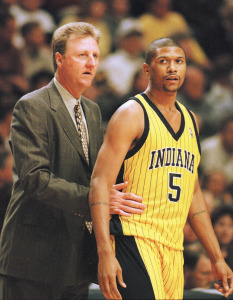
Jalen Rose had a coaching guru in Larry Bird. His career started slowly in Denver, where he had been a first-round draft pick, and he was traded to the Pacers in 1996. He didn’t mesh with coach Larry Brown the next season and didn’t even play in 15 games.
Bird, however, showered Rose with compliments from the moment he took the job in 1997, saying he had “big plans”for him.
“I love Jalen Rose,” Bird told reporters. “He’s a utility player, like a baseball player who can play all the positions. … Me and Jalen will get along fine, because I like the way he plays.”
Rose cut that quote out of the newspaper and taped it on his refrigerator. He reported to training camp in the fall with a renewed spirit and went on to win Most Improved Player honors in Bird’s last season as coach (2000), when he was the leading scorer on the Pacers team that reached the NBA Finals. He signed a $90 million-plus contract the following summer and went on to play 13 NBA seasons.
“Larry was the guy that helped validate me,” Rose said last year. “My career needed to be refreshed; it needed to be remixed.”
The careers of many athletes do. The line between a major hit and flop can be awfully fine.•
__________
Montieth, an Indianapolis native, is a longtime newspaper reporter and freelance writer. He is the author of three books: “Passion Play: Coach Gene Keady and the Purdue Boilermakers,” “Reborn: The Pacers and the Return of Pro Basketball to Indianapolis,” and “Extra Innings: My Life in Baseball,” with former Indianapolis Indians President Max Schumacher.
Please enable JavaScript to view this content.
Well done, Mark. Great idea for an article. We often forget the importance of encouragement in people’s lives.
Thank you, Glen!
There’s only one sports columnist whose writing is “can’t miss” and that’s Mark Montieth. If he was writing about sweat socks I’d make it a point to read the story, because he never disappoints. There’s a lot of reporting about the greed and chutzpah in sports these days, and it’s nice to be reminded about the positive side as well!
Feedback from a trusted or respected person is a Huge source of confidence for any athlete. However, platitudes or telling an athlete an untruth to try and boost their confidence can backfire BIG TIME! Honest and truthful feedback is what athletes are looking for: not necessarily critical or demeaning. Think of a compliment sandwich; “You’re doing great. You need to work on xyz. But I love the effort.” Dr. Richard Trammel – Sports Psychologist