
Subscriber Benefit
As a subscriber you can listen to articles at work, in the car, or while you work out. Subscribe Now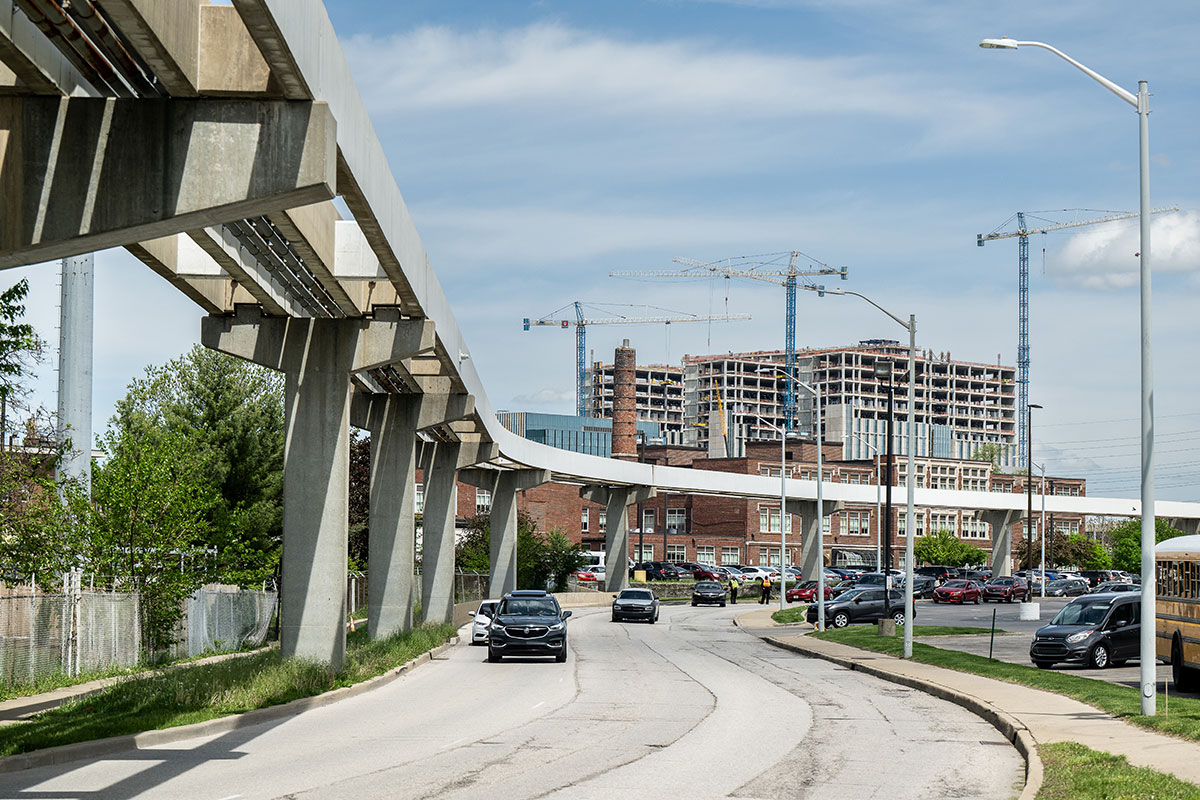
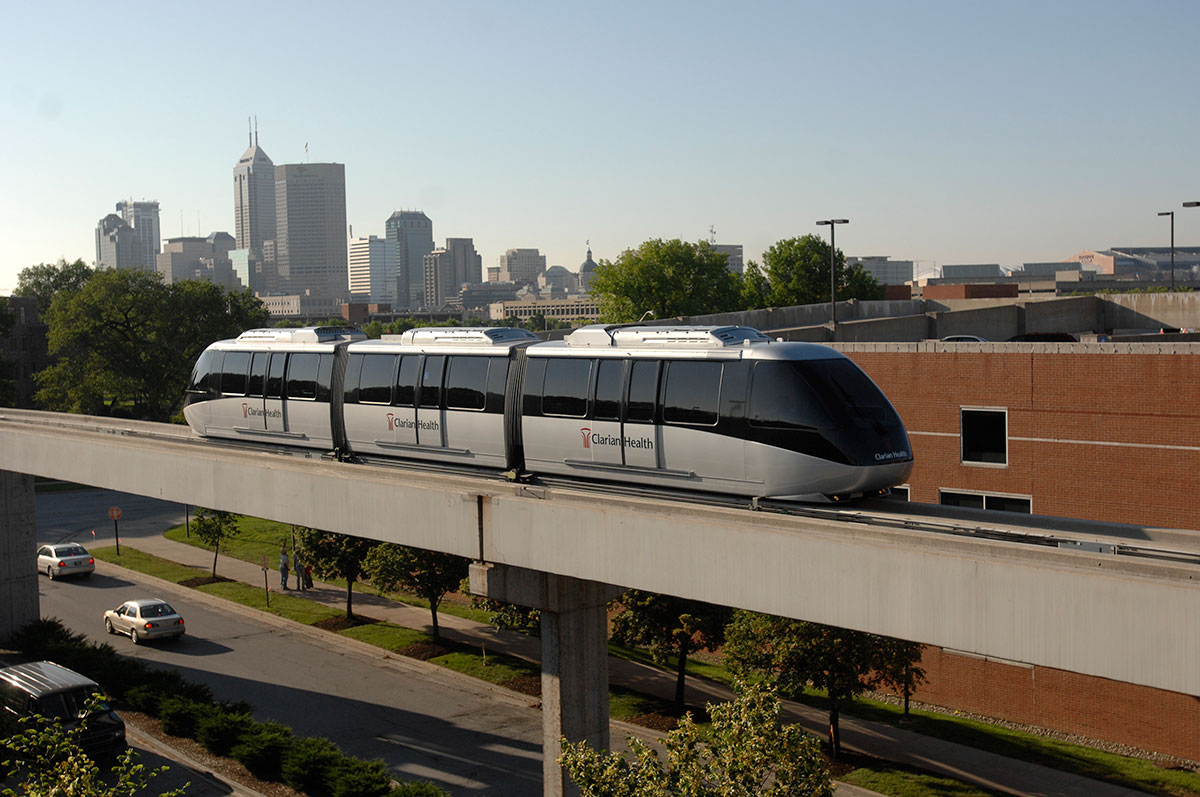
IU Health shut down its People Mover elevated tram connecting its downtown hospitals in 2019, leaving behind unfulfilled visions of urban development and massive concrete tracks above public streets.
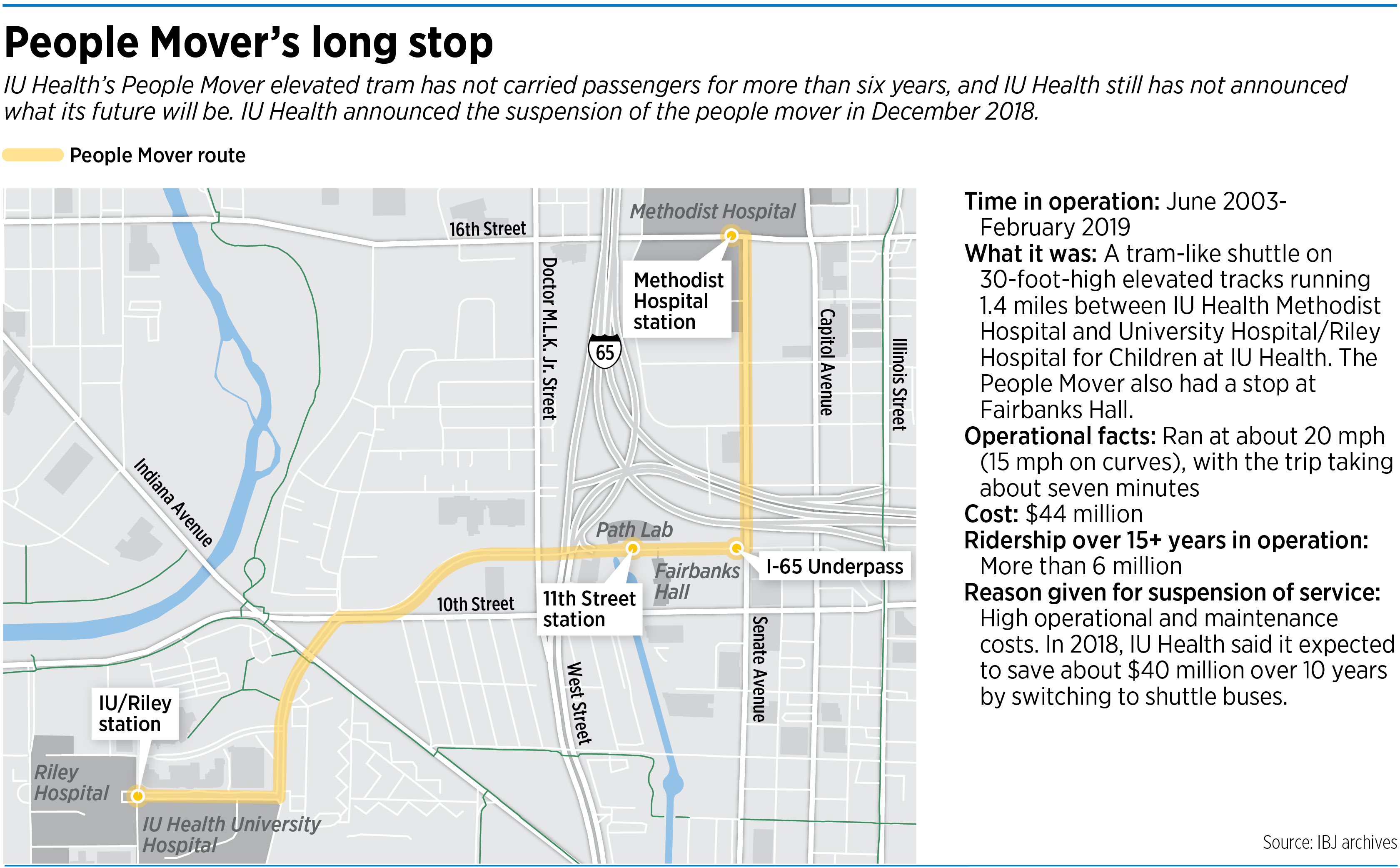
Six years later, the Indianapolis-based hospital system is saying little about its plans for—or giving a timetable for a decision about—the roughly 1.4-mile infrastructure of 30-foot-high line between Methodist Hospital and University Hospital/Riley Hospital for Children.
But some envision new life for the People Mover infrastructure, such as an elevated trail that pays tribute to the heritage of Black neighborhoods along the route, including the famous Crispus Attucks High School.
IU Health’s People Mover is unusual—or it certainly was at the time it was conceived—because of its use of public right of way. The project was approved by the Indianapolis City-County Council in April 2000, at the time making it the only privately funded system in the nation built over public roads.
In 2003, local officials and IU Health (then called Clarian Health Partners) hyped the People Mover just before its launch as an innovative public-private partnership with burgeoning potential for regional development.
“This transportation system could be a way to take Indianapolis into the future. It could be the answer to a lot of transportation issues,” a Clarian spokesperson said in an April 2003 IBJ article under the headline, “Transporter eyed for wider use.”
Potential additional uses cited in the article then included additional route links across downtown and to Indianapolis International Airport.
But the People Mover’s reality was different.
The line never expanded beyond its original purpose. And IU Health suspended its operations indefinitely in February 2019, with the health system citing cost and maintenance as reasons. The tram system, which cost IU Health $44 million to build, was replaced with shuttle buses.
In a statement emailed to the IBJ, IU Health said it has no immediate plan to resume operations of the People Mover.
“We continue to evaluate all viable options for the future that balance community impact, financial feasibility and our infrastructure needs,” IU Health said.
IU Health said the People Mover lines are still utilized for sending pneumatic tubes between facilities, but officials did not comment on questions about the infrastructure that sits otherwise unused.
“IU Health takes seriously its commitment to be a good neighbor and enhance the communities of which we are a part,” IU Health said in an emailed statement when asked by the IBJ about the People Mover. “We engage in regular communication with our stakeholders and partners.”
Change coming
At this point, restarting the People Mover would be complicated and, perhaps, impractical.
IU Health is building a new $4.3 billion downtown campus just south of the current Methodist Hospital at West 16th Street and North Capitol Avenue, where a People Mover station is located.
The new hospital will consolidate the existing Methodist Hospital and University Hospital at the new IU Health construction site.
IU Health said sections of the People Mover elevated track were removed in 2023 along Senate Avenue to allow construction equipment to access the area.
The December 2018 announcement of the People Mover suspension came as IU Health was preparing for the massive construction project, then estimated to be a $1 billion endeavor.
If the People Mover tram never restarts, its service life would be a little more than 15-½ years, just half of what its lifespan had been estimated at early on.
San Jose, Calif.-based Schwager Davis Inc., the general contractor and technology provider for the IU Health People Mover, estimated in an early project report that the system’s lifespan would be 30 years.
From June 2003 to February 2019, the People Mover twin-train system carried more than 6 million riders, with regular trips by doctors, nurses, hospital staff, patients and their families and members of the public, all for free.
According to the Schwager Davis report on the People Mover, one condition of the City-County Council’s approval was that private residents be allowed to ride the train for at no charge.
The route ran from Methodist to Riley. Later, a stop at the IU Health Pathology Laboratory and Fairbanks Hall was added.In announcing the suspension of People Mover service in 2018, IU Health said the system was due for major maintenance requiring “significant capital investment.”
While the Schwager Davis Inc. project report on the People Mover estimated the train would cost about $1 million a year to operate, Indiana University said in a February 2019 news release that the cost to operate the system exceeded $3 million a year.
Beyond costs, the People Mover did not operate during high winds or other rough weather, according to a Dec. 12, 2018, IBJ article on the People Mover’s suspension.
Lee Larsen, vice president of the transit division for Schwager Davis, worked on maintaining the People Mover. He said that IU Health told him at the time that the hospital construction project putting University and Methodist hospitals on the same campus reduced the need for the People Mover.
Larsen said the People Mover had little downtime, running at 98% or 99% availability. He added that Schwager Davis has built five or six systems in locations including at resorts in Hawaii and Nevada.
“The system ran very well,” Larsen said of the IU Health People Mover. “We did feel like it was a successful system.”
Conversations continue
In 2019, when IU Health announced it would end People Mover operations and begin offering shuttle buses, officials said they expected to save about $40 million over 10 years.
IU Health confirmed this month that it has realized cost savings from the transition to shuttle buses but did not provide updated figures. Nor did officials say what’s next for the infrastructure.
“IU Health remains in regular discussion with our neighbors and community leaders regarding the future of the People Mover elevated rail lines, and a wide range of possible uses have been discussed,” IU Health said in its emailed statement.

City-County Council President Vop Osili, whose district includes the IU Health campus, said he believes IU Health officials will be mindful as they make decisions about what to do with the People Mover. And he noted that the infrastructure still serves the area through its tubes for transporting lab material.
“IU Health has long been a critical asset to our city—particularly in the downtown area—not only through its patient care, medical services, and hospital expansion, but also through sustained investments in the surrounding neighborhoods,” Osili said in an emailed statement.
“I believe the future of the People Mover will be no different,” he said. “I expect IU Health to remain engaged with neighbors as conversations continue around the hospital’s future and surrounding infrastructure. I’m confident that any plans for the system will reflect the same thoughtful and intentional approach that has guided their past work.”
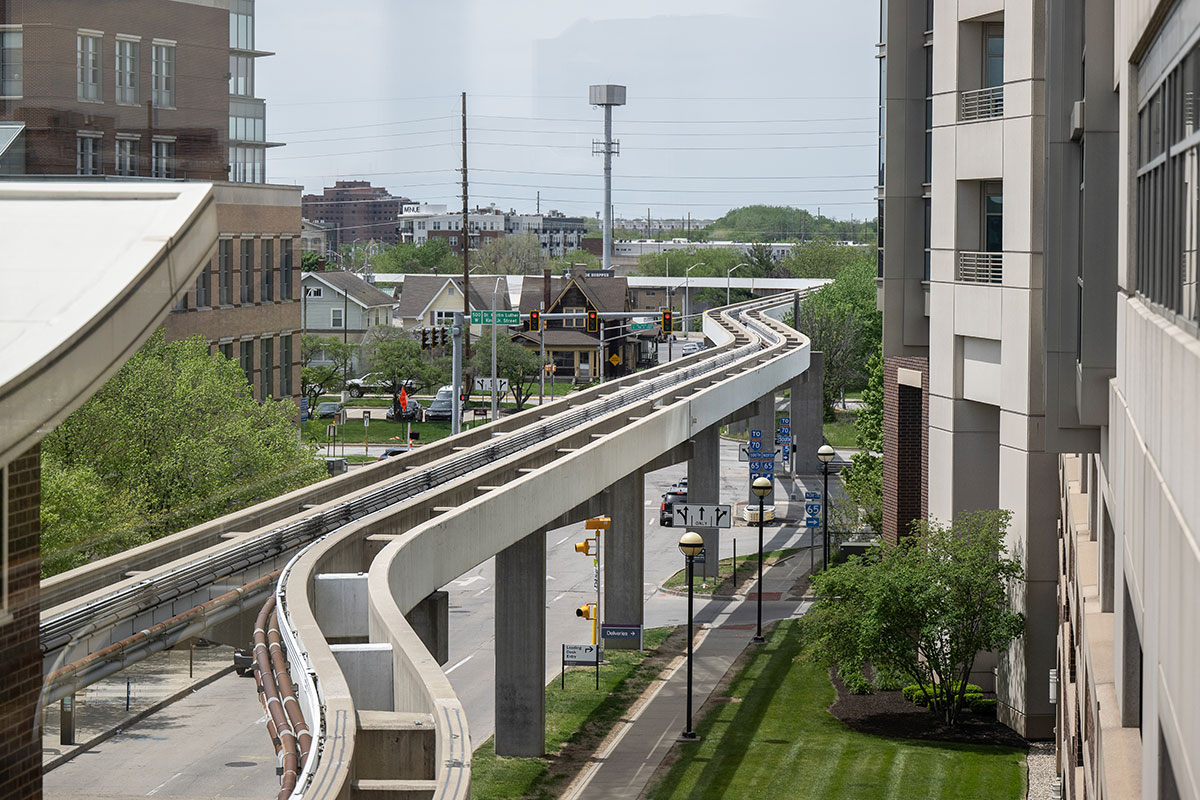
In January 2021, former City-County Council member Scott Keller, a retired downtown real estate developer, wrote a guest column in the IBJ suggesting that the People Mover’s tracks could be transformed into an elevated track for bicycles and people and proposed naming it “The Indiana Black Heritage Trail.”
Keller still would like to see that happen. “I hope they give serious thought to that as an option,” he said recently.

Eunice Trotter, Black Heritage Preservation Program director for Indiana Landmarks, said she likes that idea.
“The route of the People Mover cuts right through the historic Black community of Indianapolis,” Trotter said. “It would be a wonderful walking trail that would be a perfect home for remembering the history of that community.”
For example, Totter pointed to the legacy of John Puryear. He was one of the first Black city councilors in Indianapolis, serving from 1892 to 1897, and was instrumental in renaming streets carrying the name of slave states where many Blacks once lived.
So, Tennessee Street became Senate Avenue, and Mississippi Street became Capitol Avenue. The People Mover runs above a portion of Senate and near Capitol.
IU Health said the ultimate destination for the People Mover is still unknown: “No decisions about future uses have been made, and conversations are ongoing.”•
Please enable JavaScript to view this content.
I’ve always thought transforming it to an elevated trail would be so beneficial to the area. While this is nowhere near as large as NYC’s High LIne, I’ve walked that (old elevated train lines) and it’s wonderful. Why not use what is there and create a safe area to walk with a great view of the area.
I suspect that once they acquired the right of way, IU has saved a million dollars a year in communications cost, because they were able to run fiber optic cable along the right of way.
So even if they never run another train again, as long as the campus is split between 10th street and 16th street, they will continue to save money.
While being a solid transit proponent, I maintain that transit and transportation should be efficient and effective. To those ends, efficiency reflects operating costs versus ridership (i.e. cost per rider, cost per mile and cost per hours) but also effectiveness as related to service hours and frequency sufficient to provide a reliable and useable service.
Clearly the People Mover was a flawed system from the beginning. Very slow and not operable during strong winds, and a surprisingly bumpy ride (for no better words) — particularly shocking for the expense to construct and the fact that any rail or rubber tired fixed guideway system should be smooth, fast, and available in inclement weather.
Comparable rubber tired or cable systems operate in airports such as Cincinnati, Denver and Atlanta. However, the O’Hare Airport terminal connector is the more comparable to the defunct IU/Methodist People Mover given that it operates along an elevated guideway outside and exposed to weather. The initial system at O’Hare was rubber tired; it was rebuilt as steel wheel/steel rail. Other comparable systems that are proved, reliable, practical and operating outside include urban systems such as Vancouver SkyTrain and Dubai metro (fully automated, most elevated, some tunnel) and shorter airport systems in Phoenix (Sky Harbor Airport), Houston (Bush Airport), Seattle (SeaTac Airport), and Newark (Liberty Airport)
IU/Methodist perhaps should have better considered the designer and manufacturer before having plopped down $40 million. One asks who made this [poor] decision in manufacturer choice. Was this system the lowest cost bid? What other options were considered, Were operating and maintenance cost underestimated or did they rise significantly, and if so, why? Often, the lowest bid may not reflect the best solution. One might infer that this may well be the case for this people mover.
So unfortunate. And since the system is likely proprietary, it may be difficult and too costly from the system control and operations standpoints to retrofit another system. But the operating agreement with the manufacturer is not mentioned in this article.
The NYC High Line and the Minnesota Zoo Treetop trails are very cool and I would support the People Mover turned into a similar walkway if the People Mover went elsewhere instead just between two hospitals. Turning the People Mover into a walkway which skirts the edge of “the historic black community” doesn’t seem feasible. It would make much more sense if it passed by the Madame Walker Theatre and onward to downtown and/or the zoo. The proposed route just isn’t very exciting sightseeing-wise