
Subscriber Benefit
As a subscriber you can listen to articles at work, in the car, or while you work out. Subscribe Now
Retired restaurateur Martha Hoover, founder of (among many establishments) Café Patachou, recently commiserated with a food distributor about the state of the industry. The things they talked about—rising prices for everything from butter to restaurant labor—are pretty much the same challenges that have always bedeviled eatery owners.
The only true difference was an increased level of uncertainty, among distributors and restaurateurs, about what comes next.

“For instance, the price of carryout containers, because of the threat of tariffs and other geopolitical issues, is going through the roof right now,” Hoover said. “It’s all part of the industry’s very complex pricing ecosystem, and all of it affects the bottom line.”
That uncertainty has also seeped into the attitudes of restaurant customers.
“Americans are pinching pennies,” said Chad Moutray, chief economist at the National Restaurant Association. “Restaurants have to be able to show that they are delivering real value on the food they’re serving to their customers.”
Oddly, the most recent NRA data shows that while restaurants aren’t exactly enjoying great times, they’re still doing fairly well. For instance, the organization says overall pricing pressures have actually receded slightly. At the start of 2025, the NRA even predicted 4.1% growth in restaurant sales this year, with menu prices rising an average of 3.8%.
“Seeing growth in nominal sales figures really shows the extent to which people are still going out to eat,” Moutray said. “If you look at a lot of the inflationary data in the last couple of months, we’ve actually seen overall pricing pressures moderate pretty significantly in the overall economy.”
The problem, experts say, is that restaurant consumers aren’t reacting to what’s happening at this moment. They’re worrying about their own job prospects in the coming months and whether they should buy fewer drinks at their favorite restaurant, forgo their usual appetizer, or simply not go at all.
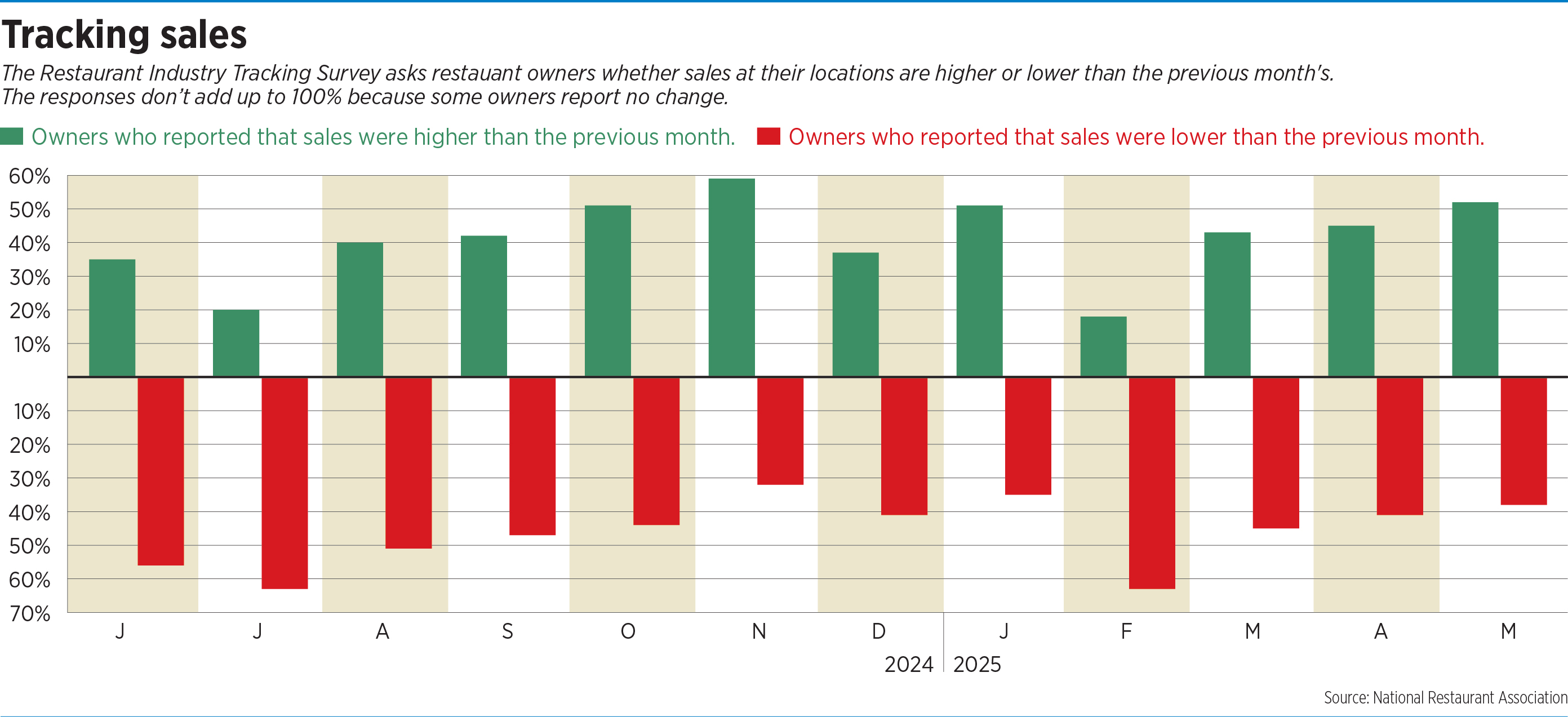
“We’re in a moment where I think everyone is just waiting to see what happens on the tariff front and what happens with other policy trends,” Moutray said. “I think there is an expectation out there that the economy will slow and that prices will pick up. Particularly as we move into the summer months.”
In the meantime, restaurateurs are trying, when possible, to switch to domestic suppliers to deflect the sting of tariffs.
“You’ve had a lot of restaurants that are really evaluating their supply chains,” Moutray said. “They want to source locally [to avoid tariffs], but of course not all ingredients can be sourced locally. Restaurants are looking for a Plan B, but in some cases there might not be one.”
Hoover, for instance, said the rising price of the aforementioned carryout containers—pretty much all of which come from overseas—could be just the beginning.
“Just think about what’s going to happen to wine pricing and olive oil pricing, to name a few,” she said. “How do you price your menu when you don’t know what’s going to happen from one week to the next? I think it’s so destabilizing and so chaotic.”

Eddie Sahm, vice president of business development for Sahm’s Hospitality Group (which operates just shy of a dozen sit-down eateries in the Indianapolis area, from Sahm’s Restaurant in Fishers to Half Liter BBQ in Broad Ripple) is also a big fan of stability and predictability.
“I’ve always thought that the restaurant business is easier when things are consistent and grounded, and everyone kind of knows what to expect,” Sahm said. “Knowing what’s coming, whether it’s good or bad, gets you into the right head space. But that’s more difficult right now. Distributors seem a little worried, and customers seem a little worried. And we’re kind of in the middle between them.”
Liquor, labor
Typically, one of the first eatery niches to wilt when customers start pinching pennies is liquor sales—or an establishment’s “beverage program” in restaurant lingo. So far, Sahm’s has seen a little bit of that, though inflation and economic angst might be only one reason for the decline. Perhaps not even the main reason.
“Beer sales are down,” Sahm said. “The younger generation doesn’t really drink like they used to, so that decline is due more to changing lifestyles than prices. As far as restaurant sales are concerned, I haven’t seen anything beyond the normal ups and downs. Nothing crazy.”

Craig Huse, CEO of Huse Culinary, whose portfolio of establishments includes St. Elmo Steak House and four locations of Harry & Izzy’s (three in Indianapolis, one in Paradise Valley, Arizona), said his establishments enjoy a bit more leeway when it comes to pricing. Especially St. Elmo, where a dry-aged, 32-ounce USDA prime Tom-A-Hawk ribeye will already set you back $150.
Lower-end establishments whose customers expend a lot less per visit have a tougher row to hoe.
“I’ve had conversations with other restaurateurs that might have a burger business, and it’s really difficult for them to take that burger north of $15,” Huse said. “Someone with more upscale restaurants has more flexibility to absorb some of these inflationary pressures.”
Though food inputs such as beef have risen (and sometimes fallen) over the past few years, the price of labor has skyrocketed since COVID.
“Restaurants are a very labor-intensive industry,” Huse said. “Hourly rates have climbed up quite a bit in the last four or five years, and that’s kind of been the biggest part of our inflationary issues.”
So far, he hasn’t seen any sort of economy-related decline in headcounts or billing at St. Elmo or the downtown Harry & Izzy’s—though that’s likely because those establishments are special cases. One might almost say anomalies. After all, not every Indianapolis eatery (actually, none of them) has Charles Barkley talking about its food during coverage of the NBA playoffs, or members of the “Monday Night Football” broadcast team talking on-air about reconvening at St. Elmo after the game.
“I’ve heard of decreased headcounts and billing in the industry in general, but we’re holding pretty steady right now,” Huse said.
While restaurants that already charge for high-end items and service can, in theory, raise their prices more easily, one wonders how counter-service restaurants and fast-food chains deal with the sting of inflation. For instance, a McDonald’s Big Mac cost about $5 in pre-COVID 2020 but has risen to an average of $5.79 in 2025.
According to Sahm, there’s little chance the world’s biggest burger chain will price itself out of its “fast and cheap” business model.
McDonald’s studies the market “more than any of us,” he said. “They’re not going to do anything that wasn’t thought out, and I’ve always felt that those guys are going to do what they can get away with.
“As for us, I think people can look at us and say, ‘I can’t believe you charged $13 or $14 for a cheeseburger,’” Sahm said. “And I say, ‘You don’t have to just trust my menu. Go out and see other places. Make a cheeseburger yourself. Go buy the fixings from Kroger and Meijer and see what you get.’”
Value wins
According to everyone from Sahm to the NRA’s Moutray, the way restaurateurs choose to fight inflationary prices is by offering value.
“We’ve always prided ourselves on good portion sizes and fair prices and transparency, and I think that’s kind of what the market’s demanding right now,” Sahm said. “The value isn’t that our food is cheaper than the grocery store. The value is that you get to relax, have some conversation, and someone cleans up after you. And it’s delicious. That’s the value.
“It isn’t that it’s cheaper than McDonald’s. It’s that we’re going to do more to make you happy than McDonald’s or Applebee’s or anyone like that.”
These days, Sahm’s establishments sell a lot more appetizers, which customers share. People want to get together over the same plate, which might be a lingering reaction to COVID isolation. There’s also lots of interest in bourbon and wine.
“I think there’s a lot of room for wine,” Sahm said. “Instead of just having the cheapest thing, I think people want a good selection of quality items. So that’s what we’re doing. I think it’s more just about trying to do the things that you do well and figuring out if your community actually wants it or not. You could have the best wine list in America, and if no one within 3 miles of you cares about wine, then you’re going to close. It’s not rocket science.”
“You’re always walking a thin line,” Hoover said. “You’ve got to make sure you cover your costs but also make sure that your customers feel well taken care of. Fortunately, patrons can tell the difference between inflation and greed, because they go to the grocery store themselves, see the pricing and understand that the same thing happens with restaurant pricing as well.”
While inflation and economic turmoil have generated a great deal of uncertainty, one thing that likely won’t change is the general public’s desire to occasionally go out and eat. Because dining on something you can’t make at home (and having someone else do the dishes) remains a pretty solid value proposition to many.
“At the end of the day, we know there’s still a lot of pent-up demand among people who want to go out to eat,” Moutray said. “That certainly is something that keeps us in business.”•
Please enable JavaScript to view this content.
Editor's note: You can comment on IBJ stories by signing in to your IBJ account. If you have not registered, please sign up for a free account now. Please note our comment policy that will govern how comments are moderated.