
Subscriber Benefit
As a subscriber you can listen to articles at work, in the car, or while you work out. Subscribe Now
After more than a year, archaeological excavation work on the Henry Street Bridge project in downtown Indianapolis has been completed, but not until far more grave shafts—1,709— were found than originally expected by city officials.
A team of about 100 archaeological excavation experts from Canadian engineering firm Stantec worked carefully to uncover the grave shafts on a 1.5-acre site on the east side of the White River that once served as part of the city’s first cemetery, removing the human remains and other artifacts, including grave markers.
The Department of Public Works, which this week announced completion of the archaeological excavation work, said a majority of the grave shafts contained human remains. About half of the remains recovered were full skeletons, Stantec archeologist Ryan Peterson said Thursday.
With excavation of the right-of-way now finished, construction on the $40 million Henry Street Bridge can now continue, with completion expected next year, but archaeological work on the remains is far from over.
Human remains were turned over to Dr. Jeremy Wilson’s anthropology lab at Indiana University-Indianapolis for analysis. Wilson is creating profiles for those found there, including approximate age at death, sex, biogeographic ancestry and physical conditions occurring before death.
Meanwhile, Stantec will continue researching and documenting other materials found at the site.
“The analysis of the artifacts coupled with archaeological, genealogical, and osteological data, will bring us closer to identifying and honoring those buried at Greenlawn before their reinterment,” said Peterson, referring to the historic cemetery at the site.
According to the DPW, human remains and all burial objects and associated items will be stored in a secure facility until proper reinterment in “an appropriately dedicated cemetery” can take place. Officials said all artifacts will be reburied with the individual with whom they were found.
A huge undertaking
In a wide path at the excavation site, temporary wooden beams sit on either side of a pit. The structure, called soldier piles and lagging, held back the earth as archaeologists unearthed the grave shafts of the city’s earliest settlers.
Peterson said he never thought he’d have a use in his work for the wooden barriers, which were at least 6 feet tall beneath the surface of the surrounding ground. But his team at Stantec used the system in the massive undertaking of finding 1,709 grave shafts.
The total number of grave shafts found was about 2.5 times the initial estimate by the city, which was 650. Peterson said workers hit that number early this summer.
“Stantec professionals worked tirelessly for nearly a year, excavating the 1.5-acre site by hand through both freezing temperatures and sweltering heat,” DPW Director Todd Wilson said in written remarks. “They encountered far more grave shafts than we anticipated, and we are thankful for their commitment to excavating the site carefully and respectfully.”
Greenlawn Cemetery
A group of four cemeteries along the White River served as the final resting place for thousands of Indianapolis residents starting in the early 1800s. The cemeteries, often collectively referred to as Greenlawn Cemetery, have a long history in which development has taken place on top of burials. Oftentimes, the removal and relocation of remains has been spotty, not always including full bodies or done only by wealthy families.
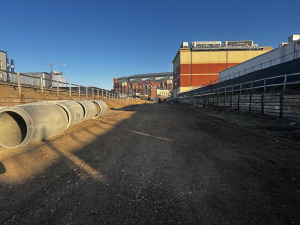
The Henry Street Bridge project’s right-of-way takes up only a small portion of the historic burial ground, which spanned about 25 acres.
The Department of Public Works budgeted $12 million just for the cost of excavating, researching and relocating remains.
A community advisory group for the project includes some of the people who, more than two years ago, raised concerns about disturbing the historic cemetery with construction. That includes Eunice Trotter, the director of the Black Heritage Preservation Program at Indiana Landmarks. She and other historians asked that excavation and reinterment of remains be careful and respectful, or alternatively, that the site be altogether left alone.
“Doing this work, you don’t make a lot of friends, you really tee people off,” Trotter said Thursday at the site with a laugh. “And I don’t care. You know, I have enough friends.”
Trotter and the community advisory group ultimately gained seats at the table with city officials, helping to research and determine appropriate memorials for those buried at Greenlawn.
Remaining research
It’s likely that research and reinterment of remains will be going on even after drivers, cyclists and pedestrians can cross the White River on the new path.
More work needs to be done to determine how many of Indianapolis’ early settlers are actually represented by these remains, or the minimum number of individuals who were uncovered.
Wilson is getting help from about 25 others, including his lab director, graduate students and undergraduate students.
“From 8 a.m. in the morning to 5 p.m. at night, we are down there processing, inventorying and analyzing these individuals and preparing them for reburial,” Wilson said.
In addition to determining about how many people were buried in that section of the cemetery, Wilson and his team will attempt to understand what life was like for them in the 1800s.
“We have a unique opportunity to tell people’s stories from their remains, and then also examine things like how disease patterns change from the early founding of the city through the late 1800s,” he said.
The undertaking at Greenlawn dwarfs the next-largest recent archaeological undertaking in the city.
Both Wilson and Peterson played a role in the excavation, research and reinterment of 543 burials at the former Bethel Cemetery at the Indianapolis International Airport. Although that cemetery is from the same era, Bethel’s status as a protected cemetery, which hadn’t been disturbed by industry, made it less complicated, Wilson said.
F0r example, on the latest project, crews had to dig up a rail line and granite bricks that were part of a 1924 electric freight terminal on the west edge of the work site. They also contended with the foundation of a baseball stadium from about 1916.
Additionally, Peterson said that Bethel was “laid out logically,” while the dense population surrounding Greenlawn meant some burials were more sporadic and could overlap.
Henry Street Bridge
When completed, the Henry Street Bridge project will extend Henry Street on the east of the White River from Kentucky Avenue to the Elanco Animal Health Inc. corporate campus on the west side of the river, near White River State Park.
The bridge will include two lanes for vehicular traffic, 80-foot concrete rings as architectural elements and serve as an extension of the Indianapolis Cultural Trail for walking and biking. The total cost tops $40 million, with the Lilly Endowment contributed $15 million toward the architectural elements.
The bridge might be named with the site’s history in mind, according to Duane Perry, a member of the community advisory group, which is considering some possibilities.

Please enable JavaScript to view this content.
Misleading framing in the article
“Please note that “grave shaft” does not mean the Minimum Number of Individuals, or MNI. Determining the MNI requires additional research and analysis.”
-wridinfrastructure.com
https://wridinfrastructure.com/archaeology/archaeology-updates/
I’m sorry, but that bridge is just ugly.
Amazing what Diamond Chain and the previous land owners got away with.
I like the bridge design. Something interesting and timeless. I am glad to hear the archaeologists were able to respectfully excavate and have plans to relocate. Agreeing with Thomas, amazing what previous owners got away with. Glad the city is recognizing its responsibility here to its previous residents.