
Subscriber Benefit
As a subscriber you can listen to articles at work, in the car, or while you work out. Subscribe Now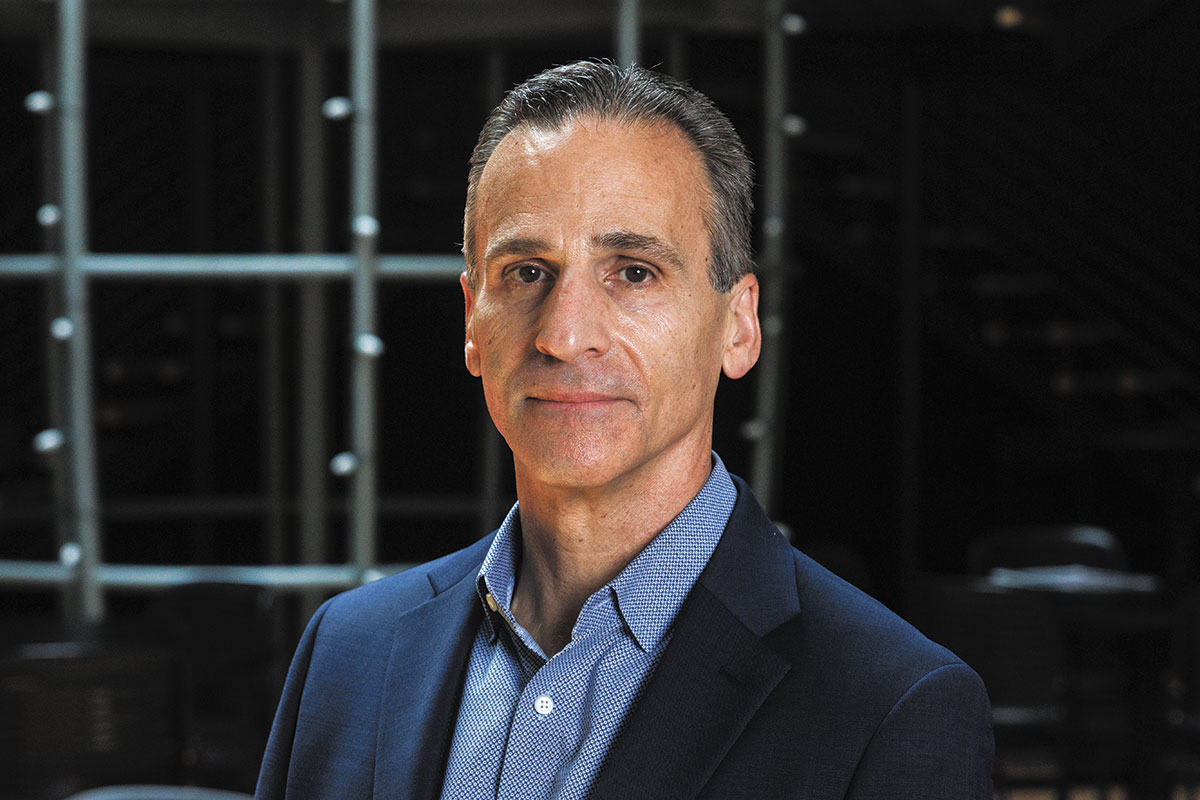
The members of U2 learned in 2014 that everybody doesn’t want something for free, when the rock band’s “Songs of Innocence” album was added to the music libraries of iTunes customers without their consent.
What was planned as a gift from Apple and U2 became a public relations debacle, labeled as “dystopian junk mail” by The Washington Post.
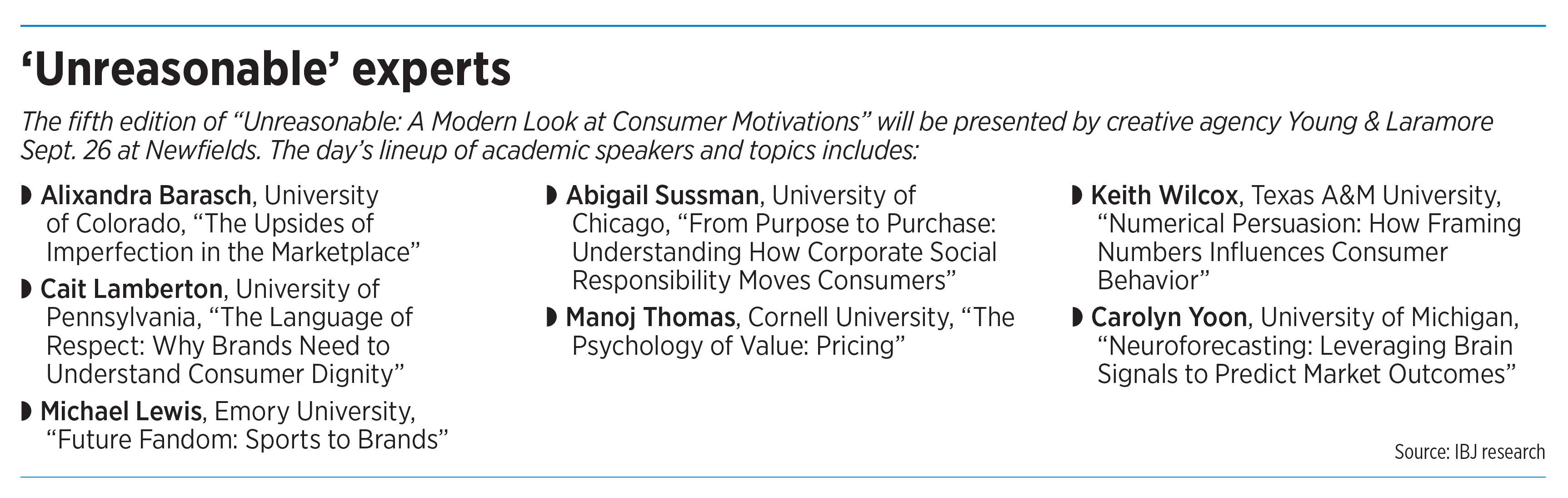
That’s the kind of public reaction to business practices that will be explored during “Unreasonable: A Modern Look at Consumer Motivations,” a conference scheduled Sept. 26 at Newfields.

Cait Lamberton, vice dean and director of The Wharton School’s undergraduate division at the University of Pennsylvania, will talk about the concept of consumer dignity at the event presented by Indianapolis-based advertising agency Young & Laramore.
Lamberton told IBJ that companies convey respect for consumers by providing choices, dealing fairly and acknowledging the buyer’s role in transactions. In the case of U2’s “Songs of Innocence” giveaway, iTunes users had no agency, Lamberton said.
“That’s such a great example of where something that should have one effect—from an economic and rational perspective—can have the opposite effect from a dignity perspective,” Lamberton said. “It took away agency. If you let people download it and it’s their choice, it’s a profoundly different experience than putting it in somebody’s face.”
Such lessons are the point of the Unreasonable conference, which Young & Laramore CEO Tom Denari founded in 2019. He said the event’s provocative name doesn’t imply a negative connotation for consumers.
“When I use the term ‘unreasonable,’ it doesn’t mean difficult or crazy,” Denari said. “It’s a way of saying, ‘I don’t always use reason to make decisions.’ That’s where dignity comes in. If someone doesn’t feel like they’re being treated with respect or treated well, they might not buy from you.”
About 300 marketers, company executives, college professors and students are expected to attend this year’s event. Sponsored by Cummins, one of Young & Laramore’s clients, Unreasonable bills itself as a conference where academic experts share “front-line insights, rooted in research” not often heard at standard industry events.
Denari presented a miniature version of Unreasonable at this spring’s South By Southwest conference in Austin, Texas. He said the participation of Lamberton and professors representing schools such as Cornell University and the University of Chicago make Unreasonable a valuable day for anyone trying to connect with an audience.
“It’s the people doing the actual research,” Denari said. “It’s one thing for the ad agency guy to get up there and tell people something. It’s another thing to be able to have the people literally doing the field work say, ‘This is what we found, and this is what it means.’”
Winning ways

Michael Lewis, professor of marketing at Emory University in Atlanta, will present an Unreasonable session titled “Future Fandom: Sports to Brands.”
Lewis told IBJ that companies can look to the culture surrounding sports for inspiration when building brands.
“I spend so much time on sports fandom because it’s the gold standard,” he said. “Sports fandom is where you see the ultimate in intensity and identification.”
However, fewer young people are committed to following sports leagues and teams, according to Next Generation Fandom, a series of surveys conducted by Lewis.
According to the 2024 edition of the survey, 38% of Gen Z respondents—a demographic born between 1997 and 2012—identified themselves as sports fans. That’s lower than for millennials (48%), Gen X (44%) and Baby Boomers (43%)
Elsewhere in the survey, 21% of Gen Z respondents identified themselves as apathetic toward sports—the highest data point among Gen X (19%), Baby Boomers (19%) and millennials (15%).
Lewis said members of Gen Z have tenuous ties to Major League Baseball. Exposure to baseball is diminished for most Americans, he said, from games rarely viewed on a home’s centralized TV, fewer newspaper readers checking out daily box scores and local newscasts devoting little time to game recaps.
“The number of Gen Z folks who say they are Minecraft fans is probably four times what Gen Z says about baseball,” Lewis said.
On the topic of brands, Lewis shared his thoughts on Indiana Fever guard Caitlin Clark. Earlier this year, Young & Laramore made a commercial with Clark for Zionsville-based annuity products company Gainbridge.
Lewis said Clark’s celebrity eclipses her on-court achievements in the WNBA.
“She’s essentially Michael Jordan as the face of this league, without winning six championships,” Lewis said. “She got the glory before she earned it on the court, in some ways.”
Perception matters

Manoj Thomas, professor of marketing and management at Cornell University, will present an Unreasonable session titled “The Psychology of Value: Pricing.”
Many factors contribute to a consumer’s decision to pay the price attached to a product or service, Thomas said. A store’s ambience, how information is displayed, what a customer has researched and what’s been recommended to the customer can influence a purchase.
Thomas said it’s possible for companies to make people feel OK about spending more than a logical amount.
He cited 100-calorie snacks, a packaging initiative introduced by Kraft in 2004 to appeal to consumers seeking diet-conscious options.
“The interesting part of the 100-calorie pack is that it’s usually a small fraction of the product that is there in a regular pack,” Thomas said. “A regular pack usually would have between 300 to 500 calories. The product quantity in a 100-calorie pack is about one-third or one-fifth, but the price is not one-third or one-fifth. It’s much higher. But consumers actually are happy to spend, and they are grateful to the company for looking out for them.”
Thomas said he’s eager to see academic experts talk about marketing at Unreasonable.
“People often get stuck in a particular mindset or a particular way of thinking, which is driven by the way things have been done in their organization for many years,” he said. “When you have someone else coming in and presenting a completely different perspective to a similar problem, it allows the managers to look at the problem from a different perspective. That can be very enriching.”
Finding worth
Young & Laramore leader Denari said Unreasonable’s sessions will offer tips that can be applied in business-to-consumer and business-to-business contexts.
“Some people think you sell differently, B2C and B2B,” Denari said. “No. You still have to appeal to people, who generally are motivated beyond the facts and figures. There are other things at play that people don’t necessarily recognize and sometimes happen below your consciousness.”
Lamberton, the vice dean at Wharton, founded in 1881 as the world’s first collegiate business school, will present an Unreasonable session titled “The Language of Respect: Why Brands Need to Understand Consumer Dignity.”
Customers typically don’t forget negative interactions with companies, Lamberton said.
“If I ask people to reflect on a time when they felt disrespected, they remember those experiences years and years later,” she said. “When you ask them why, you’ll start to hear the anatomy of dignity come out. They will say, ‘I felt trapped.’ That’s a loss of agency. Or they will say, ‘I felt invisible.’ You respond, ‘Yes, you weren’t feeling represented.’ Or they will say, ‘It was just so unfair.’ That’s a loss of equity. I think people have a strong intuition about respect for dignity when it doesn’t happen.”
When talking about what academic experts will bring to the conference, Lamberton mentioned a quote that’s attributed to John Wanamaker, a successful department store owner in Philadelphia in the 19th century: “Half the money I spend on advertising is wasted; the trouble is I don’t know which half.”
Lamberton said she and her peers can help companies identify and affirm what’s working.
“Out in the field, you’re basically running constant experiments,” she said. “Sometimes we come in and say, ‘Listen, this is what we did in a very controlled environment.’ People say, ‘Oh, you know what? I’ve been doing that for 20 years and now I understand why it works.’
“When you’re in a turbulent environment where you really have to have reasons to stand up for what you’re doing, it can be helpful to be able to say, ‘Science has established this is a useful tool.’”
For ticket information to Unreasonable, visit unreasonableevent.com.•
Please enable JavaScript to view this content.

Editor's note: You can comment on IBJ stories by signing in to your IBJ account. If you have not registered, please sign up for a free account now. Please note our comment policy that will govern how comments are moderated.