
Subscriber Benefit
As a subscriber you can listen to articles at work, in the car, or while you work out. Subscribe Now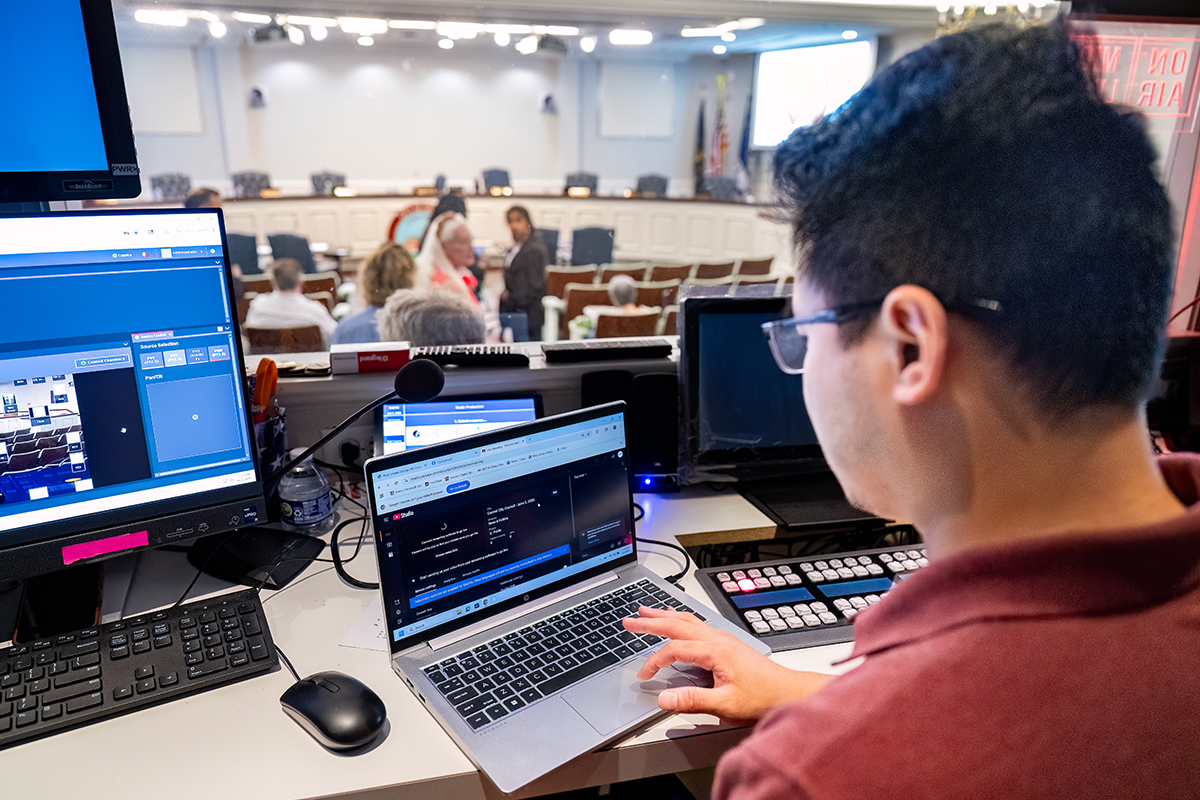
Lance Overholser describes himself as the “fire chief and in-house IT guy” for the town of Cicero. That’s a nontraditional resume, but it has come in handy as Cicero leaders chase a state-mandated July 1 deadline to offer online access to public meetings.
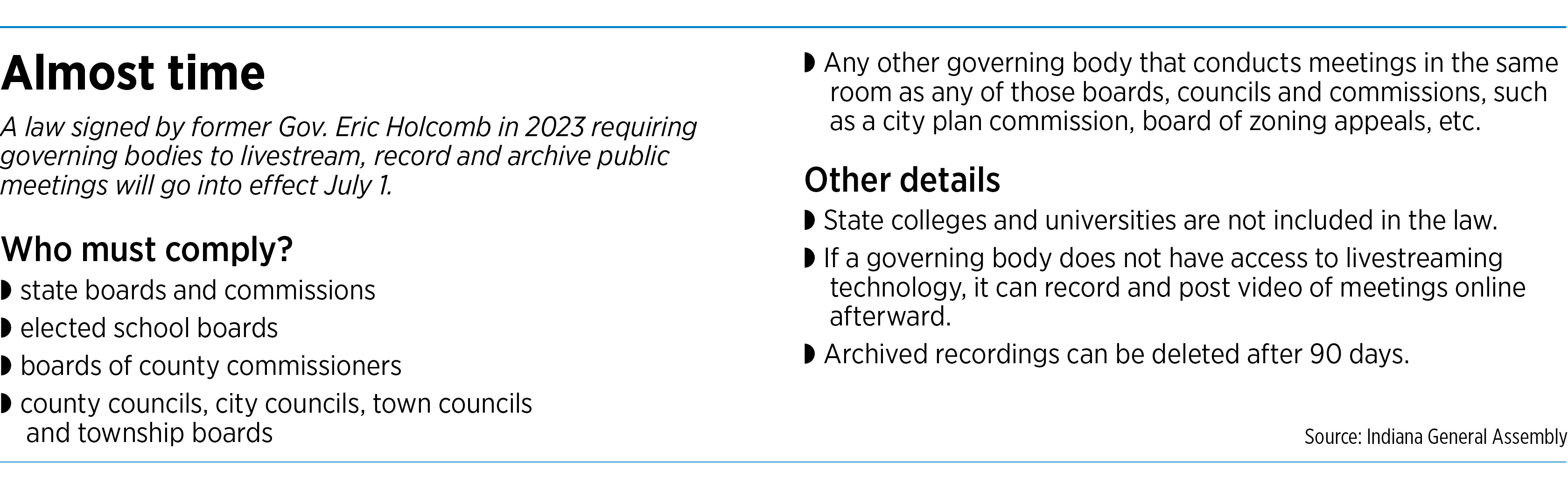
In 2023, Indiana lawmakers passed House Bill 1167, which says state and local governments must begin livestreaming, recording and archiving meetings. The law covers public meetings held by state boards and commissions; elected school boards; county commissions; and county, city and town councils.
Any other meetings held in the same room as those boards, councils and commissions—such as a city plan commission or a board of zoning appeals—will also need to be streamed.
Overholser, who has been chief of the Cicero Fire Department since 2016, said the town’s streaming system is ready to go, with cameras mounted in Town Hall, a mixer board in place that will switch between cameras and a YouTube channel set to go public.
He worked with Cleveland, Ohio-based BoxCast on a system to schedule livestreams by building a schedule spreadsheet uploaded into BoxCast’s software package. Meetings will begin automatically on YouTube without needing a person to push a button.
The Cicero Town Council gave Overholser a budget of $12,000 to $15,000, and he put together a system for $8,000.

“We had great support from the council on the way we wanted to do things, and they pretty much said, ‘OK, here’s your budget, and you guys run with it,’” said Overholser, who is also helping Cicero’s neighbor to the north, Arcadia, install a streaming system of its own.
Cicero Town Council President Joe Cox said he has mostly stayed out of the way as Overholser worked to get the town in compliance with the law.
“What we hear a lot is, ‘I just don’t have time to make it to the meetings. I’d like to be more involved,’” Cox said. “One of our biggest things that we found is, the more information we can get to the public in advance of any decisions we make, it just seems to go smoother for everyone. There’s less pushback. There’s a better level of education to the resident, and it’s just a better situation all around.”

Rep. Ben Smaltz, R-Auburn, authored HB 1167. His motivation was to increase government transparency and accessibility, which he said would answer questions that “get caught up in social media spin as fact.”
“I think it’s important for people to see their government in action,” Smaltz said.
The law has some carve-outs. For example, colleges and universities are not required to livestream meetings. It also provides flexibility for governing bodies that do not have access to livestreaming technology or are in an area of the state without reliable access to broadband internet. In those cases, meetings can be recorded and posted online afterward.
Smaltz said the focus is more on just making meetings available and less on making governments invest in complex and sophisticated video systems.
“We tried to make it as clear as possible with the guardrails as wide apart as possible, because we’re just starting something that I think will be around long past us that will only get better and better and better,” Smaltz said.

If a community or state government body does not establish a program to put meetings online, residents can file an open-door complaint with the office of the Indiana Public Access Counselor.
However, Zac Cook, vice president of sales and marketing for Indianapolis-based videoconferencing installation company River Systems, said he has heard hesitation from some municipalities, counties and school boards. River Systems has installed several livestreaming systems around the state.
“I think they’re wanting to see what everybody else does,” Cook said. “The House bill really doesn’t have any teeth in it. If you don’t do this, nobody’s coming down on you [with] some sort of fine or punishment, but everybody knows they need to do it.”
Increasing access
Many cities and towns in Indiana have livestreamed meetings for years. Others began streaming during the pandemic when meetings were held remotely.
Carmel was an early adopter; it began streaming public meetings on its YouTube channel and city website in 2017. The city first broadcast City Council meetings on its Carmel TV public access television channel in 1999.
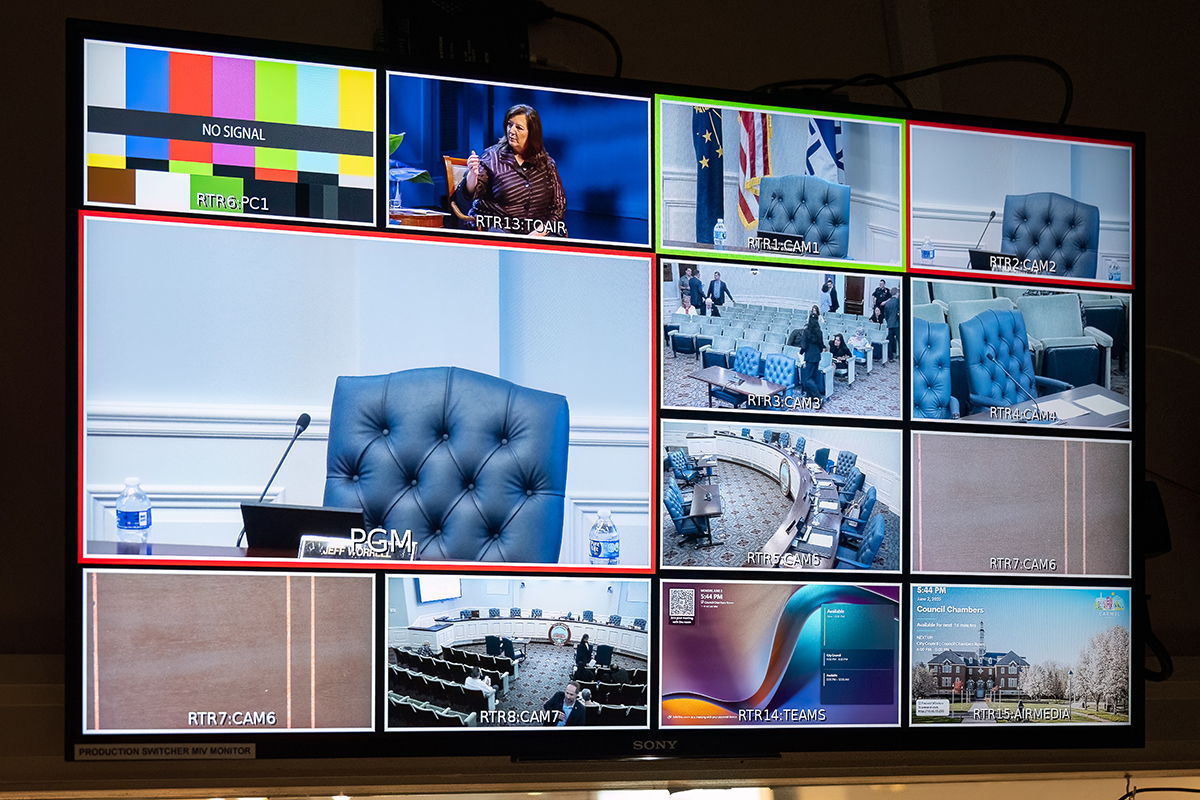
George Zhang is the man behind the scenes when someone checks in on a Carmel City Council meeting on TV or the internet. While councilors discuss topics at the front of the chamber, Zhang sits in a small room in the back where he uses a control panel and laptop to produce the meeting video that people watch at home.
Zhang, a digital media specialist for the city, said cities and towns streaming for the first time will need an employee on staff who can fix the inevitable problems.
“There are a lot of gremlins that do come up,” he said. “Even with us, after doing it for eight-plus years or so, we still have little issues here and there that require troubleshooting.”
In neighboring Fishers, city officials were already looking to increase the number of meetings they provide online when HB 1167 passed. At the time, they were deep into designing the Fishers Municipal Center, which opened last year and replaced the old Fishers City Hall.
Along with the main theater where the City Council, Plan Commission and other boards meet, conference rooms throughout the building have video capability in case they are needed for a public meeting.
“[The new law] came at the right time,” Fishers city spokesperson Ashley Elrod said. “It coincided with the design of the building, which was happening [on] the heels of COVID, so we were already thinking about video and livestreaming and meetings where we would need to have people in person and virtually.”
Tracy Gaynor, the city’s director of information technology, said city officials began thinking in 2020 about how to stream more than just City Council meetings. This year, meetings will also be available on the city’s website.
“We’re always sort of evolving and changing what we’re doing just to try to provide more transparency and more availability, more connectivity to our [residents] and interested parties,” Gaynor said.

The new law has also led the city of Noblesville to expand the menu of meetings it offers online. Currently, only City Council meetings are livestreamed, and they are available on the YouTube channel of Hamilton County Television, which also provides webcasts of high school sporting events and local talk shows. The city will launch its own YouTube channel where it will stream meetings of the Plan Commission, Board of Zoning Appeals, Board of Public Works & Safety and other boards.
Noblesville City Attorney Jonathan Hughes said the look of the product is second only to the content.
“For us at the city, and I think most cities and towns think this way, [it’s about] trying to present something that looks professional,” Hughes said. “That is really important to us. What we’re doing is an important service to the community, but we want to present it in a professional manner.”
Improving technology
Cook, with River Systems, said he has been in touch with about 50 counties, municipalities and state agencies since former Gov. Eric Holcomb signed HB 1167.
River Systems has a contract with the state and has installed livestreaming systems for agencies such as the Indiana Economic Development Corp., Indiana Office of Technology, Indiana Public Retirement System and Indiana Professional Licensing Agency.
The company has also put systems in place for the northern Indiana cities of South Bend and Ligonier, the southern Indiana city of Huntingburg, St. Joseph County in northern Indiana and the South Newton School Corp. in northwestern Indiana.
“Once it was announced the date wasn’t going to get pushed back last year, things really started to ramp up in terms of calls,” Cook said. “We were getting requests on, ‘What technology [do we use]? How do we implement this?’ And for state agencies and the counties and municipalities, it was scary. It’s like, ‘Oh my God, we have to stream every public meeting.’ That seemed overwhelming.”
Cook said his advice for local leaders is to keep it simple. While some cities and state agencies have elaborate streaming systems, the approach he suggests is to use a virtual meeting platform like Zoom and choose an all-in-one video bar that has a speaker, microphone and camera that can stream to YouTube, Facebook or a city website.

“It’s not really worth the money to go over the top, and we can do it, but we tell people, ‘Unless you just have a real need to spend that kind of money, it’s really hard to justify,’” Cook said. “The systems are just so advanced. They’re so simple. You just don’t need that level of logistics.”
Cook said it would not have been possible a decade ago to expect every community to livestream meetings, but technology has improved “by leaps and bounds.” The cloud removes the need to purchase large amounts of storage. Artificial intelligence technology can move a camera between speakers and automatically provide closed-captioning transcription.
“It makes it easy for the non-tech person to be able to operate these systems,” he said. “The timing is fantastic because it’s affordable, it’s easy to use and it’s reliable. Whereas, in the past, it would have been very expensive, high-maintenance and unreliable. The technology wasn’t there.”•
Please enable JavaScript to view this content.
Editor's note: You can comment on IBJ stories by signing in to your IBJ account. If you have not registered, please sign up for a free account now. Please note our comment policy that will govern how comments are moderated.