
Subscriber Benefit
As a subscriber you can listen to articles at work, in the car, or while you work out. Subscribe Now
The Indianapolis department that issues building permits and fines for city code violations and conducts inspections has been “paying 2025 bills with 2010 revenue.”

That’s what Abbey Brands, director of the Department of Business and Neighborhood Services, said is driving the decision to more than double the cost for some permits next year, including those for building a new home or commercial structure in Indianapolis, and to add new fees.
The department says it will use the increased revenue to improve and speed up the overall permitting system, which is hampered by a small staff and other inefficiencies.
The Department of Business and Neighborhood Services handles licensing, permitting and inspections and oversees property use, safety and maintenance.
City leaders estimate that proposed changes to BNS’ fee structure, which include increasing plan review and structural fees for new builds and raising violation fees, could bring in an additional $5 million annually for the department that is self-funded.

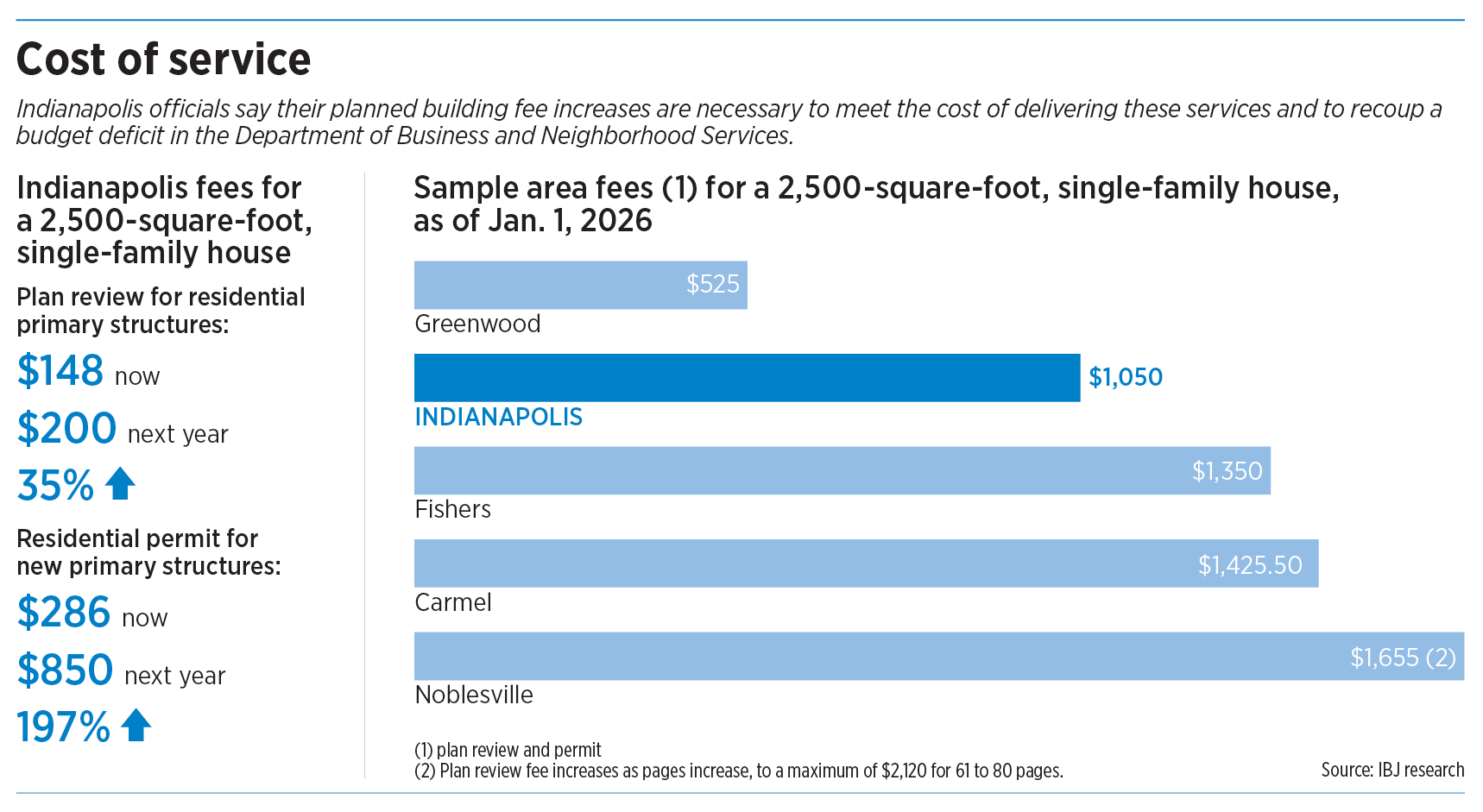
Indianapolis has historically had lower permit costs than nearby cities, but homebuilders in 2026 will pay 142% more than they do now to get necessary permits for a 2,500-square-foot home, according to the Builders Association of Greater Indianapolis.
The plan review fee for that size home will increase to $200, up from $148, and the structural fee will jump from $286 to $850.
While those increases will ultimately show in the sticker prices Marion County homebuyers and renters pay once projects are complete, some homebuilders told IBJ they won’t mind paying higher fees if the higher revenue for BNS results in quicker permit turnaround times. Indianapolis lags surrounding suburbs in processing time, and those delays can cost developers.
“From my perspective, if the increased fees can increase the level of service and speed up the permit time frame, I think that’s a benefit and can make Marion County more competitive,” Kelli Lawrence, CEO of Indianapolis-based Onyx+East, told IBJ.

A residential building permit in the suburbs might take one to two weeks, Lawrence said, but the same process can take one to four months in Marion County.
In a statement to IBJ, Chris Hancock, CEO of the Builders Association of Greater Indianapolis, referred to those same delays.
He said that while Indianapolis building fees are much lower than those of other municipalities, even with the upcoming increases, “the level of service may not be as efficient, resulting in delays and increased costs.”
The new fees won’t go into effect until Jan.1, so it will take about a year for the city to see the full revenue impact. But department leaders say they’ll use the funding to create efficiencies.
A key audit
Unlike other city departments and agencies, the Department of Business and Neighborhood Services doesn’t rely on taxpayer dollars. Its only revenue source is the money it collects for services.
In 2024, local government accounting firm Baker Tilly conducted a study on the cost to provide services for the department. It looked at the time it takes staffers to complete certain tasks, the salary and benefits they are paid, and administrative overhead, and compared that cost with the amount a customer pays for the service.
The report Baker Tilly provided to the department this May found that in many cases BNS was losing money. For example, the average cost for the department to provide a permit for a new, 2,000-square-foot primary structure is $524. A builder would pay just $263 for that service, leaving the department’s cost only half covered.
That deficit has led to BNS’ having to dip into its reserves. And without increasing fees, it might eventually become reliant on tax dollars, which are already stretched thin for Marion County and the city of Indianapolis.
The same study, which the department paid Baker Tilly $83,350 to conduct, was used to determine other new costs.
Dawn Olsen, chief communications officer for the department, told IBJ in a written statement that the fee increases will allow BNS to cover costs in real time. Olsen also said these funds will eventually be used to help the department grow and invest in staff, as well as in information technology and user-friendly systems.
Impact on affordability
Builders told IBJ that Indy’s fee increases make homes less affordable in Indianapolis, but they won’t be a deterrent to builders.
To illustrate that, the builder’s association’s Hancock pointed to a study from the National Association of Homebuilders. That study found that for every $1,000 in additional regulation and fees added to the cost of a home in the Indianapolis metro area, 551 working families would be effectively “priced out” of the market for a new home.

Arbor Homes Division President Christian Rector told IBJ the increase is just one factor that will combine with rising construction costs, increased material prices, labor shortages and expanding regulatory requirements to put pressure on prices.
Arbor Homes is the second-largest home builder in Indianapolis based on permits filed in 2024.
Lawrence, of Onyx+East, said the few-thousand-dollar increase through the city’s raised permit costs doesn’t “change the picture substantially” but is another factor of home building that will increase the final cost of homes.
“We do have some projects in queue for next year [in Marion County], and I think while it’s another cost in the project, it’s not going to stop us from moving forward,” she said.
Hancock, of the builder’s association, said if the current turnaround times aren’t improved after the fees increase, the combo would likely be a deterrent to city development. That doesn’t mean development would stop, he said, but it could cause some builders to look elsewhere.
Cities surrounding Indianapolis not only have higher starting costs but also pile on thousands of dollars for developers in impact fees. In Carmel, for example, builders will pay $5,425 per home to fund parks. To build a single-family home in Fishers, developers must pay more than $7,440 for parks, roads and bridges.
While Indianapolis does not charge impact fees, the communities that do generally have higher housing values, so sale prices better absorb the cost to developers, Lawrence said.
According to MIBOR data from September, the average sale price for a home in Marion County was $250,000. That’s well below the $315,000 median for central Indiana and for counties like Hamilton ($497,250), Hendricks ($350,000) and Johnson ($349,450).
Other new fees
Beginning Jan. 1, BNS will also hike penalties for code and ordinance violations, some that haven’t changed since 1988.
Brands, the department’s director, told councilors at an August meeting that current penalties for violations don’t reflect “levels of egregiousness.” For example, placing signage without a permit carries the same fine as skirting commitments made to city development officials.
Rather than maintain the flat $50 fee for first offenses, the department will increase some fees up to $325—commercial vehicle parking and petition violations, for example—and maintain lower tiers at $50 and $100 for others. The fine for illegal dumping of hazardous waste will increase from $500 to $1,000.
Inspection costs for commercial structures (but not residential structures) will also have new fees.
When inspectors have to return to a site for an inspection, the builder will pay $175. Brands said the fee might help decrease instances in which an inspection is scheduled, but the builder is unprepared or unavailable when the inspector arrives.
“If you know that we’re not going to come out for free anymore, and you’re actually going to have to pay a fee, then I think maybe you’ll be available for your inspection,” Brands said.
The department is also implementing fees for violating stop-work orders. These are cases in which an individual has been cited for a violation, but the department finds they are continuing construction.
That fee will be $750 for a commercial project and $250 for a residential project.•
Please enable JavaScript to view this content.
The higher permitting fees ought to have zero impact on the affordability of a new house, because the cost of those fees are a tax-deductible business expense for builders.
seriously? have you ever taken a business class? the cost will be passed through to the consumer. BUS101
tax deductible items just don’t disappear. your property taxes are deductible – does it still hurt your wallet?
BNS has a surplus so large that it is what the City is using to pay for alley resurfacing. Perhaps if they used that money on staff they wouldn’t have a surplus and would be fully staffed.
Has anyone studied the permitting process to see how many (if any) unnecessary and time wasting steps are involved? Hard to imagine that there is not some way to streamline the process when you take several months to complete something and some areas can do in 2 weeks.