
Subscriber Benefit
As a subscriber you can listen to articles at work, in the car, or while you work out. Subscribe Now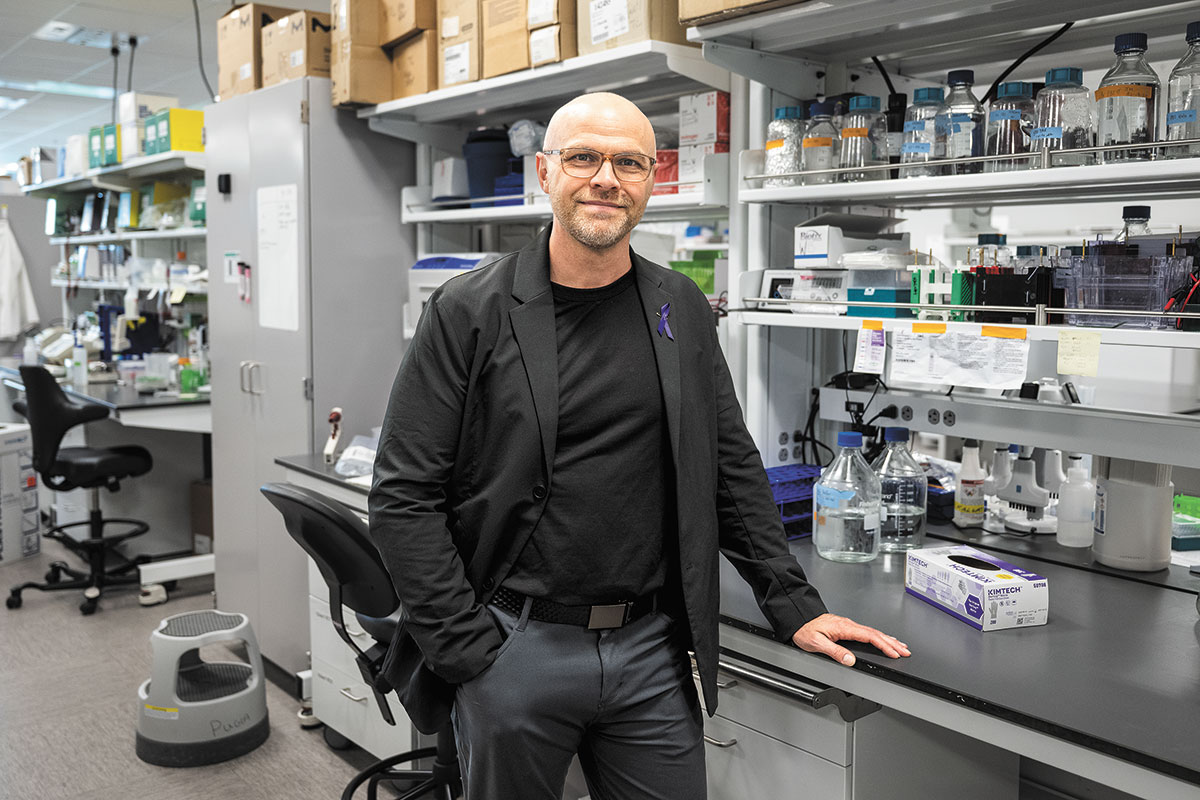
Syndeio Biosciences sees burgeoning potential to treat mental health and cognitive conditions, including Alzheimer’s and depression, with therapies that target the almost countless minuscule brain synapses that give people the ability to think and function.
The Indianapolis-based startup, launched last month, enters the biotech fray with significant resources: $90 million-plus in venture backing, labs in Illinois and California, and a roster of seasoned executives and scientists that include a top adviser who is a Nobel Prize winner.
“They just assembled just a rock star team,” said Vince Wong, CEO of BioCrossroads, a nonprofit advocacy group focused on Indiana’s life sciences sector. “It’s a convergence of great science that then is followed by great investors led by great executive talent.”
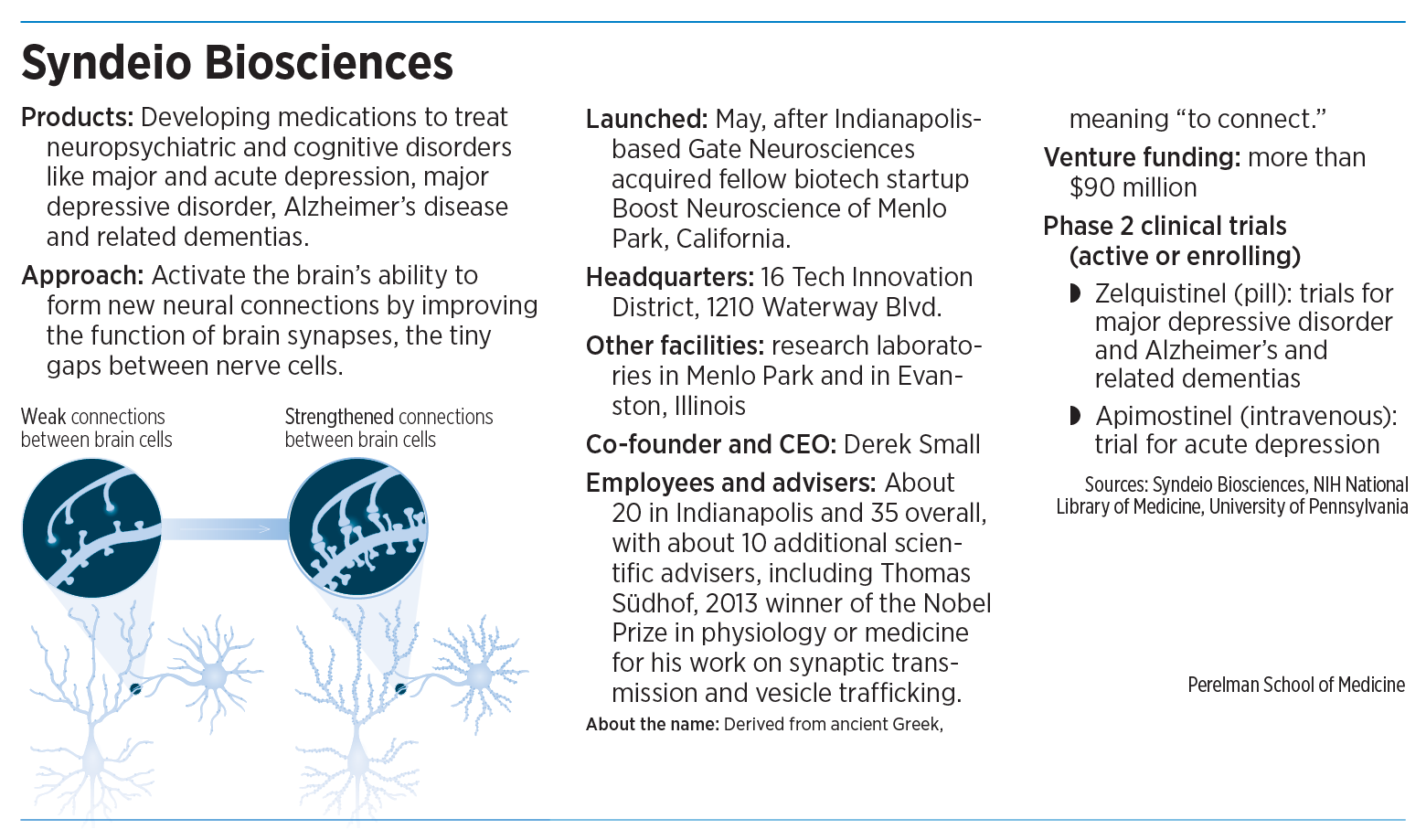
Syndeio is based at the 16 Tech innovation district downtown in the same building as BioCrossroads. Yet the startup also includes labs in California and Illinois and is built to be in-part virtual, with about 20 of 35 employees in Indianapolis plus another 10 scientific advisers.
Syndeio co-founder and CEO Derek Small, a native Hoosier who graduated from Franklin College, has been leading and funding biotech companies for decades. He was the founding CEO of Naurex, an Illinois-based company focusing on conditions including depression that was acquired by Dublin-based Allergan in 2015. He also is the founder of Luson Bioventures, a venture firm that is one of Syndeio’s backers.
Syndeio—a name derived from ancient Greek meaning “to connect”—is developing medications to treat diseases and disorders of the central nervous system, including major and acute depression, major depressive disorder, Alzheimer’s disease and related dementias.
“This is an effort to really create a resilient brain,” Small said.
The company’s therapeutic approach is to attack disease by improving the function of brain synapses, tiny gaps between nerve cells called neurons. Communication between neurons at the synapse is needed for people to think and carry out behaviors, and they break down in patients suffering from neurodegenerative diseases.
The company has two drugs in or enroll in Phase 2 trials. Zelquistinel, a pill, is in trials to treat major depressive disorder and is enrolling now for an Alzheimer’s and related dementias trial. Syndeio said that upcoming trial is a first-of-its kind synaptic function biomarker trial in Alzheimer’s disease.
Also, an intravenous drug, Apimostinel, is enrolled in a trial for acute depression. Syndeio also has multiple other synapse-targeted medications in development.
The startup has such a large number of potential products because it has a long family tree of related or predecessor companies.
Deal-driven
Syndeio grew out of the Indianapolis-based Gate Neurosciences acquisition this year of fellow biotech startup, Menlo Park, California-based Boost Neuroscience.
Gate’s assets included Zelquistinel and Apimostinel. Boost, which spun out of Stanford University, focused on synapse-targeted drug discovery and development based on work by Dr. Thomas Südhof, the 2013 Nobel Prize winner in physiology or medicine. Südhof serves as co-chair of a scientific advisory board for Syndeio.
At the time of the Gate-Boost deal, Südhof said Boost’s proprietary platform was designed to develop drugs to promote the health of synapses and treat a wide array of central nervous system diseases. “Synaptic dysfunction and loss are known precursors to both neuropsychological and neurodegenerative disorders,” Südhof said in a written statement in February when the deal was announced.

As for Syndeio leadership, Small’s diverse background in biotech prepared him well to look after the funding and organizational needs of a complex startup, said Brian Stemme, who collaborated with Small during his time at BioCrossroads.
Stemme, now CEO of the Hoosier Cancer Research Network, said Small has valuable experience as a biotech executive and investor in Indiana and across the country.
“He has the contacts in all the different venture capital firms,” Stemme said. “He has contacts on Wall Street. He’s been through kind of A to Z; that’s super helpful because there are not a lot of people who have done that.”
For Small, watching his father, John Small, suffer from early-onset dementia was motivation for him to eventually help create Syndeio. While suffering from the disease, his father would experience medical emergencies that caused him to lose consciousness and his heartbeat, requiring resuscitation. His dementia symptoms worsened, eventually leading to his death in 2017.
“That’s the reason that I got so passionate about jumping in. Every drug that was potentially available to my father didn’t actually help him remember my name,” Small said. “I was really frustrated with that, and so that’s why I’m like, ‘Why don’t we just go right where the action is at the synapses?’”
He brought together his favorite business and neuro advisers and shifted to focus on neuro inflammation and synaptic dysfunction.
Devastation
The goal is to find a way to alleviate the devastation of Alzheimer’s and dementia in general for patients, their families and other caregivers.

“There is really no other disease like this where there is really such an effect on the patient as well as their family and caregivers,” said Natalie Sutton, executive director of the Alzheimer’s Association Greater Indiana Chapter.
She said the effects of the disease start with memory loss but eventually steal a person’s ability to carry out daily functions of living, often requiring years of caregiving.
More than 7 million Americans are living with Alzheimer’s, with the prevalence projected to increase to almost 13 million by 2050, according to the Alzheimer’s Association, a Chicago-based nonprofit focused on support, research and care related to Alzheimer’s. In Indiana, 121,300 people age 65 and older are living with Alzheimer’s.
Sutton said advancements in medicines, approved and still in development, are giving patients and caregivers more hope. “It’s the most exciting time we’ve ever seen in the Alzheimer’s and dementia space,” she said.
According to a recent Alzheimer’s Association nationwide survey of more than 1,700 Americans age 45 and older, 92% said they probably or definitely would want to take medication that could slow the progression of the disease after an Alzheimer’s diagnosis.
Also, 58% indicated that they would accept “moderate to very high levels of risk” with medication to slow the progression of Alzheimer’s disease in the early stages.
Syndeio jumps into a complex and growing array of potential medications for Alzheimer’s and other cognitive diseases.
According to the Alzheimer’s Association, the 2024 Alzheimer’s drug development pipeline saw 127 unique therapies and 165 clinical trials.
Available FDA-approved drugs include Kisunla by Indianapolis-based Eli Lilly and Co., which also is a strategic shareholder in Syndeio, and Leqembi, a drug jointly developed and commercialized by Japan-based Eisai and Massachusetts-based Biogen. Both medications are approved to treat patients with early Alzheimer’s by targeting amyloid plaques in the brain associated with the disease.
BioCrossroads CEO Vince Wong said he sees Syndeio as a potential pioneer in developing targeted therapies for synapse. In fact, BioCrossroads was an early investor in Gate Neurosciences, which is now part of Syndeio, through the Indiana Seed Fund III it manages.
He praised the Syndeio team’s talent and deep relationships across the biotech industry. Yet Wong added that, as with any drugmaker, everything comes down to the eventual results of clinical trials.
“The data is king in science,” he said.•
Please enable JavaScript to view this content.
Editor's note: You can comment on IBJ stories by signing in to your IBJ account. If you have not registered, please sign up for a free account now. Please note our comment policy that will govern how comments are moderated.