
Subscriber Benefit
As a subscriber you can listen to articles at work, in the car, or while you work out. Subscribe Now
For decades, Hoosier governors and lawmakers have sparred over what can be done during a special legislative session. But state leaders are now confronting a different dilemma—can the General Assembly legally ignore a governor’s demand to convene?
Indiana’s debate reached a new breaking point Tuesday when the Senate chamber voted to adjourn until Jan. 5, rebutting Gov. Mike Braun’s call for a special session on redistricting.
The Senate’s decision to simply not show up appears to be unprecedented in state history.
Republican Sen. Mike Young, who supports redistricting, said Tuesday that lawmakers are already, by definition, in a special session and therefore can’t ignore it.
“The governor has the power to call us into a special session, which he’s done,” Young said. “But we have a right as a body to set a different schedule. … We could have been in and adjourned, sine die, but we chose not to do it. This is a slap in the face of the governor of the state of Indiana.”
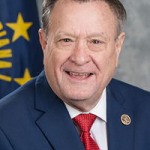
He told the Indiana Capital Chronicle that the legislature must at least gavel in and out of the special session—even if redistricting matters are left untouched.
“We first have to go in,” Young said. “I’m not saying we have to do any work. I’m just saying they’re not following the rules of the Constitution.”
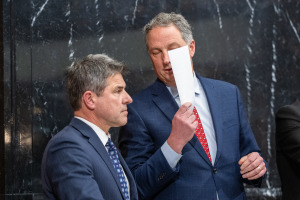
But Senate President Pro Tem Rodric Bray, who leads the chamber, told reporters the opposite.
“It does not appear to be a problem that we can make a decision as to whether we come in or not,” Bray said, citing internal legal advice to the Senate.
Republican House Speaker Todd Huston offered only a brief response Tuesday when asked whether he believes the legislature can ignore the special session call entirely.
“We’ll see if that’s even necessary,” Huston said.
Facing mounting resistance from his own party, Braun said he’s now looking for ways to “compel” the Senate to act. The governor’s office had no further details on what authority he believes he can use. He did radio and television interviews Wednesday but didn’t include print reporters.
The legislature previously planned to meet Dec. 1 to take up President Donald Trump’s wish for Republican-led states to draw more GOP-friendly U.S. House districts ahead of the 2026 midterm elections.
Indiana’s Senate Republican leadership has maintained the caucus lacks enough support to pass mid-cycle congressional maps. GOP senators were split 19-19 in a vote to adjourn until January. It passed with Democrat support.
‘I don’t see where the legislature can ignore that’
Over the last century, governors of both parties have relied on special sessions to resolve deadlocks, rewrite tax codes and complete budgets. While executive and legislative leaders have clashed, at times, over the content and length of special sessions, historical records reviewed by the Capital Chronicle showed no examples of the General Assembly simply refusing to convene at all.
In 1865, then-Gov. Oliver Morton called a special session to address Civil War-era financial emergencies and reorganize state institutions. In 1919, Gov. James Goodrich summoned lawmakers so Indiana could ratify the 19th Amendment.
In 2002 and again in 2018, governors convened special sessions to tackle unfinished bills and complete budget work. And in 2022, former Gov. Eric Holcomb called lawmakers back for a special session that ultimately produced the state’s near-total abortion ban.
The Indiana Constitution provides that “if, in the opinion of the Governor, the public welfare shall require it, he may, at any time by proclamation, call a special session.”
But the Constitution also grants each chamber authority to “determine its rules of proceeding, and sit upon its own adjournment.” It does not say what happens if lawmakers simply do not convene.
Who controls the session’s length, agenda and existence once called has been debated since Indiana’s first constitutional convention in 1816 and again in 1850.
It resurfaced most recently in a 2022 Indiana Supreme Court case involving Holcomb.
In that case, the high court justices struck down a statute—House Enrolled Act 1123—that would have allowed the Legislative Council to call the full legislature into special session. The justices held that the governor alone has that authority—but notably did not decide whether the legislature is legally required to meet once the governor calls them in.
The 2022 ruling also traced how delegates in 1850 explicitly rejected proposals to allow the legislature to call itself into session—evidence which the justices said reflected a deliberate choice to vest that power exclusively in the governor.
The opinion further noted that while governors historically initiated special sessions, “the General Assembly retained authority over the conduct and duration of such sessions.”
Indiana Code currently caps special sessions at no more than 30 session days and no more than 40 calendar days following the first day of the governor’s desired session calendar.”
Former House Speaker Brian Bosma, who served in more than half a dozen special sessions during his tenure, said his reading of the Indiana Constitution is that lawmakers are required to convene, even if only for minutes.

“My personal view, my read of the Constitution and statutes as a lawyer, is that the governor has every right to call us because it’s a singular right to call a special session. And I don’t see where the legislature can ignore that,” Bosma said. “But what I’m confident the legislature could do is come in on the first day and adjourn.”
He added that lawmakers could “adjourn after two minutes,” taking attendance, saying the pledge, and ending the session if they choose.
“It seems to me that the legislature is compelled to be there,” Bosma continued, “but it could adjourn.”
The former House speaker pointed to a notable gathering in 1991, when Senate Republicans abruptly adjourned the first special session during a budget impasse—and “no one questioned (then-Senate President Pro Tem Bob Garton’s) authority to do so.”
Could Braun force lawmakers to appear?
Internal legislative policies could help compel some senators—but only if enough show up in the chamber first.
Senate rules, for example, allow 25 members to “compel the attendance of absent Senators.” There are 40 Republican senators currently in office.
If at least 25 senators appeared—along with Lt. Gov. Micah Beckwith, who presides over the Senate as its constitutional president—they could order absent senators to return, issue calls of the Senate, or adjourn.
But, crucially, those powers apply only after the Senate gavels into session. If the chamber never convenes, none of those enforcement mechanisms can be activated.
Indiana has some precedent for large-scale absences, though. In 2011, Democrats fled the state during a weeks-long walkout over “right-to-work” legislation.
Bosma said “there has been discussion in the past” of the governor “dispatching the state police to collect people up and bring them in”—including in 2011. But while “it’s been threatened, it’s never happened.”
In the wake of that walkout, Indiana enacted “anti-bolting” laws that allow the House and Senate to fine members who intentionally refuse to attend and prevent a quorum. Those penalties can reach $1,000 per day. But those statutes apply only when the chamber is already in session—meaning they provide no mechanism for enforcing attendance at a special session lawmakers never convene.
Bosma emphasized that then-Gov. Mitch Daniels declined to send state police to retrieve the absent lawmakers, however, and noted that such a move today could be politically explosive.
“Certainly, it wouldn’t be done, I would think, (by) a Republican governor to Republican legislators,” he said. “But we’ll see how it plays out.”
The Indiana Capital Chronicle is an independent, nonprofit news organization that covers state government, policy and elections.
Please enable JavaScript to view this content.

Good for them to follow the peoples’ opinion.
Robert, I’ve not seen or heard any evidence of the people’s opinion in whole, just a few speaking out. Goode’s meeting in Vigo Co was all Dem attendees, and Lisa’s comment below didn’t really say what the people wanted.
(Different Robert H. here.)
Kevin, there have been several polls on early redistricting in Indiana. Every single one shows that a majority of Hoosiers do not want redistricting. A slim majority, but a majority nonetheless.
Kevin, this is going to be more embarrassing to you than it will be to me.
Goode’s district is so solidly Republican that Democrats couldn’t find a single person to run in 2022. When there was last a competitive election, Republicans won by 16%.
Every single one of the attendees (200+) to Goode’s meeting was a constituent in his district. No one else was allowed in to speak. Goode, to his credit, sat there and let everyone say their two minutes.
… AND NOT ONE SINGLE PERSON IN SUPPORT OF REDISTRICTING bothered to show up.
Supporters of redistricting couldn’t get 50 people to come to the Statehouse in support. Most schools bring more people when they tour the Statehouse!
A rare beacon of hope in our hyper partisan times
Braun is our worst governor since… Pence. Probably worse than Pence.
Holcomb was okay.
Mike Young, please retire. Sit down. Close your mouth. There are adults at the table. You told a packed room in Decatur township that you work for US, the People. You told us that repeatedly. Like 20 times in a 1 hour meeting. You aren’t listening to the people that you serve. And just a reminder, you serve ALL of the people in your district. Not just the Republicans. So stand up and speak on our behalf, as you told us you would do.
Braun is following in the foot steps of his beloved leader Donald Trump by ignoring the voters, ignoring the State consitution and making up his own rules as he goes along. Braun needs to go!!
Braun’s only loyalty is to his dear leader TRUMP . He is a TRUMP MAGA CULT scyophant . As TRUMP says Braun owes TRUMP for ever getting elected to office . He represented TRUMP as a Senator and now as TRUMP’s Governor over Indiana .
All the comments here seem to be personal and biased. There is nothing in violation of our state constitution, so far. With a 19-19 closing vote on Tuesday it seems the gop is still not in agreement, it took the Dems to go over the top to avoid a special session, and the Dem members were always against most actions by the gop members. No clear evidence of the people’s opinion being against the session, only politics.
Wrong as usual, KKKevin P.
Kevin, you’re correct, there’s nothing stopping Indiana Republicans from drawing new Congressional districts every two years if they wish.
Other than, well, it does make clear they don’t care one whit about the needs of Hoosiers and exist solely to do what their big money out-of-state donors tell them to do.
When will politics take back seat to governing?
what’s there to gain for the republicans by redistricting? There’s only two Democrat districts in the entire state. Marion county and Lake county, the rest of the state is republican. 9 republican seats and 2 dems. Not sure if Indiana can do much more than that.
Getting Trump through the second half of his term without having the immense amount of graft investigated… not having to compromise with Democrats … the list is endless.
It’s worth noting that Bray went to IU and has stayed in Indiana for his entire life, but Braun and Trump are Ivy League elites who think Hoosiers are suckers.
What do you mean? Braun is a man of the people! He wears a blue shirt and everything!
/sarcasm