
Subscriber Benefit
As a subscriber you can listen to articles at work, in the car, or while you work out. Subscribe Now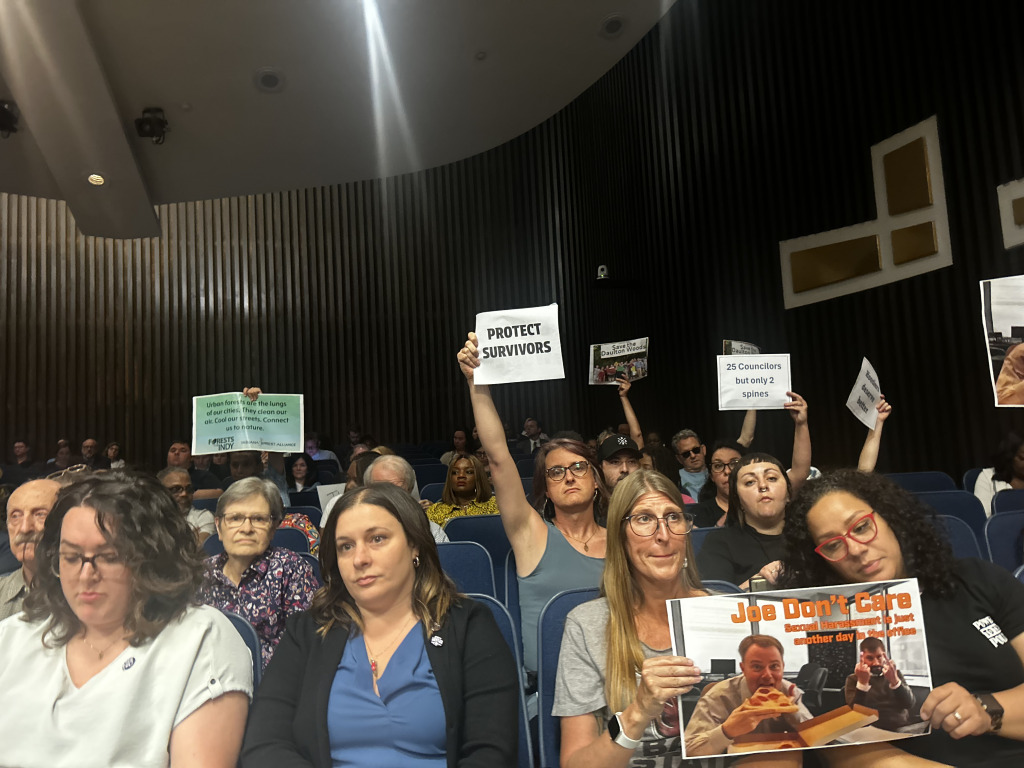
The law firm hired to investigate allegations of harassment against a former member of Mayor Joe Hogsett’s administration and campaign says that texts the mayor sent to two of the women at the center of the allegations—who said the communication made them uncomfortable—were outside the investigation’s scope.
While Fisher Phillips received the texts from the women, its attorneys chose not to include them in the final report based on the Indianapolis City-County Council’s ordinance, General Resolution 41, that created the investigative committee, according to a two-page memo partner Danielle Kays sent to investigative committee chair Crista Carlino on June 9. Kays also wrote that nothing the firm found indicates that the mayor violated the city’s anti-harassment policies.
The memo was shared with IBJ by council spokesperson Sara Hindi, who told IBJ that councilors, through legal counsel, followed up with Fisher Phillips for clarification. They received a response June 9.
On June 5, IndyStar first reported the mayor’s texts, which were provided to reporters by a lawyer representing the women who say they were harassed by his former chief of staff Thomas Cook. The women believed the firm omitted key details they provided, including the mayor’s texts.
Kays wrote that the firm “reviewed and considered all information and materials provided” and “learned nothing that would have led us to believe Mayor Hogsett had violated the city’s non-fraternization policy or anti-harassment policies.”
“Even though nothing stood out as reportable under GR 41 as to Mayor Hogsett’s text, this information supported our recommendations,” Kays wrote.
Because “complainant 1,” Lauren Roberts, was never employed by the City-County, the texts she provided fell outside the scope of GR 41, the memo states.
As for “complainant 2,” Caroline Ellert, the firm reviewed the texts she provided “within the full context of all interviews and information provided by complainants and all witnesses.”
“Specifically, we considered how Complainant 2 described her relationship with Mayor Hogsett and vice-versa. Both confirmed they had a good working relationship and had developed a personal relationship … and each had positive descriptions of their interactions,” the memo states.
Ellert, however, disagrees with that assessment.
Through an attorney, she told Fisher Phillips the texts made her uncomfortable and called them “erratic,” an email provided to IBJ shows.
The memo from Fisher Phillips doesn’t address statements by Ellert and Roberts that they feel the report slanted heavily in the mayor’s favor and disregarded specific details they shared.
A statement written by Ellert and read by women’s advocate Emma Davidson Tribbs during a council committee meeting Tuesday says that Fisher Phillips’ final report “undermined and belittled” her experience of sexual assault.
“Throughout his experience, people in powerful positions have expressed more concern with the way survivors choose to share what happened to us than what actually happened to us,” she said.
Questions regarding contract, scope of investigation
The alleged omissions in Fisher Phillips’ final report have prompted calls from councilors for a deeper probe into the firm’s investigation.
They’ve also raised questions about whether council leadership had a hand in crafting the scope of the investigation behind the scenes. Carlino said during a meeting Tuesday that she was not the “architect” of that scope.
Fisher Phillips’ June 9 memo clarified what the firm believed its scope to be. GR 41 and an engagement agreement, signed by Council President Vop Osili, charged the firm with investigating “‘allegations of sexual harassment and abuse by members of the Administration’ as specifically made by Complainants 1 and 2 and an assessment of ‘how the Administration addressed these allegations,’” Kays wrote.
Neither the services agreement nor GR 41 are as specific about whose allegations should be investigated.
Carlino, chair of the investigative committee, on Tuesday called on Osili and Council Vice President Ali Brown to step down from their leadership posts. She seemingly implied that the pair narrowed the investigation’s focus without saying how. Osili and Brown denied that they had a hand in crafting the scope.
Her comments mirror allegations made in a June 12 email newsletter from Councilor Jesse Brown, an elected Democrat who was expelled from the caucus earlier this year. Brown wrote that Osili was “directing staff to subtly influence the scope of work that Fisher Phillips engaged in.”
The council’s legal counsel LeAnnette Pierce, who drafted the agreement and all other council contracts, denied those allegations.
In a statement read by Tribbs Tuesday, Roberts reiterated Brown’s theory. She called it a “so-called independent investigation” that was secretly “interfered with and manipulated” by Osili on behalf of Hogsett.
Osili maintains that the contract aligns with the council proposal.
“The scope of work was based on the proposal drafted by a working group of Councilors, including the Chairwoman, received by Fisher Phillips, and presented back to the committee by them on November 14,” Osili wrote in a statement to IBJ Thursday.
Please enable JavaScript to view this content.
This entire thing is slimy. I didn’t vote for this individual and don’t understand how the voters of Marion Couinty could have elected him, let alone to multiple terms.
Same for the President
The “investigative process” that the mayor requested from one of his “friendly” law firms lengthened the process past the deadline for the individuals to file a complaint with the Equal Employment Opportunity Commission (EEOC). Having dealt with the EEOC on many instances, I am quite sure they would have found Hogsett’s text messages very relevant.
This is not correct. An employee can file a claim with the EEOC or ICRC without awaiting the outcome of an internal investigation by their employer.
Robert,
You only have 180 days to file a complaint with the EEOC unless it is regarding an anti-discrimination claim that will extend it to 300 days. In real life, unfortunately, most victims think the investigative process will rectify the issue.
“‘allegations of sexual harassment and abuse by members of the Administration’ as specifically made by Complainants 1 and 2 and an assessment of ‘how the Administration addressed these allegations,’”
How would this exclude the text messages. We need a shake-up of our city-county council.