
Subscriber Benefit
As a subscriber you can listen to articles at work, in the car, or while you work out. Subscribe Now
Indiana University School of Medicine researcher Jeff Dage’s years of research into biomarkers helped lead to a first-of-its-kind blood test to diagnose Alzheimer’s disease.
The U.S. Food and Drug Administration last month granted clearance for a test from Pennsylvania-based Fujirebio Diagnostics that identifies a key part of a specific protein in the brain that is a potential biomarker for Alzheimer’s disease.
The first of its kind to receive FDA clearance, the Lumipulse blood test offers patients a less invasive, less expensive and more accessible way to detect signs of amyloid plaques associated with Alzheimer’s disease than current methods of FDA-cleared cerebrospinal fluid, or CSF, testing or PET scans.
The test is approved for use in people 50 or older showing symptoms of the disease.
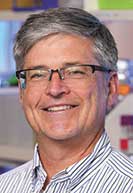
The work by Dage, senior research professor of neurology at the IU School of Medicine, and the test’s FDA clearance underscore the long and complex path for medical innovation, often resulting from years of inquiry and collaboration among scientists in industry and academia.
Interestingly, Dage—in his “Conflicts or Competing Interests” disclosure at IU—said he serves or has served as a paid consultant or on advisory boards of 20 companies, organizations and universities. But Fujirebio Diagnostics is not among them.
“For sure, I don’t think I directly benefit from the commercialization of the Fujirebio test,” Dage said.
Dage did, however, receive research support from Fujirebio Diagnostics, according to his disclosure.
Of his motivation he added: “I help anybody who wants to help to make the test and to make a new, better platform.
“Maybe we can drive the prices even lower and lower, because if you can get it below $100, then it’s more affordable, even to countries that don’t necessarily have the best health care.”
Dage’s research into potential biomarkers to identify Alzheimer’s spanned his years as a research fellow at Indianapolis-based drugmaker Eli Lilly and Co. before he joined the IU School of Medicine in 2021.
Almost a decade ago while at Lilly, Dage discovered that phosphorylated tau, a protein in the brain filtered through the bloodstream, is a potential biomarker for Alzheimer’s disease.
As the years went on, Dage collaborated with scientists at the Mayo Clinic in Minnesota, Columbia University in New York, the University of San Francisco and Lund University in Sweden.
From 2018 to 2020, the researchers published journals showing they had identified a useful blood-based test.
‘Humble, sweet, collaborative’
But just finding the biomarker wasn’t enough. To be reliable, the diagnostic test must measure the part of the phosphorylated tau protein that changes most from its normal state.
It was a challenging scientific puzzle.
“People think it’s the whole protein. It actually gets chopped up inside the cell. It gets put out in your blood, in the brain, in the CSF and in the blood,” Dage said. “It’s all just different pieces and parts of the protein. And so we design an assay [test] that tries to identify the piece that changes the most in Alzheimer’s disease.”
That crucial section of the tau protein turned out to be pTau217.
The new blood test measures the ratio of two proteins that are hallmark characteristics of Alzheimer’s disease: phosphorylated tau (pTau217) and an amyloid protein (ß-amyloid 1-42), according to the IU School of Medicine.
“This has been an amazing journey of great scientists,” said Dage, adding that multiple researchers, diagnostics companies and funders of medical research collaborated.
Dage said one of the reasons he left Lilly, where he worked for 20 years as a scientist, for IU was for the freedom to work with a variety of companies and researchers to move products like the new Alzheimer’s test forward. In fact, he said he still consults with Lilly, which has an FDA drug, Kisunla, to treat Alzheimer’s and is making a significant investment in treating the disease.
A spokesperson for Lilly, however, said the company had no involvement in the Fujirebio test.
“We do drug discovery in a way that [if] we hit up something, a problem or we see something interesting, we’ll go and chase it because we can uncover how something works,” Dage, who has a doctorate in biochemistry, said of his academic approach. “In pharma, we don’t care necessarily how every little bit works as much as we want to deliver a meaningful therapy. In academia, if we have a chance to learn something, we’re going to go and try and figure it out, and so we’ll spend more time.”
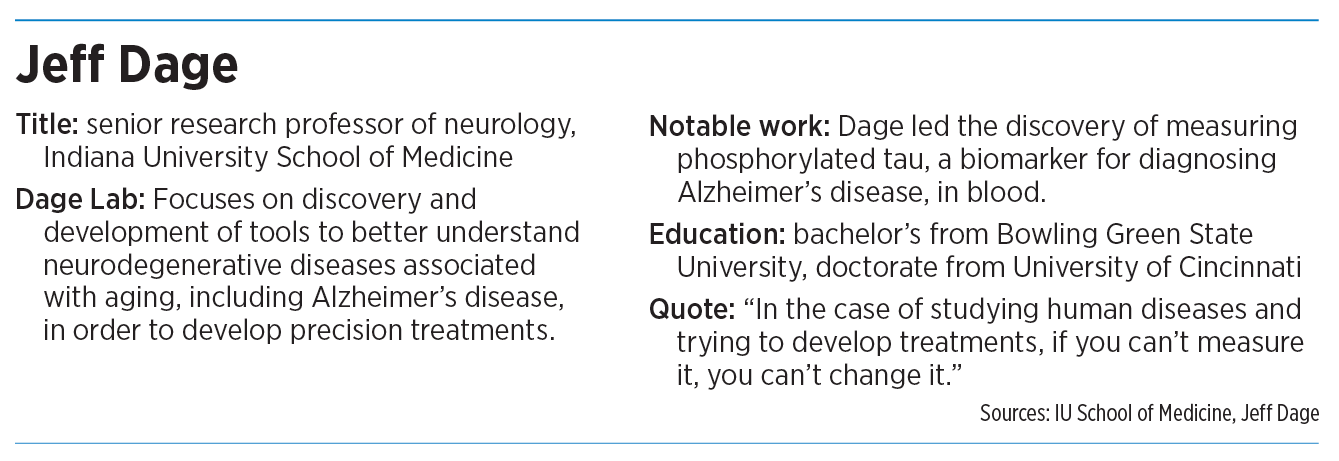
At the IU School of Medicine, the Dage Lab focuses on discovery and development of tools to treat neurodegenerative diseases associated with aging, including Alzheimer’s disease.
Matthew Bell, vice president of sales and marketing at Fujirebio Diagnostics, called Dage “the father of pTau217 during his time at Lilly.”
In an email to IBJ, Bell added: “Jeff Dage is someone who is very scientifically curious but has demonstrated a willingness to share insights with the research community to advance the entire field. If you get the impression that I hold him in high regard, you would be right.”
Beyond his work at IU, Dage has served as a consultant or on advisory boards for a variety of companies, universities and funding organizations.
For example, he has worked with California-based ALZpath, which he said has developed its own antibodies for measuring pTau217.
Dr. Eric Reiman, a co-founder and adviser to ALZpath, said blood tests to detect Alzheimer’s disease are vital for developing new treatments and reaching large populations of patients.
“We have a woefully inadequate standard of care for people with memory and thinking problems,” said Reiman, also CEO of the Arizona-based health care system Banner Health’s Alzheimer’s Institute.
He said 60% of people who have dementia never have an evaluation or diagnosis in their lifetime. But he said researchers are entering a “golden era in research, care and prevention” of Alzheimer’s that he believes will be enabled eventually by commercially available blood tests to detect the disease before symptoms.
“This humble, sweet, collaborative guy is one of the reasons we have entered that new era in the fight against Alzheimer’s disease,” Reiman said of Dage.
Measure it, change it
Fujirebio Diagnostics’ Bell said the company has collaborated with Dage while he has been at IU through studies and his laboratory.
In a clinical study of 499 patients receiving Fujirebio Diagnostics’ Lumipulse blood test, 92% of those with a positive test result also showed amyloid plaques by PET scan or CSF, according to Fujirebio Diagnostics. Also, 97% of patients with negative test results had a negative amyloid PET scan or CSF test result.
“The big difference in what the blood test does is, it makes something that’s accessible to everybody,” Dage said. “You know you have symptoms. They can very quickly get you onto a treatment or something like that.”
He estimated the new test could cost around $400, though he was hopeful insurance companies would cover most of that. The price will be set by laboratories, which bill Medicare, Medicare Advantage or private insurance companies.
Fujirebio Diagnostics said the test should be ordered by a physician for patients age 50 or older who are in the care of a specialist for symptoms of cognitive decline. The test is not intended to screen people without symptoms.
More than 7 million Americans are living with Alzheimer’s, according to the Alzheimer’s Association. That number is projected to increase to 13 million by 2050.
The new test “will go a long way to assist physicians and patients to obtain an AD diagnosis in early stages of the disease, when interventions are more effective,” Fujirebio Diagnostics CEO Monte Wiltse said in a statement when the Lumipulse test received FDA clearance May 16.
Dage also has a personal connection to the toll of degenerative cognitive disease. His mother died from complications of dementia in 2019.
He credits his father, who worked for a pharmaceutical company, as one of the main reasons he went into science.
“Get a chemistry degree. There are always a lot of jobs for chemists,” he remembered his father telling him during his freshman year at Bowling Green State University in Ohio.
So that’s what Dage did.
“I have always thought of myself as focused on translational science and an expert at measuring things with biological relevance,” he said. “In the case of studying human diseases and trying to develop treatments, if you can’t measure it, you can’t change it.”•
Please enable JavaScript to view this content.
In the meantime, the HHS and RFK, Jr have likely cut their funding as such research does not align with RFK, Jr’s vision for “healthcare”
This is an excellent example of why funding research is critical to every single one of us, regardless of whether it feels like it in the short term.