Med school enrolls first U.S. patient in global trial to treat childhood chronic kidney disease

If chronic kidney disease progression is not slowed, patients eventually face being put on dialysis or may require a kidney transplant.
Read More
If chronic kidney disease progression is not slowed, patients eventually face being put on dialysis or may require a kidney transplant.
Read More
More than 50 medical schools — including the Indiana University School of Medicine — are set to pledge Thursday to boost their nutrition education.
Read More
The 326,000-square-foot building is just south of the IU Neurosciences Research Center on 16th Street and next to Indiana University Health’s 864-bed, $4.3 billion downtown hospital complex.

The IU School of Medicine is the largest medical school in the United States, and Hess is one of the longest-serving medical school deans in the country.
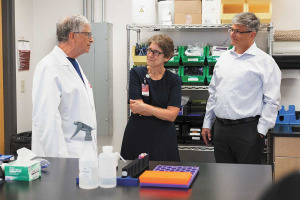
Indiana University School of Medicine researcher Jeff Dage’s years of research into biomarkers helped lead to a first-of-its-kind blood test to diagnose Alzheimer’s disease.

The study looked at the behaviors of more than 550 medical school students from across the country to understand how these young professionals cope with the stress of their programs.

The lab, which will be located on the second floor of the 11-story IU Medical Education and Research Building, will emphasize hands-on physical dissection as a vital component of medical training.
The study followed a group of testicular cancer survivors for an average of 14 years, revealing that 78% experience significant difficulties in everyday listening situations.

There have been only a handful of previous $1 billion donations to universities in the U.S., most coming in the past several years.
The Indianapolis-based medical school ranked 29th in the country for landing funding from the National Institutes of Health.
The IU School of Medicine scored a major coup five years ago when it recruited one of the nation’s top experts in the fast-growing field of regenerative medicine. But the University of Pittsburgh recruited him away this spring.
Fred Cate, IU’s vice president for research, informed federal officials that the research group had “a pattern of non-compliance” and had been warned several times against using expired materials.

Dr. Rachel Patzer, director of the Health Services Research Center at the Emory University School of Medicine in Atlanta, will join Regenstrief Institute on May 1.
The money will be used to provide new opportunities for graduate students typically underrepresented in biomedical science, officials said.
The not-for-profit Tumaini Foundation for Global Health and Humanitarianism says it wants to train medical students with a special concern for the health of needy individuals and populations worldwide.

The high-tech approach allows a patient recovering from substance abuse to interact with potential future versions of himself or herself.
The medical school said the commitment will help launch research efforts to develop better therapies for triple negative breast cancer, an aggressive form of breast cancer that is often not responsive to hormone therapies and is resistant to chemotherapy.

IU said the 11-story, 325,000-square-foot facility in Indianapolis will be used to address instructional and research needs of programs in the university’s school of medicine.

Fueled with a $36 million Lilly Endowment Inc. grant, the Central Indiana Corporate Partnership has launched AnalytiXIN to promote innovations in data science throughout Indiana.
Speakers at the IBJ Life Sciences Power Panel on Friday said their organizations have largely weathered the lockdown—raising records funds, taking on huge expansions, hiring new employees and reporting higher productivity.
The center, which is home to one of the medical school’s largest programs, will move from its current location at Senate Avenue and 15th Street to the IUPUI campus.
In 1879, Dr. William N. Wishard, then 27 years old, became superintendent of Indianapolis City Hospital, an institution so little regarded that it lacked city water and gas.