
Subscriber Benefit
As a subscriber you can listen to articles at work, in the car, or while you work out. Subscribe Now
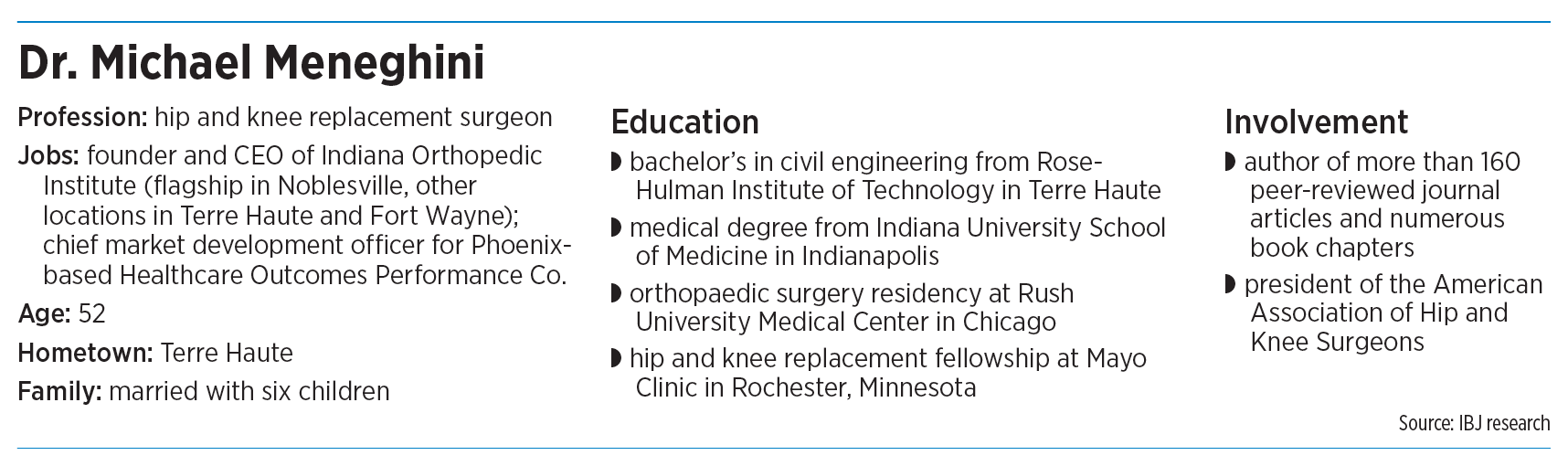
Dr. Michael Meneghini, 52, is a man of big numbers and big plans—all shaped by a life unapologetically obsessed with orthopedic surgery.
As a surgeon, he’s performed more than 10,000 hip and knee replacements.
As an entrepreneur, he waited out a two-year noncompete clause after leaving Indiana University Health before opening the $35 million Indiana Orthopedic Institute early this year as the first tenant in Noblesville’s Innovation Mile.
Meneghini views his business model, emphasizing research and value-based care, as a potential template for change, describing the current health care system as unsustainable and a poor financial arrangement for both orthopedic surgeons and patients.
He said people don’t understand “that the health care earth is shaking underneath” due to price pressures for both providers and consumers. “People aren’t paying attention,” he said. “I want to be part of the solution in delivering lower-cost, higher-quality care.”
IBJ asked the Indiana Hospital Association for a comment about Meneghini’s move and whether other doctors might follow suit. IHA spokesman Steve Cooke said “competition is an important part of Indiana’s health care ecosystem.”
But he said, “Hoosiers can depend on their local hospital for that high-quality care, knowing their doctors and nurses can treat the most medically complex patients in their community 24/7, regardless of their ability to pay.”
A spokesperson for IU Health declined to comment about Meneghini’s clinic or his thoughts about the health care system before IBJ went to print.
Meneghini’s 38,000-square-foot building features outpatient operating rooms for a variety of orthopedic procedures but focused mostly on hip and knee replacement. His business’s organizational approach emphasizes surgeons’ active involvement in clinical research and professional development paired with a focus on streamlined care and personalized patient service.
Indiana Orthopedic Institute said most of its patients—about 90% of those undergoing primary hip and knee replacements and 45% of those having revision, or redo, surgery—go home the same day as their procedure. The institute’s surgeons perform procedures in hospitals, including Meneghini at IU Health Fishers, as well as their own facility.
By comparison, according to the American Academy of Orthopedic Surgeons’ OrthoInfo website, a projected 51% of joint replacements are expected to be performed on an outpatient basis by 2026.
Meneghini said practices such as getting patients up and walking in as little as 55 minutes after surgeons have closed their wounds and adjusting anesthesia to avoid problems like urinary retention, a risk for men with enlarged prostates, help prevent hospital stays.
Even one night in the hospital typically adds thousands of dollars in additional costs. Meneghini said he can perform a typical joint replacement at about half the cost of what a hospital charges.
Before creating the Indiana Orthopedics Institute, Meneghini was founder and director of the IU Health Hip and Knee Center at IU Health Fishers.
However, part of Meneghini’s pitch is his disdain for what he sees as the administrative creep of bureaucracy into modern health care, which he said hampers productivity and raises costs for service lines such as orthopedics.
The Indiana Orthopedic Institute ramped up quickly. Its staff of about 76 includes 13 orthopedic surgeons, 12 physician assistants and nurse practitioners, and two anesthesiologists. Meneghini said only about nine staff members are non-clinical employees.
He said the organization is structured to be “vertically integrated,” and as part of that, the same anesthesiologists oversee the perioperative clinic that handles pre-surgical patient evaluations and help coordinate care.
Straight talk
Orthopedics is typically a lucrative business line for hospitals and is often used to subsidize less-profitable services.
Yet orthopedic surgeons—despite their high prestige—have seen compensation fall even as the volume of procedures they perform has ballooned.
For example, Medicare volume of total knee replacements increased from 603,704 in 2013 to more than 1.01 million in 2022 and is projected to reach 2.8 million by 2040. It’s expected to have an annual growth rate of 5.9% from 2023 to 2040, according to the Journal of Arthroplasty.
At the same time, research published in the same journal found that orthopedic surgeons’ absolute income, adjusted for inflation, fell 38% from 2000 to 2020.
Meneghini said he had an “aha moment” years ago about the problem with health care while attending a meeting at a large hospital system.
“I’m in my scrubs. I’m coming out of surgery,” he remembered. “I looked around. … I [saw] administrator, administrator, administrator, administrator.
“I said it out loud in the meeting room … . ‘Do you know that I’m the only revenue generator in this room? … I’m paying for your salaries, and you’re setting the time of the meeting, pulling me out of the operating room.’”
Meneghini added, “That’s health care in the United States.”
Such straight talk is his style, said one longtime friend.
“He’s helping to lead the charge or fight the fight for orthopedic surgeons across the United States,” said Eric Huebner, founder and principal of Certus Medical, an Indianapolis-based distributor of orthopedic implants and instruments.
Huebner said Meneghini’s blunt approach speaks to the frustrations common among orthopedic surgeons in dealing with payments from insurance companies and hospitals. “Surgeons take cuts every single year,” he said. “They don’t lobby very well. … He’s helping to bring light to a lot of this stuff.”
Meneghini has more than 3,850 followers on LinkedIn, where he regularly posts about orthopedic care, research and the business of medicine.
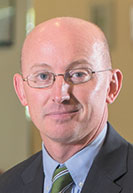
In addition to Noblesville, the Indiana Orthopedic Institute has locations in Terre Haute and Fort Wayne.
Earlier this year Meneghini became president of the American Association of Hip and Knee Surgeons, a role in which he emphasizes better collaboration among surgeons, health care systems and industry.
His approach has earned respect.
Former IU Health executive Ryan Kitchell remembered Meneghini as a visionary who combined broad goals with intense focus on his own work as a practitioner.
“Michael is as driven as any physician I’ve ever worked with,” Kitchell, who previously worked as chief administrative officer at IU Health, said in an email to IBJ. “In all my dealings with Michael, he did what he said he’d do, and he kept the patient at the center of his work.”
Attracting talent
Meneghini’s message has motivated some to leave employment at hospital systems.
Dr. John Meding, most recently employed as an orthopedic surgeon at Franciscan Health, joined Meneghini at the Indiana Orthopedic Institute in October 2024.
“It’s a breath of fresh air,” said Meding, who has written more than 180 peer-reviewed publications, including clinical studies and book chapters on hip and knee reconstruction techniques.
“Over the years, because of cutbacks … conferences were done away with, and now we’re reestablishing those things,” he added. “I see the cases Mike’s doing. Mike sees the cases I’m doing. Everybody knows what everybody’s doing. You could bounce ideas and thoughts off of each other, and we all grow that way.”
Meding is one of five Franciscan Health surgeons who joined the Indiana Orthopedic Institute at once.
In Meneghini, Meding said, he finds a blending of hard-charging work with personal touches.
“His house is always open. We have meetings there. We have dinners there. He’s a very gracious host,” Meding said. “When you do a lot of research, you’re not going to be spending Saturday afternoon playing golf.”
Meneghini traces his work ethic to his childhood in Terre Haute, especially to his mother, Nancy Farr.
“My mom grew up in poverty,” he said. She thought her only way out was through education. “Early on, I remember her working three jobs, getting a master’s degree in mathematics.”
Meneghini graduated near the top of his class from Terre Haute North High School and enrolled in nearby Rose-Hulman Institute of Technology to study engineering. As an incoming freshman, he listened to longtime Rose-Hulman President Samuel Hulbert and school leaders talk to new students.
“I remember it like it was yesterday,” he said. The speaker told the students to look around—that most of the new students were near the top of their class, many valedictorians.
Meneghini remembered hearing the speaker say: “As of tomorrow, first day of classes, 50% of you will be in the bottom half of your class.”
“I just studied like crazy,” Meneghini said. “I remember my first report card. I remember just being terrified opening it, and it had a 4.0.”
He then turned to medicine, earning his degree at IU. His training included a fellowship in hip and knee replacement at the Mayo Clinic in Minnesota.
‘Very good hands’
In evaluating surgeons, he looks for specific qualities.
“No. 1, treat every patient like they’re your own family, period,” Meneghini said. “If you do that, you’ll see good decision-making, you’ll see good judgment.”
Also required, he said, are “very good hands”—fine motor skills and dexterity to go along with the ability to make sound decisions and to “still yourself in the craziest situations,” such as excessive bleeding.
“I operate Monday and Tuesdays, and then I do clinic on Wednesday,” he said. “Thursday and Friday are my administrative days.”
He travels 20 to 25 weeks a year. He added that he needs only about five hours of sleep a night.
“I don’t have any hobbies,” said Meneghini, who is married with six children. “It’s my work or my family, and that’s what I love to do, both of them.”•
Please enable JavaScript to view this content.
Editor's note: You can comment on IBJ stories by signing in to your IBJ account. If you have not registered, please sign up for a free account now. Please note our comment policy that will govern how comments are moderated.