
Subscriber Benefit
As a subscriber you can listen to articles at work, in the car, or while you work out. Subscribe NowEditor’s note: This story ran in the print issue of IBJ on April 18. It has been updated here to reflect that the property tax bill was signed into law after this story went to press.
Legislators determined to cut property tax bills for homeowners and businesses this session have left local officials with difficult choices about whether to cut services or raise income taxes to make up for substantial funding gaps over the next three years.
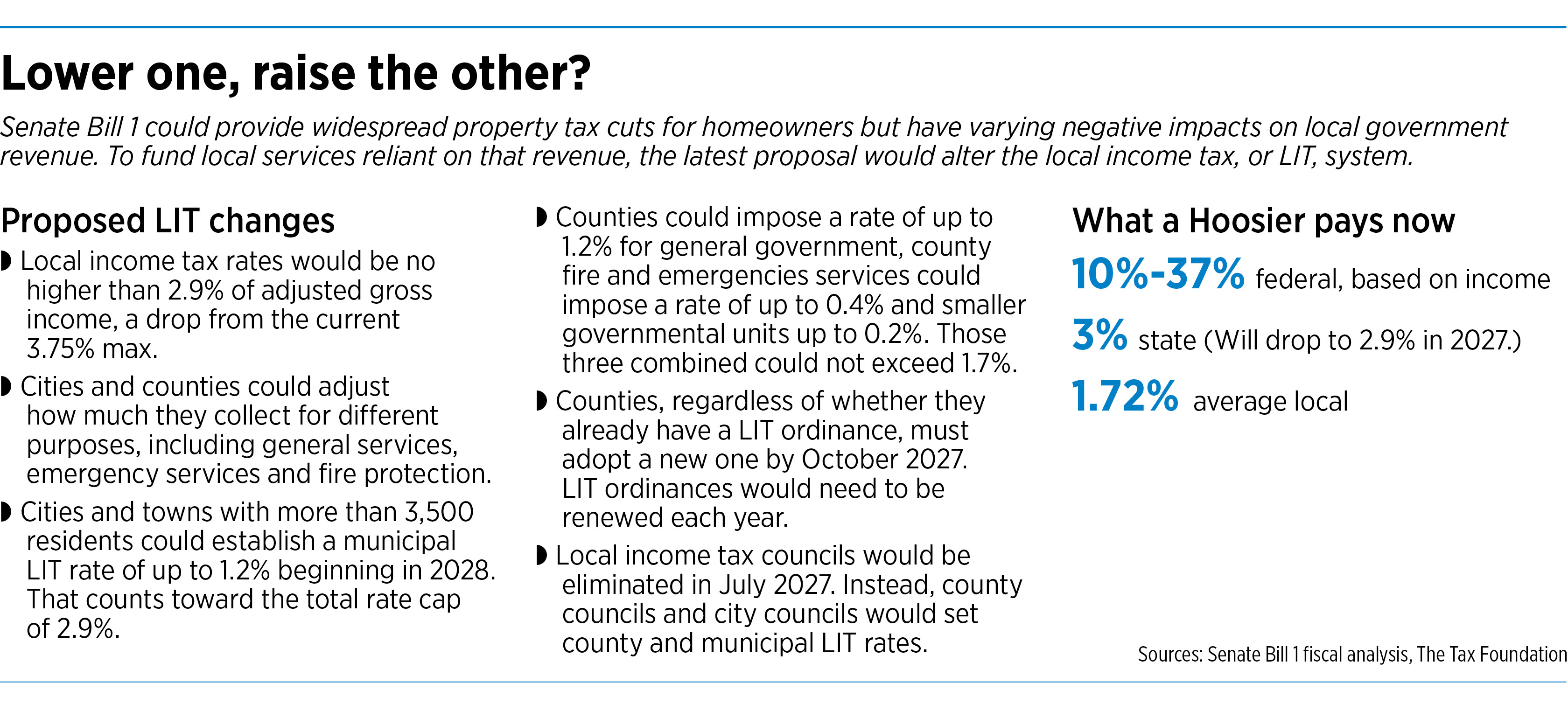
Already, Hoosiers pay income taxes to every county government in Indiana, but elected leaders are expected to consider raising those rates, which now average 1.72%.
And for the first time, Indiana lawmakers have given cities of more than 3,500 residents the chance to impose an income tax rate, as well.

“It will become a necessary option as this bill becomes fully implemented over a series of years,” said Matt Greller, CEO of Accelerate Indiana Municipalities, a state association of city and town officials. “There will be some communities that won’t use [local income tax] at all. There will be some communities that will have to use it extensively.”
In all, the new property tax rules—signed into law this week—will limit total county tax rates to no more than 2.9%, including rates imposed by cities. Any increase would begin to offset cuts to the state income tax rate that lawmakers have been phasing in.
The new property tax rules—which received final Senate approval early Tuesday morning—are expected to give two-thirds of homeowners tax bills in 2026 that are lower than this year’s.
The legislation increases a credit for homeowners to 10% or a maximum of $300, cumulatively saving homeowners $1.4 billion over the next three years. The bill also exempts more business equipment from taxation, which an Indiana Chamber of Commerce study has found could save companies more than $1 billion a year.
With all the changes implemented, the state’s bipartisan Legislative Services Agency estimates that local governments will have $1.5 billion less to spend over the next three years on employee salaries, public infrastructure projects and services such as trash pickup, landscaping and parks.
Much of that loss could impact cities, which offer more services and generally have higher property tax rates than other local units of governments. Under the new law, cities with more than 3,500 residents could impose an income tax rate of up to 1.2%.
That would cost a worker with annual income after exemptions or deductions of $300,000 an additional $3,600 a year.
But while Greller said he expects to see many cities implement new tax rates, most will act judiciously. He doesn’t expect all local governments to jump to the max 1.2% unless they have no choice in order to balance their books.
Local government leaders told IBJ they will need to see how much the property tax changes affect their revenue before making any decisions about income taxes.


“More tools are always appreciated,” Lebanon Mayor Matt Gentry said. “I don’t think we’ll have to necessarily exercise that, but it’s hard for me to say that. not having exact firm numbers of where we’ll be.”
But Greenwood Controller Greg Wright called the local income tax option “a bit of a saving grace.”
“I don’t think we will be able to absorb losses on the property tax side without some sort of” local income tax increase, he said. “I just don’t see that there are enough cuts that could be made and keep service levels where they’re at.”
A system shift
Local governments have throughout Indiana history relied on property taxes to fund the majority of their operations and capital projects. In 1973, the Legislature first acted to let local governments collect income tax revenue, as well, diversifying their revenue streams.
Now lawmakers are seeking to reduce local government reliance on property taxes even more.
The shift toward income taxes adds more uncertainty into local government. Property tax revenue doesn’t tend to swing during economic ups and downs. That’s because property values don’t tend to change quickly (the last few years have been an exception), and the current property tax system prioritizes total collections over rates, which also adds stability.
The property tax system also collects revenue from a broad range of payers—homeowners, farmers and businesses.
Shifting dependence to the individual income tax means revenue is likely to be more volatile. Income tax changes with shifts in the population and the economy. In a recession, for example, layoffs could heavily impact tax collections. Also, local income taxes are collected only from individuals, not businesses (at the state level, corporations pay income taxes, as well).
There will likely be a shift in who’s paying, too. Most homeowners are expected to get a property tax cut under the plan, but working Hoosiers will likely shoulder the bigger income tax burden. And while the owners of limited liability corporations and partnerships pay taxes on their firms’ profits, so-called C-corporations don’t pay local income taxes at all.
Critics of the changes say many Hoosiers will end up paying more, assuming local officials raise income taxes.
The planned property tax credit will save homeowners up to $300 per year, potentially more—and lawmakers hope overall system changes will stem future increases. A half-point increase in the income tax rate, however, would cost an additional $750 for a person who earns $150,000 after deductions and exemptions.
That’s why House Democratic Leader Phil GiaQuinta of Fort Wayne called the law “a tax hike in disguise.”
“Paying up to 2.9% in income taxes to your city and county on top of state and federal taxes is much more than the $300 max in ‘credit’ you could receive off your property tax bill in 2026,” he said. “Businesses still get a break, but working Hoosiers get crumbs. This is a bad deal for working Hoosier families, which is why House Democrats voted no on this plan.”
The state, meanwhile, has been reducing its income tax rate over time. This year, the rate for individuals is a flat 3%, down from 3.05% in 2024 and 3.15% in 2023. The rate is expected to continue to go down over time if state revenue exceeds projections.
No blanket solution
Whether local officials will increase income tax rates remains uncertain. Leaders emphasized that every county and city in the state will have different property tax impacts and different considerations to consider—there is no one-size-fits-all solution.
“What they’re going to find with this tax structure is … that every county in the state is affected differently,” said Hamilton County Commissioner Mark Heirbrandt, a former president of the Association of Indiana Counties.
Hamilton County’s income tax rate is currently 1.1%, well below the 2.9% cap lawmakers are considering. Heirbrandt said county officials are fortunate to have been conservative in the past, so they have capacity left to raise their tax rate if needed to offset property tax cuts.
Some officials said they hope they will not need to increase the local income tax.
Gentry told IBJ that economic development in his city will offer an additional revenue stream, and he doesn’t believe Lebanon will need to raise taxes.
Johnson County Council President Larry Scott said he prefers not to increase the income tax, which will affect individuals, because it’s the property tax reduction on business equipment that he’s most concerned about.

Fishers Mayor Scott Fadness sees opportunity in the changes. He said giving cities the ability to establish income tax rates is “an appropriate path forward” and one that makes sense.
The resulting local funding model could be more complex, Fadness said, but it should give cities more autonomy. And Gentry said “giving [cities] local tools to make local decisions is always a good idea.”
Other local officials told IBJ in written comments that it’s too early to tell what the tax changes would mean for their budget and future taxing decisions. But several said their goal is to keep taxes as low as possible for their constituents.
“Senate Bill 1 presents challenges, and while a local income tax could help offset lost property tax revenue, it’s crucial that we explore all options to ensure a fair and balanced approach,” Johnson County Council President Pam Burton said in a statement.
In the meantime, local officials say they are “tightening their belts” as Gov. Mike Braun has requested. Both Fadness and Wright said they are trying to identify ways to cut back on 2026 spending as much as they can.
“When we do the budget for 2026, it’s going to end up being, ‘Batten down the hatches,’” Wright said. “Anything that we can hold the line on, we’ll lock it out until we know what it’s going to look like realistically.”
Wait and see
The House-passed bill phases in tax changes over about four years, giving localities time to plan for a drop in property tax revenue. The built-in transition time, Greller said, means local elected leaders have time to ask lawmakers for tweaks as problems with the legislation are discovered.
And local leaders told IBJ they will need that time to see how property tax revenue and forecasts evolve before making definitive decisions.
“All of the impacts are going to take a while to shake out,” Wright said. “Just in the short term, I think everybody’s going to be in that same boat of, ‘Lock everything down and hold on until we know for sure.’”
And while local leaders work to understand how this legislation impacts them, many said they will need to make sure they explain to their constituents how their tax burden is changing. Fadness said the “onus is going to be on the local governments, frankly, to explain this from a policy perspective as we move on and kind of digest what the state Legislature has come up with.”•
Please enable JavaScript to view this content.
So really, there’s no actual cut for regular people. We’re going to be paying the same, if not more.
There was never going to be a cut for regular people. The property tax cut only really helps those who own LOTS of high-value lane. Major corporations, corporate farms, data centers, warehouses, people with large estate properties, etc. It was a cut for the wealthiest among us and another method of shifting the tax burden further onto the middle class.
*lots of high value land. Grrr…can’t type today.
ah, but our legislature can blame it on the evil schools and blue cities
A “10% tax cut” that’s actually going to lead to a tax hike of thousands of dollars. Indiana GOP’s logic is astonishing.
Now it’s on people to hold towns and cities accountable to use this windfall to fix the schools and roads.
I don’t think anybody was talking about a windfall. The Mayor of Greenwood was just talking about not cutting services. That doesn’t sound like a windfall to me.
At least they can’t sell your job for getting behind on your taxes like they can steal sell your house for just the taxes owed on it
Charles, You can choose not to maintain your own home, and it will fall into disrepair and while nobody is going to take it away from you right away, the value of your home will eventually fall to zero as it becomes worthless.
Your property taxes are maintenance money for specific public services. If you don’t understand what your property taxes pays for, flip the bill over and read the list of taxing entities. Do a few Google searches to find out what those entities pay for. I’m pretty sure that this never got covered in high school civics, but I know the Scout Merit Badge, “Citizenship in the Community” covers this topic.
Unfortunately in many cases, there is enough civics ignorance out there that to ensure everyone will pay their fair share, the government has to threaten tax sales.
Those that don’t own property are the ones paying more under this tax scheme.
Nothing but a shell game.
I’m sure there are very few communities where the town/school employees don’t outnumber business employees by a huge number. Plus those employees are paid more and with much better benefits than any business can afford.
Given Carmel Mayor Sue Finkam crying poor while the property tax reduction was being debated, should we be expecting her to be going for the maximum increase? Maybe they should sell the hotel if they’re that hard up.
Yes, nothing but a shell game where property taxes are lowerd a pittance while local option income taxes go up more than the savings on the property tax reduction but Braun can say he met his promise of lowering property taxes with an *