
Subscriber Benefit
As a subscriber you can listen to articles at work, in the car, or while you work out. Subscribe Now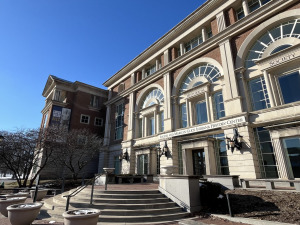
Provisions in the state’s draft budget could leave the Indiana Historical Society in a bind, possibly without a building.
In Gov. Mike Braun’s proposed spending plan—and the House version approved last week—Republican budget writers moved to terminate the state’s contract with the nonprofit institution.
The historical society, or IHS, owns the downtown Indianapolis building at 450 W. Ohio St. where its headquarters, museum and archives are housed. However, it does not own the land on which the building sits.
The contract in question—in tandem with a provision in state code—allows IHS to pay $1 per year to lease that land from the state, and in return, Indiana’s Department of Administration, or IDOA, handles various operational maintenance costs.
The last state budget, approved in 2023, appropriated close to $1 million per year to maintain the building, its exterior and the surrounding site.
A legislative fiscal analysis estimated that repeal of the IHS lease would reduce state expenditures by roughly $1.16 million per year. According to the contract, in the event of a canceled lease, IHS can either purchase the land or sell its building to the state.
Braun’s office did not reply to a request for comment before publication. The Indiana Historical Society additionally declined to weigh in on the pending budget language.
House Democrats attempted, unsuccessfully, to add back in the contract language and return the line item to the budget. The minority caucasus’ master amendment would have earmarked $984,966 in the next two fiscal years, matching the taxpayer dollars allotted previously.
Indiana’s next budget is now in the hands of Senate Republicans. Both chambers have until the end of April to finalize the plan.
Rep. Greg Porter, D-Indianapolis, maintained the funding cuts “are clearly related to a divisive, partisan agenda” and alluded to programs the IHS has put on as being related to the maneuver.
“It’s unusual for the state to terminate a contract unless there’s been fraudulent activity. This is a deviance in the way our state does business, and it’s a bad faith move that tells vendors we’ll cancel contracts with no explanation,” he said. “Curiously, this is the contract that’s being terminated when we’re still paying a contractor for our Medicaid forecasts who’s responsible for the $1 billion mistake.”
He added that “ending the contract puts the IHS in a fiscal bind.”
A contract in question
IHS is a private, nonprofit membership organization that is not affiliated with any state government agencies.
Construction of its headquarters began in downtown Indianapolis in 1996 on the site of the prior Holy Trinity Greek Orthodox Church. The new building opened to the public in July 1999. Before that, the historical society was housed in a building across the street, alongside the Indiana State Library.
The 165,000-square-foot building was built on state-owned land and funded through an IHS bond issue. At the time, the building cost $35.7 million to construct.
A 2007 lease agreement between IHS and the state was intended to last until 2098.
In the contract, the state agreed to provide, at no cost to IHS, “management, maintenance, operation, utilities (exclusive of telephone) and other services reasonably necessary to maintain the building, exterior improvements and surrounding site.” IHS, the “tenant,” retains the title to its building, per the deal.
The historical society is permitted to use the property to house its offices, collections, library, publishing facilities and visitor amenities, as well as for conducting programs and other related activities.

The contract lists the state’s specific upkeep obligations, like routine janitorial services and supplies; heat, air conditioning, ventilation and humidity control maintenance; water for drinking, lavatory and restroom purposes; sanitary sewerage and stormwater disposal; pest control and trash removal; fire alarm service and fire protection systems; and lawn and grounds care.
A second contract signed in April 2009—meant to last through March 2039—details an additional agreement around the parking lot located adjacent to the IHS building.
The state agreed in that contract to handle “all ordinary maintenance of the parking area” during normal business hours Monday-Saturday.
IDOA indicated that contractual services provided to IHS currently add up to $1,183,102 per year, including for:
- Elevator preventive maintenance: $59,991
- Elevator permits: $850
- Window cleaning: $7,550
- Trash pickup: $50,000
- Utilities (current year estimate): $801,500
- Preventive maintenance contractor: $221,711
- Parts and supplies: $20,000
- Grounds and maintenance supplies: $6,500
- Snow pretreatment and removal: $15,000
One section of the contract says that “upon the expiration or sooner termination of this lease, (IHS) shall surrender to (the state)” the land in question.
A cancellation provision makes clear that “[i]f the Director of the State Budget Agency makes a written determination that funds are not appropriated or otherwise available to support continuation of this Lease, the Lease shall be canceled.”
It further states that IHS “shall have the sole and exclusive option to purchase” the land if the agreement is terminated. In such an instance, the state and IHS must each obtain an appraisal of the land before agreeing on a purchase price.
If IHS did go through with a purchase, it would still have to notify the state before selling the property to a third party, however. The nonprofit would then have to provide the state an opportunity to purchase the land back “at the same price” paid to the state, adjusted for inflation.
It’s not clear in the contract what would happen if a deal can’t be reached.
Another provision in state law also says “after completion of construction and negotiation of a lease under section 8 of this chapter, the society shall convey title to the building to the state.” Notably, the next state budget does not propose a repeal of that language.
Recent tax documents filed by IHS calculate the building and connected assets to be worth roughly $33.6 million.
Slashing state spending
Porter praised the IHS as Indiana’s “primary repository for our state’s rich historical record,” and amounted the proposed contract elimination to the Republican governor’s “divisive cuts.”

The state’s historical society, Porter continued, “has always highlighted and celebrated the diverse ethnic and racial history of our state.” He pointed to annual programming around Black History Month, and to a current special exhibit called “Resist,” which highlights the rise of the Ku Klux Klan in 1930s Indiana. IHS recently closed “Eva Kor from Auschwitz to Indiana,” an exhibit on the Holocaust and the life of Auschwitz survivor Eva Kor.
“We know that 2030, 2040, 2050 … this nation is going to be mostly people of color and women—and they want to cut that out. I think this is just a way to do that. It continues to put barriers out there,” Porter told the Indiana Capital Chronicle. “In the Black church, we talk about how you’ve got to know whose you are to know who you are. That means you’ve got to know your history to know where you are now, and know where you’re going to go. And I think the majority caucus right now, which are mostly men, want to cut that out.”
He added that the IHS will now have to come up with an additional $1 million each year, and potentially have to cut exhibits or raise the cost of admission or cut.
“This is yet another move by Braun that will harm Hoosiers by putting the preservation of our history at risk. History is not a partisan issue. In my experience, those who berate history refuse to acknowledge the evils that exist within it.”
Republican budget writers in the House emphasized the need for spending cuts amid a lack of new revenue under current projections. Revenue growth is projected to be moderate in the first year, with far slimmer margins in the second year of the biennial budget.
Braun’s budget plan proposed spending cuts—large and small—across the board.
The Indiana Capital Chronicle is an independent, nonprofit news organization that covers state government, policy and elections.
Please enable JavaScript to view this content.
Brilliant maneuver by the Governor and Legislature: create an obligation for the taxpayers to buy a $33+ million building to avoid $1 million in annual expenditure.
Did they teach that at Harvard Business School?
But it can be sold as “winning”. Being ignorant of the details is bliss.
A correction to the article: the Indiana Historical Society occupied space within the Indiana State Library building, not alongside it.
That makes the close relationship with the state much more clear. Thanks.
The State can afford to support this facility. Seriously!!!
It provides a significant portion of the historical record for Indiana–the State Museum curates the physical history primarily and the History Center curates and documents the written history, while providing an excellent venue to celebrate our State. With the new Archives Building opening across the Canal perhaps some legislators feel that they no longer need to honor this arrangement but again, all of these three institutions are critical in telling the story of our State. If we can’t pass up the chance to have an MLS team. then we should not pass up the chance to adequately document, preserve and share our history. We have an obligation to preserve the record of who we have been and are today.
First, I can’t believe Greg Porter is trying to turn this private nonprofit facility into a racial issue. Really Greg, that’s how you see it? This society was established for all people of all races and religions who helped found and build the state.
Second, maybe the Society should expand their fund raising to a broader population. In this city $1M a year is fairly easy if they try.
Third, sell the whole thing to the State Museum, and let the museum manage and run it. It’s easier to fund the State Museum than a private nonprofit.
I think Greg just pointed out what brought the group into the MAGA anti-DEI crosshairs.
Would be a big blunder not to maintain this beautiful museum and building. Do better, Indiana.
I don’t understand if the State signed a contract and said they would agree to the maintenance cost how they can go back on that contract they’ve signed? Maybe let the IHS assume maintenance and everything related to their building?
The KKK came to power in the 1920s, not the 1930s.
This story describes the details of the land lease and the building contract/lease in a very confusing way. As I understand it, if the state budget does not provide for maintenance and upkeep, the building lease with IHS is cancelled. If the IHS wants to pursue purchase of the building, each party will have an independent appraisal made to determine fair market value. What is unknown is whether this appraisal includes the parcel the building sits upon.
The Indiana Historical Society is a public corporation, established by state law (IC 23-6-3). The enabling legislation permits the Society, and the state’s Office of General Administration, on its behalf, to establish trusts, and to accept grants and gifts as appropriate. This may be a source of confusion for the Society being a nonprofit operating independently and as a tenant of state owned property.
Because the land and the building that is currently occupied by the Society are owned by the state, the state is not obliged to purchase the building at the termination of the lease.
As a taxpayer, I appreciate the Governor’s unwillingness to spend $1.1 Mil annually to maintain a property that is not only in close proximity to, but has a mission and objectives that are synergistic to both the Indiana State Library’s Historical Division and the Indiana State Museum. Co-locating the Society’s collections and operations at one or both of these locations seems achievable.
To be honest, if the intent was to house the Indiana Historical Society in this facility, with maintenance being funded by taxpayers, the design is too elaborate, and the size is excessive. I know business functions, wedding receptions, etc. are held there. Who receives the income from these events? Does this revenue help to offset the maintenance expense? Or, does the revenue from these events enrich the Society while the taxpayer holds the bag on maintenance?
The question going forward is not only where is the Society’s new home, but what does their future look like?