
Subscriber Benefit
As a subscriber you can listen to articles at work, in the car, or while you work out. Subscribe Now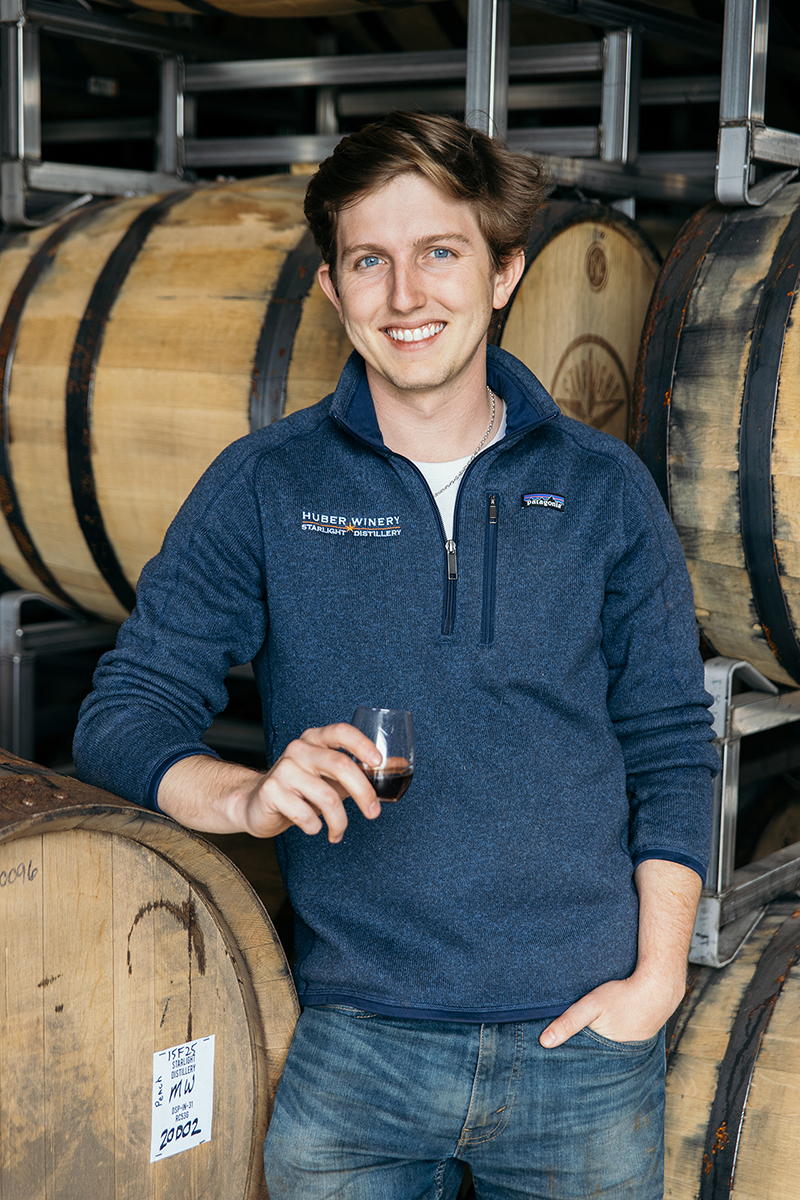
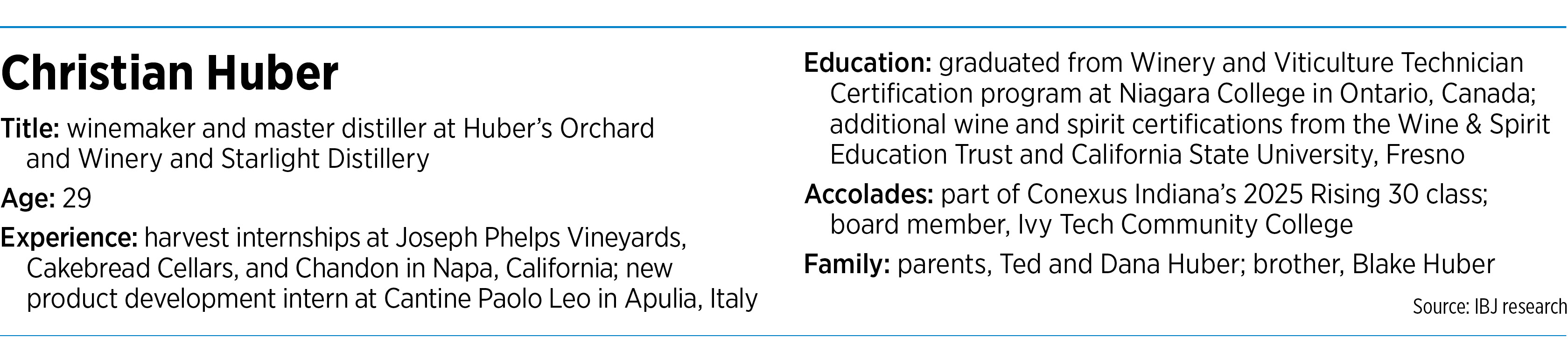
Christian Huber, 29, could have been complacent in riding the continued success of his family’s seventh-generation business, Huber’s Orchard and Winery. But he feels strongly that that isn’t the way to learn the crafts of winemaking and distilling.
Instead, he traveled to work and learn in Canada, Italy and California. He credits those adventures with helping him find his independent voice in the wine and spirits industry. Huber said the outside experience—for both him and his brother, Blake—has also helped cultivate a spirit of innovation to ensure the nearly two-century-old business doesn’t stagnate.
Starlight Distillery, the spirits-producing arm of the Clark County company, launched in 2001. It distilled mainly American brandy from fruit grown on the farm until 2013, when it branched into other hard liquors.
Today, part of Christian Huber’s job—as both winemaker and master distiller—is working with his family to raise the distillery’s profile in neighboring Kentucky’s key spirit, bourbon.
This year, Starlight Distillery will release a bourbon that has aged for a decade. Huber said the product will aim to tell the story of the farm, the family and how holistic practices like sustainable agriculture and integrated pest management transfer through the still, the cooker and into the 10-year bourbon.
Huber spoke with IBJ about learning the tricks of the trade, how he found his own voice in the family company and the importance of new technology. The conversation has been edited for brevity and clarity.
It seems like, to get acquainted with distilling and winemaking, you have had to jump around a lot. What was your training like? And what was it like to get to this point?
It’s very difficult to find a major around the heartlands for viticulture, enology or anything to do with distillation. I really wanted to find a school that was hands-on. How my body loved to learn was being in the field, in the cellars, in the distilleries.
I found my home at Niagara College up in Canada. They call it the teaching winery. And they started a distillery the year after I left, but they were kind of going through the motions of actually getting it set up. Being able to be hands-on with that was super important.
Growing up in the family business, seeing Dad with a passion, seeing Mom with a passion and really getting to absorb that, finding my own kind of footing in the industry, and allowing myself to go away, work away, find my own unique—I always call this, this particular segment of, like, manufacturing wine and spirits … an art form. I just wanted to find where my voice was, what my style was.
Moving away, working in California, working in Italy, Canada and even my short tenure at IUPUI for a year, and then just finding my own voice and where I was going to go. But the courses were really nice. Every mentor I had taught me a new little twist, either on family businesses or on wine-making practices or distillation practices.
You came from a family business that’s obviously been operating for a long time. How important was getting away from it?
I’ve told a lot of people who are in family businesses: The best decision I ever made was working outside the company.
When you work inside your company and you see what your parents do, you’re used to what they do. Times change. You’ve got to figure out new ways, new techniques. And one way I’ve always done that is by working for other people.
I think it’s crucial to get out there and hear how other people do things. I’ve worked for a lot of family businesses. I worked for the Cantine Paolo Leo family in Italy. They were great. But you know, generation after generation, you saw how they innovated and how they kept the family values in business, what I would call their own core beliefs, centralized. But they ultimately really went to the drawing board every generation. They made their children always work outside the company.
Then in California, the Cakebread [Cellars] family and Joseph Phelps [Vineyard], it was just really, really nice just to see other family businesses that weren’t my own and hearing it from Mom and Dad, so to speak. Hearing [advice] from other people made me a little bit more concrete on certain beliefs that I might not agree with my parents on.
But it also helped in figuring out new techniques to bring back to the family business. And, you know, it took me a while to get the confidence of our team and also the confidence of the family, of trying something a different way.
It was invaluable, that time spent outside the family.
Are there any specific innovations that you’ve worked to implement?
One of the big ones, and also what helped us (through a Manufacturing Readiness Grant from Conexus), was the installation of our new 18-inch continuous-column still.
When my dad had the company, we were running a 500-gallon [pot] still with an 80-gallon Christian Carl still. My brother, Blake, was getting back from Cornell. He was done with his Napa adventure, as well. And so, we were both sitting back in the company saying, “How do we take this to the next level?”
We were able to get an 18-inch continuous column under contract with Vendome Copper and Brass Works out of Louisville, Kentucky. We’re one of the first ever distillers to implement their new, advanced HMI [human-machine interface] system, which really gave us a critical edge. We’re able to 10 times our production with only one additional technician.
We couldn’t do this without the manufacturing grant that we received, either. The technology was so new, and the cost burden was insane. It revolutionized what we’re doing. From what we were doing in 2020, even 2021, to what we’re doing today, it’s like reinventing the wheel.
In pot still distillation, there’s no machine backing it up. Everything we do on the pot still is all done by hand through valves. Full disclosure, it took me years and years and years just to get to the point where I felt proficient in that.
[With the HMI], everything can be done at the touch of a button. But the best part is that it can help optimize itself. It can predictively turn on certain pumps, turn off certain pumps and basically watch itself.
[The technology] brings it to a very skilled operator but to a singular operator. For a small business like us, that was crucial. We want to try to keep a very educated, very passionate team.
Another one to mention is our crossflow filter, which my brother and I brought back from California. What was taking us about three days’ worth of filtering time for wine has now been wrapped up in basically a four-hour period. It would take three guys three days to filter as much as we’re doing in four hours.
When it comes to the distillery, what has it been like growing that portion of the business?
The best way to describe—and I know a lot of people describe business this way—is we’re going down the road at 65 miles per hour trying to rebuild the car as we’re going.
Our distillery side of our business has grown tremendously. Honestly, as a family business, it almost brings you to tears looking back at how quickly this place has grown. We started with a humble two-state distribution in Indiana and Kentucky. Today, we’re distributing to over 20 states and Canada.
It’s amazing to see people from all over the world visit. Last weekend, I had guys from South Korea, and guys from Australia this week. As they’re visiting the Kentucky Bourbon Trail, we’re so close to Louisville, Kentucky; we’re 25 minutes from downtown.
It’s great to get those people to cross the river in Indiana and be able to understand our portfolio. And that’s what gets me up every day. It’s seeing and meeting these people and sharing our products.•
Please enable JavaScript to view this content.
Editor's note: You can comment on IBJ stories by signing in to your IBJ account. If you have not registered, please sign up for a free account now. Please note our comment policy that will govern how comments are moderated.