
Subscriber Benefit
As a subscriber you can listen to articles at work, in the car, or while you work out. Subscribe NowFrozen grants, delayed allocations and terminated funds are all examples of what Indianapolis housing providers and builders face as President Donald Trump’s administration slashes federal programs and jobs. The worst part, leaders say: not knowing what might come next.
According to reporting from the Associated Press, Trump plans to cut jobs at the U.S. Department of Housing and Urban Development in half.
Providers fear that shrinking the department’s staff will weaken programs that provide a safety net to Indianapolis’ poorest residents. And they say they’re already seeing some of that.

Steven Meyer, CEO of Intend Indiana, a community development nonprofit born from the merger of Renew Indianapolis and King Park Development Corp., has spent a decade using a combination of federal funds and tools to help build and maintain affordable housing. Although Intend hasn’t lost any federal funding, Meyer said his staff is experiencing delays while working with HUD, which he attributes to understaffing.
“We’ve had decades of experience working through these programs and have clear ideas of what the process looks like and how long it takes,” Meyer said. “I think every nonprofit affordable housing developer at this point is scaling back what their expectations are for the next year as we try to plan around uncertainty.”
Meyer said Intend Indiana can’t plan long range without a clear sense of whether the federal funding that constitutes 20% of its budget—HUD grants and Community Development Financial Institutions Fund dollars—will continue.
The uncertainty comes at a time when more affordable housing is needed across the state.
A National Low Income Housing Coalition and Prosperity Indiana study found that the state needs 139,318 more rental homes for extremely low-income renters, defined as a family of four earning on average $28,390 a year. Additionally, the study found that 74% of very low-income renters spend more than 30% of their income on housing and utilities.
Homelessness is also rising nationally and locally. The United States hit a record high for homelessness in 2024 with an 18% increase over the previous year, according to the annual point-in-time count, a single-day tally of homeless individuals. In Indianapolis’ point-in-time count last year, homelessness was up 5% from 2023.
Intend Indiana is leading a large-scale neighborhood redevelopment project in South Bend, developing housing in Shelby County, and providing financing to homeowners in Kosciusko, Shelby and Marion counties.
On March 14, Trump issued an executive order directing agencies to eliminate the Community Development Financial Institutions Fund. The economic development program invests in disadvantaged communities, like poor rural and urban areas underserved by big banks. The funds go to homebuilders, credit unions and banks to inject capital into neighborhoods that lack access to financing.
Congress had already approved Intend Indiana’s 2025 allotment of CDFI funds, so no current projects are impacted, Meyer said.
Section 4 funding
But the Trump administration has cut other funds, including $60 million for affordable housing developments across the nation under a program called Section 4, the Associated Press reported.
Section 4 grants are to be used to build capacity at community development corporations. Three major national nonprofits compete for the funds: Habitat for Humanity, Enterprise Community Partners Inc. and Local Initiatives Support Corp.
Local Initiatives Support Corp.’s Indianapolis subsidiary distributes Section 4 funds locally. A spokesperson for the local organization referred IBJ to its national counterpart, where a spokesperson did not respond to multiple requests for comment. In a statement posted online, LISC said the cancelation “strikes a severe blow at the nation’s infrastructure for creating affordable homes and, if sustained, will damage local economies for years to come.”

LISC Indianapolis used examples of work that Section 4 funding supported to promote a petition to Congress on social media. The program, which requires a 3-to-1 local match, doled out dollars to Englewood Community Development Corp. and Midtown Indy for major projects. For the latter, Section 4 funding supported seven key initiatives, including affordable housing, food access and public safety.
Englewood Community Development Corp., which helped develop $30 million to $40 million in near-east-side affordable housing last year, receives about $40,000 in Section 4 funding annually. Joe Bowling, the nonprofit’s leader, said that is a small amount for an organization like his—it reported $30.2 million in assets in 2023—but the money helps pay the salary of one or two staff members.
Otherwise, the Englewood CDC has not been impacted by federal changes so far. Bowling said he’s turned his attention to the 2026 budget cycle, where he fears deeper cuts.
The most vulnerable
Last September, HUD under President Joe Biden’s administration awarded the Indianapolis Continuum of Care $14 million, one of the homelessness coalition’s highest awards.
The release of that funding has been on hold for months.

Chelsea Haring-Cozzi, executive director of the Coalition for Homelessness Intervention and Prevention, said the latest word is that local communities can still expect to receive the funds.
But local homeless care providers experiencing significant disruptions in receiving federal funds, including a long delay such as this, could leave 1,000 Indianapolis residents homeless, Haring-Cozzi said.
Housing providers that offer services to specific populations have been hardest hit by changes at the federal level, experiencing a double-whammy of both funding cuts and executive orders that ban diversity, equity and inclusion initiatives.
Damien Center, an Indianapolis nonprofit that provides services for LGBTQ populations and people with HIV, administers rental assistance and provides housing guidance. The rental assistance is funded through HUD’s Housing Opportunities for Persons with AIDS program, or HOPWA.
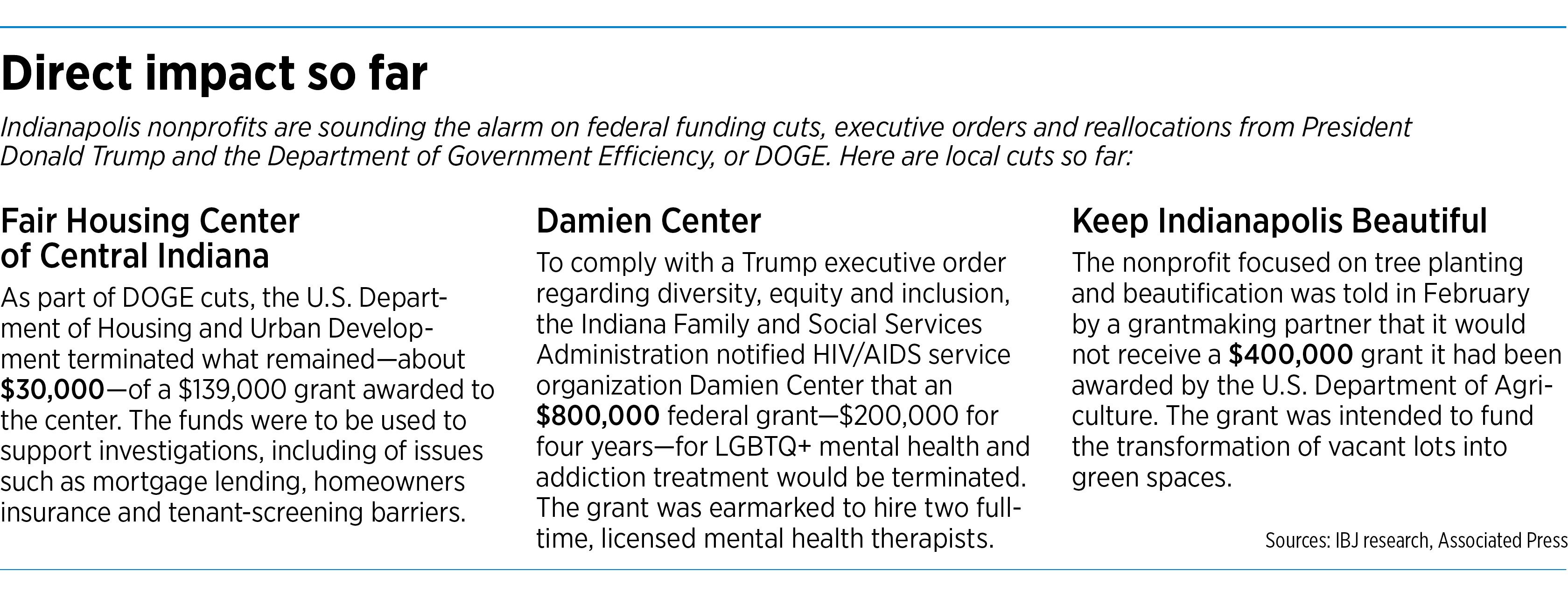
There’s no direct sign that the program is in trouble. But the Trump administration pulled an $800,000 federal grant intended for counseling. That funding was administered through Indiana’s Division of Mental Health and Addiction within the Family and Social Services Administration.

The funding was to be distributed in $200,000 annual increments for four years and was earmarked to hire two full-time, licensed mental health therapists. Damien Center CEO Alan Witchey said those employees were never hired.
He called it a scary time for organizations like his. Additionally, he said, there are still questions about what exactly qualifies as a diversity, equity and inclusion program.
“If people of color are more predominantly experiencing a lack of food, and we promote our food program to people of color, is that prohibited?” he said.
Rachel Scott, CEO of domestic violence housing organization Coburn Place, expressed similar thoughts.
“The administration seems to be telling us, ‘You can’t have specific strategies that help each group be successful, and you also can’t train your staff on how to understand the various populations you’re serving,’” Scott told IBJ. “That feels like undue interference.”
Corburn Place is the largest domestic violence housing organization in Indianapolis, housing 55 families. Scott said the organization provides one or two years of transitional housing for survivors of domestic violence, during which time they can process their trauma.
Scott said that in a typical year, Coburn Place staff would be focused on applying for grants from the U.S. Department of Justice’s Office on Violence Against Women. Instead, those opportunities have been rescinded, meaning Coburn Place might not receive the $2.6 million it says it needs to continue essential housing programs.
“Coburn Place enjoys great community support,” Scott said. “But, you know, getting another $2.6 million out of a supportive community is going to be a challenge.”•
Please enable JavaScript to view this content.
Lol remember when Trump said he would lower housing costs? Turns out that was a lie.
Right, like the war in Ukraine was supposed to be resolved within 24 hours after he returned to office. Do you remember that one? Now, it’s been thousands of hours since he took office and nothing has changed.
I think it’s safe to assume the opposite of the President’s promises. Lower housing cost? No, increasing housing costs due to tariffs on Canadian lumber, cement, and steel.
And now copper too. Every wire in every house is copper…
“Prices will come down,” Trump told voters during a speech (Aug. 2024) laying out his vision for a return to the White House. “You just watch: They’ll come down, and they’ll come down fast, not only with insurance, with everything.”
Everything on the campaign trail was fugazi.
Have you covered how many have been laid off at IHCDA as well?
And voters believed it. There were never any plans (saying there were concepts of plans provides too much credit) and exaggerations about the border to distract from other issues.