
Subscriber Benefit
As a subscriber you can listen to articles at work, in the car, or while you work out. Subscribe Now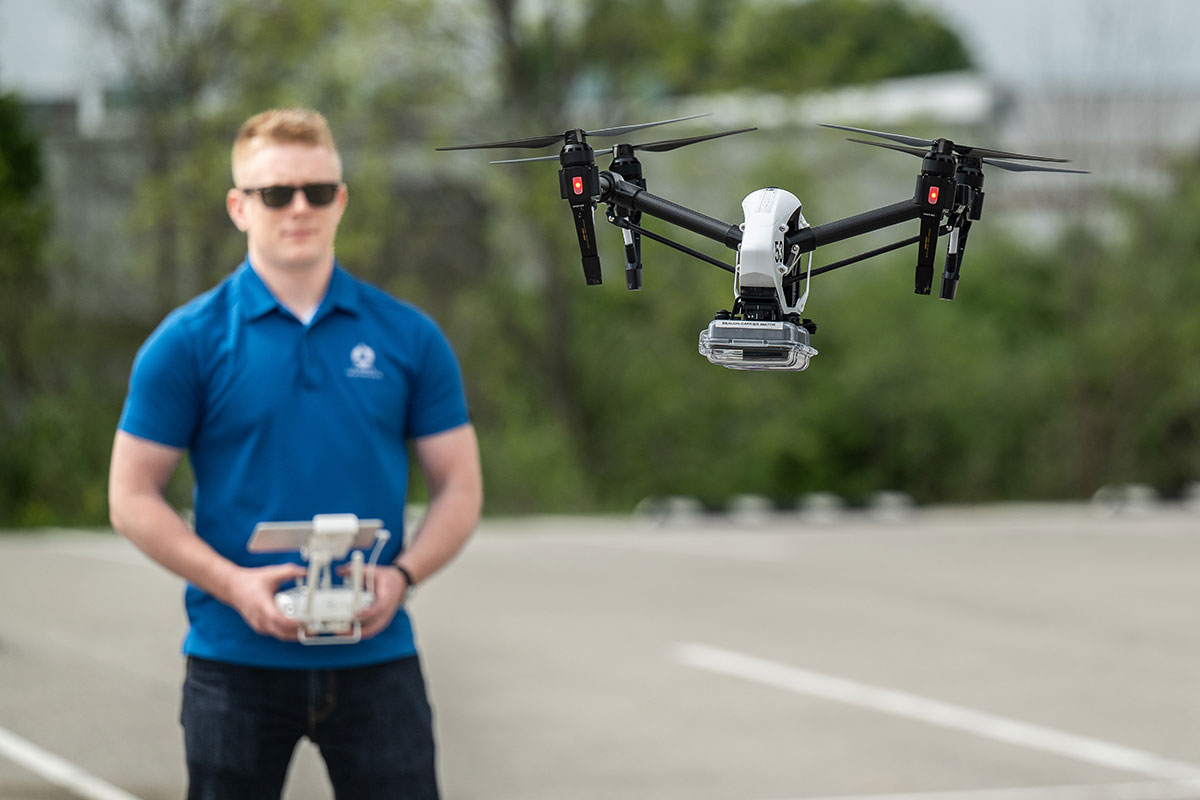
It’s easy to imagine that a startup in an emerging field might be wary of pending federal regulations that will directly impact it.
For Fishers-based Pierce Aerospace, it’s precisely the opposite.
Launched in 2016, Pierce Aerospace has developed technology that allows government and commercial users to detect, track and identify drones. The company offers two types of products: remote ID beacons that affix to a drone and signal its identification and location information, and sensors that can detect those beacon signals.
The company’s technology allows airport officials, law enforcement agencies or stadium security personnel, for instance, to better monitor their airspace by identifying and tracking overhead drones.
The company has achieved some notable successes, including landing a $10 million federal contract earlier this year, being honored as Tech Innovation Team of the Year in TechPoint’s 2024 Mira Awards program, and testing its technology during the 2023 Super Bowl.
The company sees even bigger opportunities ahead once the Federal Aviation Administration issues its “beyond visual line of sight” rules for unmanned aircraft systems such as drones.
The regulations, which are still going through the public rulemaking process, would spell out requirements for drone flight on routes that extend beyond the operator’s sight line—opening the door for widespread use of drone-powered parcel delivery and other commercial uses.
Currently, users must secure waivers on a case-by-case basis to be allowed to fly drones beyond the operator’s sight line. The new regulations would create a standard set of requirements for beyond-visual-line-of-sight drone flight, eliminating the need for individual approvals.
“That is an incredible piece of regulation that’s really going to open up the skies for a lot of this activity,” Pierce said. “We’re very excited about it.”
These pending regulations, which are also sometimes called Part 108 because of where they would fit into federal code, have been in the works for years. Earlier this year, Commercial Drone Alliance Executive Director Lisa Ellman publicly urged President Donald Trump to expedite the issuance of the rule “and remove the bureaucratic red tape inhibiting drone technology in America.”
Pierce Aerospace is not focusing all its efforts on commercial customers, however—its customer base also includes a mix of government and defense users.
In January, the company landed a $10 million contract as a subcontractor to Virginia-based government contractor Amentum. Under the subcontract, Pierce Aerospace will deploy its technology to locations, departments and agencies that fall under the U.S. Department of Homeland Security.
Pierce Aerospace is also part of a five-member team that includes Indianapolis-based product development firm Glassboard, which was awarded a SeaPort NxG prime contract from the U.S. Navy in February. The multiyear contract is valued at $50 billion.
And in April, Pierce Aerospace announced it was working with San Francisco-based Skylark Labs to provide drone-detecting technology along the U.S.-Mexico border.
“We’re absolutely dual use—meaning that we’ve got civilian and commercial applications, and we have security and defense applications,” Pierce said.

That versatility is a key advantage for Pierce Aerospace, said Colorado-based entrepreneur and investor Jonathan Fentzke.
“Pierce has built solutions that can essentially serve multiple markets simultaneously, which is very unique,” Fentzke said.
Pierce and Fentzke met when Pierce Aerospace was one of the startups chosen to participate in the 2021 cohort of the Techstars Space Accelerator program. Fentzke was managing director of the Los Angeles-based program that year, and he and Pierce have remained in touch since then.
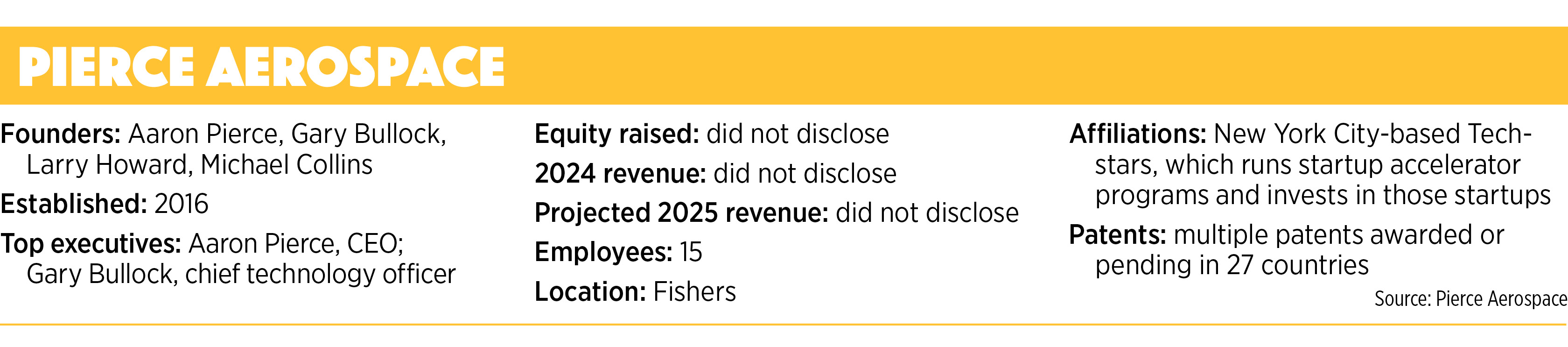
Pierce, who studied English and creative writing at IUPUI (now Indiana University Indianapolis), went on to earn a master’s degree in geography. It was his graduate studies in remote sensing and geographic information systems, or GIS, that led him to establish Pierce Aerospace.
Pierce said he saw an opportunity to get in on the ground floor of the emerging drone industry. “I wanted to dive in and really kind of investigate and look for the really hard problems and then get to work and see what happens.”
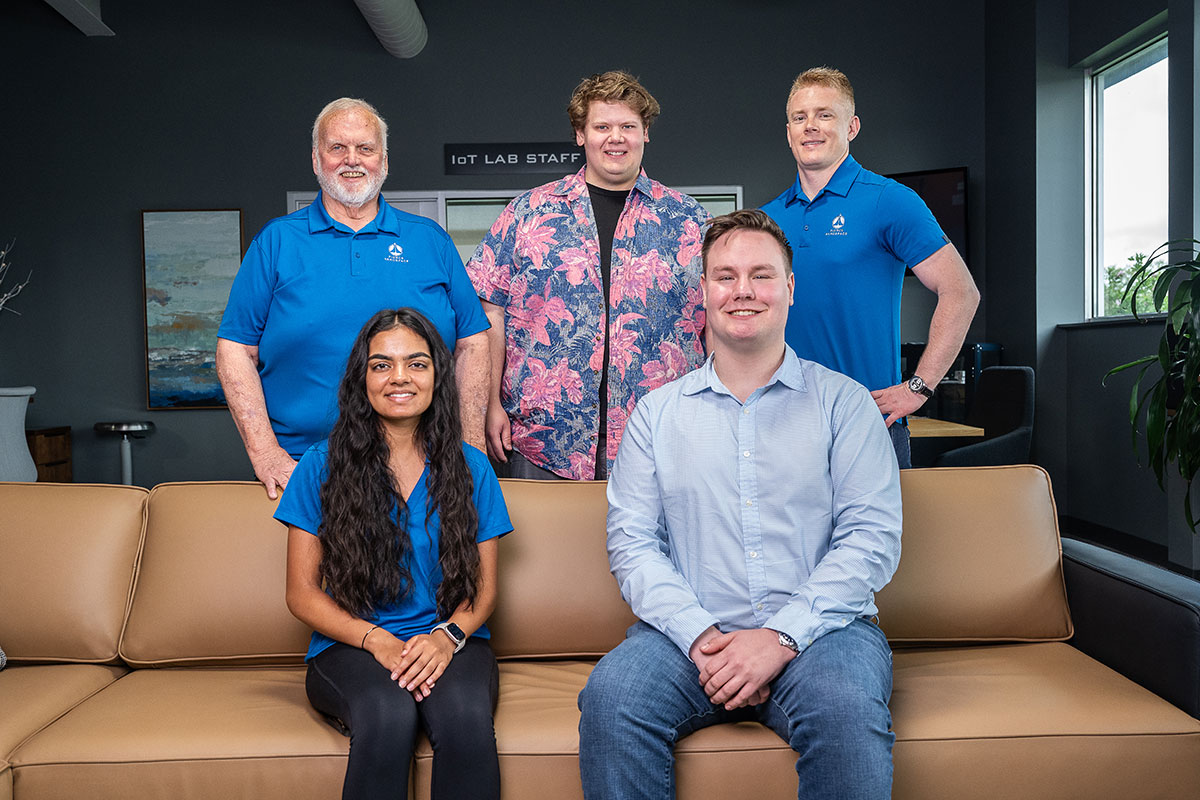
Through an organization called the Association of Uncrewed Vehicle Systems International, Pierce met Gary Bullock, an engineer who had a few years earlier retired from a civilian job at the Naval Surface Warfare Center at Crane.
Pierce brought Bullock on as a co-founder and chief technology officer at Pierce Aerospace.
The company also went on to add two other co-founders: Larry Howard, an engineer who had also worked at NSWC Crane; and Michael Collins, a self-taught engineer who joined the company just a few months after graduating in 2019 from Danville Community High School.
Pierce Aerospace is not the only company developing technology that can locate and track drones.
But Pierce said he believes his company was the first to launch, giving it a jump-start on the competition. The company has multiple patents awarded or pending in 27 countries, Pierce said.
Another differentiator for the company, Fentzke said, is that Pierce’s understanding of federal policy rivals that of policy wonks on Capitol Hill. “Most people that aren’t within 50 miles of the White House don’t talk like he talks or think like he thinks.”
And in the heavily regulated aviation and aerospace industries, he said, someone with that level of understanding has a big advantage.
Fentzke said he views Pierce Aerospace’s technology as a critical component of creating “highways in the sky” for drones. Just as traffic signs and stoplights enable the safe and coordinated movement of traffic on the nation’s highways, Fentzke said, so will drone-locating and drone-tracking technology allow drones to safely navigate the skies.
“You need companies like Pierce Aerospace; otherwise, it doesn’t function properly,” Fentzke said. “Having traffic signals and stop signs and yield and all the rules that we have on the roads, those need to be enforceable in the skies, as well. And that’s really what Pierce is helping usher in.”•
Please enable JavaScript to view this content.
Editor's note: You can comment on IBJ stories by signing in to your IBJ account. If you have not registered, please sign up for a free account now. Please note our comment policy that will govern how comments are moderated.