
Subscriber Benefit
As a subscriber you can listen to articles at work, in the car, or while you work out. Subscribe NowNearly six months ago, a law firm made a series of recommendations to the City-County Council aimed at making the city of Indianapolis a safer and better operation for its employees. Yet, few of those recommendations have been implemented, including one that would create a general inspector position or a human resources board to independently investigate employee allegations of wrongdoing.
Following an incident in which Mayor Joe Hogsett ignored the advice of the city-county’s human resources director—a position he oversees—to immediately fire his then-chief of staff for having a personal relationship with a subordinate, a working group of councilors agrees the administration needs a new way to handle internal harassment complaints.

“We need to do something in the end where the buck does not stop at the mayor’s desk,” Councilor Dan Boots, a Democrat leading a six-member bipartisan working group, said of its goal.
The working group consists of Democrats Boots, Brienne Delaney, Andy Nielsen and Jessica McCormick and Republicans Michael-Paul Hart and Joshua Bain. It meets in private weekly and is the most recent initiative in a long string of council actions taken since the summer of 2024. That’s when the mayor’s former chief of staff, Thomas Cook, was publicly accused in media reports of sexual harassment by three women.
A council investigative committee created to look into those allegations authorized Chicago-based employment law firm Fisher Phillips to conduct an investigation and make recommendations based on its findings. Ultimately, the report released in late May cost $450,000 between the council’s costs and additional legal help at the Mayor’s Office.
It found the administration’s response complied with law and did not violate city-county policy. But it recommended some reforms to councilors, including establishing an inspector general or a human resources board.
Councilors haven’t rushed to implement any of the Fisher Phillips recommendations.
And although human resources or personnel boards are common in both cities and counties nationwide, councilors and an attorney for the administration say that under such governance public records laws could compromise the privacy of human resources complaints and therefore employees’ trust.
Additionally, Boots said the council is “not motivated to jump into another expensive endeavor” after the cost of the initial investigation. He also cast doubt on the specificity and depth of the report.
“I don’t believe they did a deep enough analysis of our structure and necessarily fashioned their recommendations to fit our model specifically,” he told IBJ.
Now, Boots’ working group has to determine what recommendations to implement and with whom to consult on them, in what he said will likely be a long process for the part-time councilors who often have day jobs.
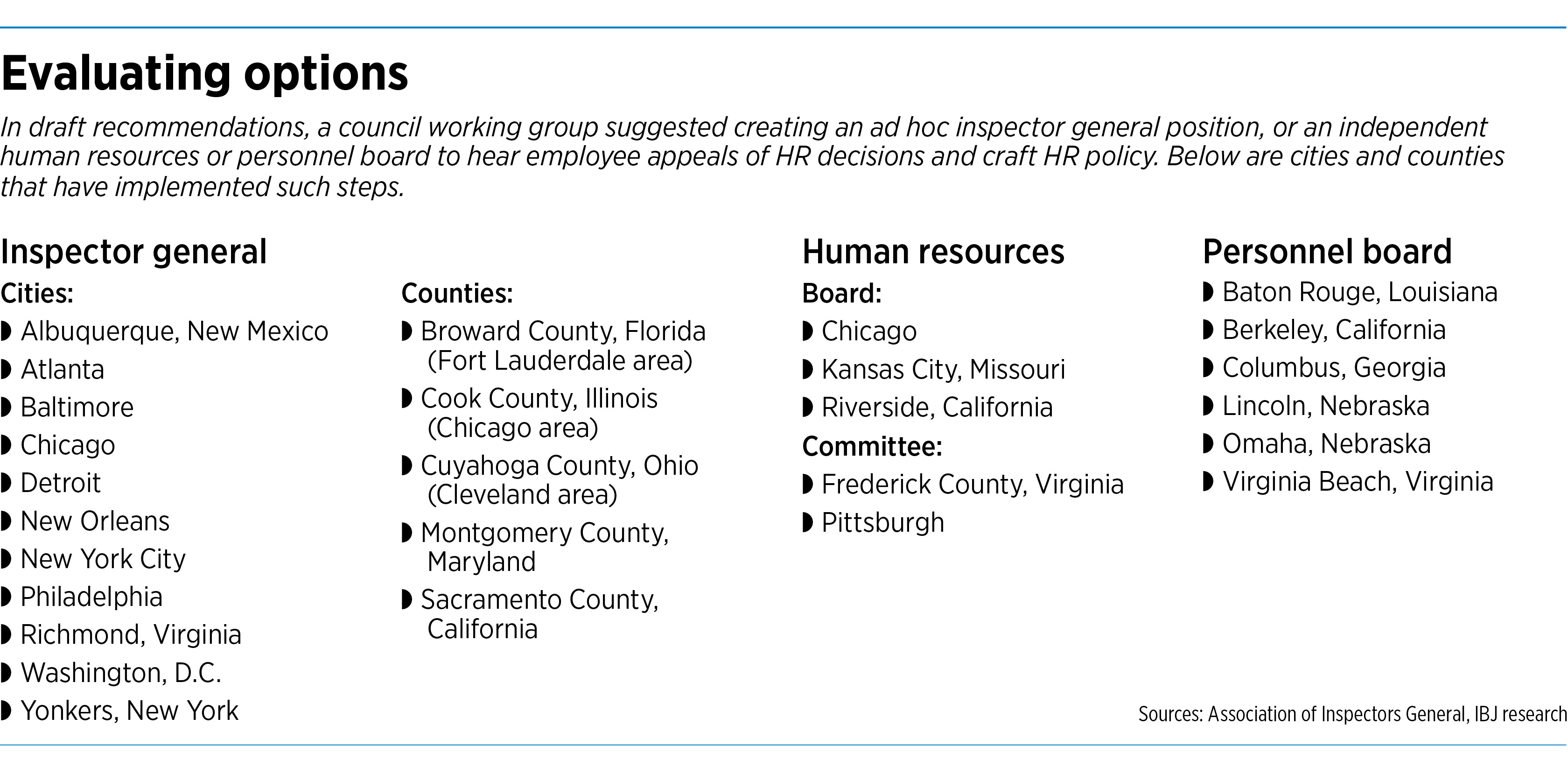
Contemplating an HR board
Of the primary recommendations presented at the end of Fisher Phillips’ 55-page report—creating an office of the inspector general and/or an independent human resources board—the latter might be more cost-effective.
The law firm recommends the Human Resources Division be removed from the city’s Office of Finance and Management and housed instead in an independent human resources board. It suggests that this could look similar to the city’s existing information technology board.
“Independent,” as Fisher Phillips frames it, means the board would be separate from elected and appointed officials “in terms of its overall operations,” but the members would still be appointed by the mayor and council. In Fisher Phillips’ suggestions, six board members would be city staff and county elected officials.
The board would be required to include the Marion County assessor and two people with senior management experience overseeing the HR operations for a private entity or another municipality.
At the Oct. 28 Rules and Public Policy meeting—during which councilors brought in experts to discuss their options—the discussion got stuck on how to implement a structure that is not costly and protects employee privacy.
Brandon Beeler, the city’s attorney, told councilors he had evaluated inspector general models used by other cities. He said the administration’s position at this stage is that neither option would work.
“Witnesses, survivors or complainants have the right not to be identified should they not want to be identified,” Beeler said. “To turn something to another board would make investigatory material public record. So it seemed to not strike that balance, and we haven’t figured out a way at this point to do that.”
When IBJ asked a spokesperson from the Mayor’s Office for more information, she said Beeler was out of the office and wouldn’t return by IBJ’s deadline.
Figuring it out

Morgan Mickelson led the city’s Office of Sustainability for three years until she left in September 2024. She testified at the Oct. 28 meeting that human resources failed to act when she reported her own experiences with inappropriate behavior within the administration.
She said the city must find middle ground to allow more input into how personnel complaints are handled but not expose individuals who wish to remain anonymous.
“It is a legitimate concern that the employees that do not want to be identified may be identified through this process. However, there should be a solution for that. I’m sure we can figure it out. We are smart people,” Mickelson said. She said if councilors accept that “our hands are tied” on the issue, “the Hogsett administration gets to use its workers as a shield for not releasing this information.”
Other cities have figured out a way to implement human resources or personnel boards that still guard private employee information. These include Chicago; Kansas City, Missouri; Omaha and Lincoln, Nebraska; Baton Rouge, Louisiana; and Berkeley, California.
In Chicago, which has had an HR board since 1979, the board takes on employee appeals of disciplinary action. When the mayor or commissioner of human resources requests the board’s advice, it may give recommendations on all aspects of public personnel administration, including employee grievances and employee training, according to a city of Chicago website about the board.
Seung Lee, a communications specialist with the city of Berkeley, told IBJ that personnel boards are common in California municipalities. Lee said Berkeley’s operates as an advisory and quasi-judicial body that provides recommendations on certain personnel matters, like civil service rules, classification and compensation recommendations, and employee appeals related to disciplinary actions.
According to the Berkeley code creating the body, the nine-member board also is charged with investigating and assisting in complaints of personnel rule violations for employees not represented by a union.
Lee said in an email that matters involving employee privacy—such as disciplinary appeals or personnel records—are protected under California laws regarding closed session discussions.
Indiana, too, has provisions for government bodies to hold closed sessions when employee privacy is in question. Even the information technology board, which Fisher Phillips suggests the city’s HR board might replicate, has that power.

Indiana’s Open Door Law, which grants public access to most government meetings, allows government bodies to hold closed meetings to discuss alleged misconduct by an employee. Steve Key, retired executive director and general counsel for the Hoosier State Press Association, said the law allows a board to meet privately to discuss a course of action—suspension, a letter of reprimand or termination, for example.
But Key said the law requires any action to be taken in a public meeting.
“You can’t have secret firings,” he said.
Key said Indiana’s Access to Public Records Act also protects materials discussed in these closed sessions, including investigatory records or personnel files. And it allows local governments to refuse to disclose work that is the product of an attorney, which often protects investigatory records from becoming public.
Inspector general option
Longtime public investigator Isabel Cumming, who is inspector general for the city of Baltimore, called it shocking that a city the size of Indianapolis doesn’t have an inspector general.
Inspectors general aim to eliminate waste, fraud, abuse and mismanagement or violations of the law by investigating complaints and conducting audits. They come to findings, identify remedial options and provide recommendations to decision-makers.
Cumming also serves on the board of the Association of Inspectors General, a nonprofit and nonpartisan organization that supports state and local offices and provides training.
She estimated that her Baltimore office receives 1,000 complaints a year, has conducted more than 200 investigations and identified more than $7 million in potential savings for 2025.
Those investigations are confidential until the office opts to release public findings. An independent advisory board—which Cumming fought to establish—determines whether her work has been sufficient to earn another term but does not receive information on ongoing investigations.
According to Fisher Phillips, an inspector general for Indianapolis could have jurisdiction over all offices—elected and appointed—employees and others having or desiring a business relationship with the administration. It recommended an inspector general structure like the city of Chicago’s or the office separately established in Cook County, which includes Chicago.
Fisher Phillips also presented the option of creating a temporary ad hoc inspector general to deal with a specific complaint or a specific type of complaint. But Cumming cautioned against that idea. She called it foolish to believe that a single investigation could root out fraud or abuse.
Another expert agreed.

Mark Levin, an Indiana University instructor on local government and an International City/County Management Association member, said the work of an ad hoc inspector general likely wouldn’t be much different from the work done by Fisher Phillips—it would involve an attorney or a law firm conducting an investigation into a complaint and presenting findings.
It’s not uncommon for a mayor to have significant authority over all functions of the executive branch, including personnel matters, he told IBJ. It’s also not uncommon for a legislative branch—like the City-County Council—to try to control the executive branch’s action.
But creating a third-party oversight for HR would be “a very expensive system,” Levin said, while the issue at hand really comes down to the council’s lack of trust in the mayor.
“That starts with the mayor, or the head of any organization. The head of the organization has to establish, maintain and model ethical behavior,” he said.•
Please enable JavaScript to view this content.
Editor's note: You can comment on IBJ stories by signing in to your IBJ account. If you have not registered, please sign up for a free account now. Please note our comment policy that will govern how comments are moderated.