
Subscriber Benefit
As a subscriber you can listen to articles at work, in the car, or while you work out. Subscribe NowWhen she’s helping people with cybersecurity, Chetrice Romero likes to keep things low-tech.
It’s not that she doesn’t know the technical side of things. It’s that she sees cybersecurity as more of a people-focused and organizational issue than a straight technology issue.
“I really try hard to keep it very human,” Romero said.
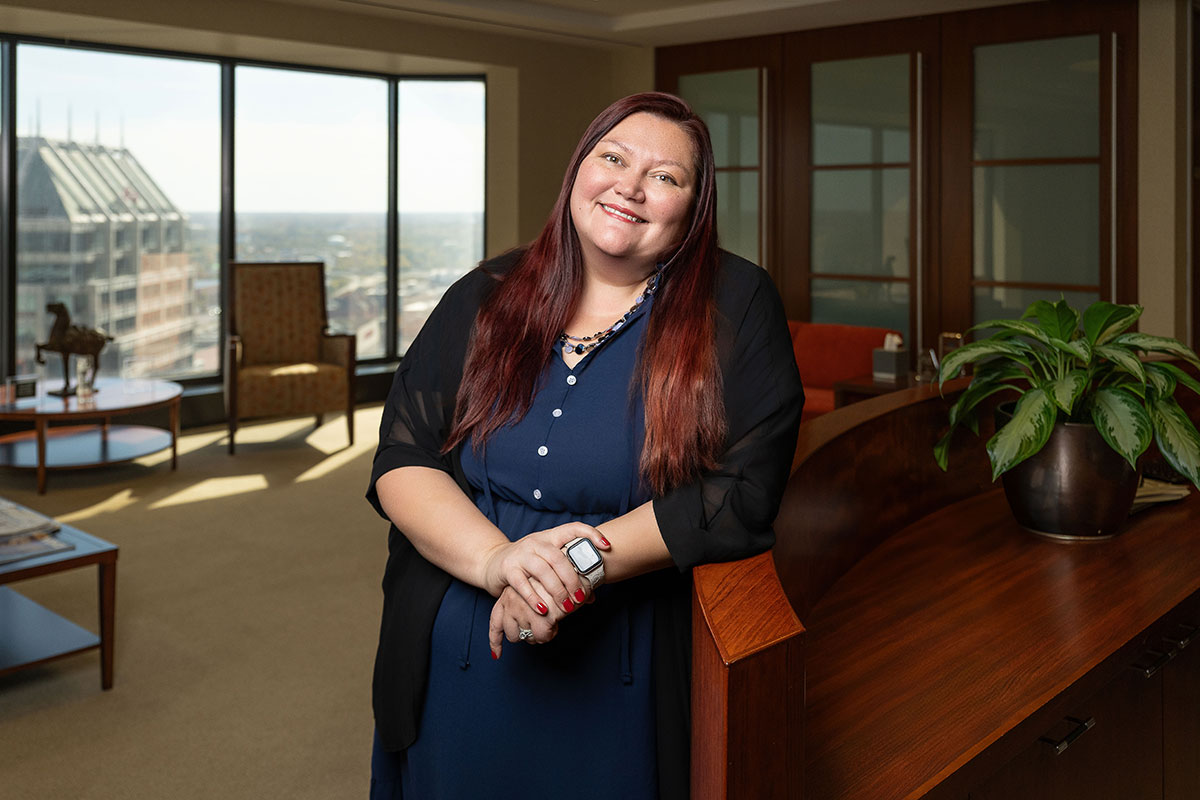
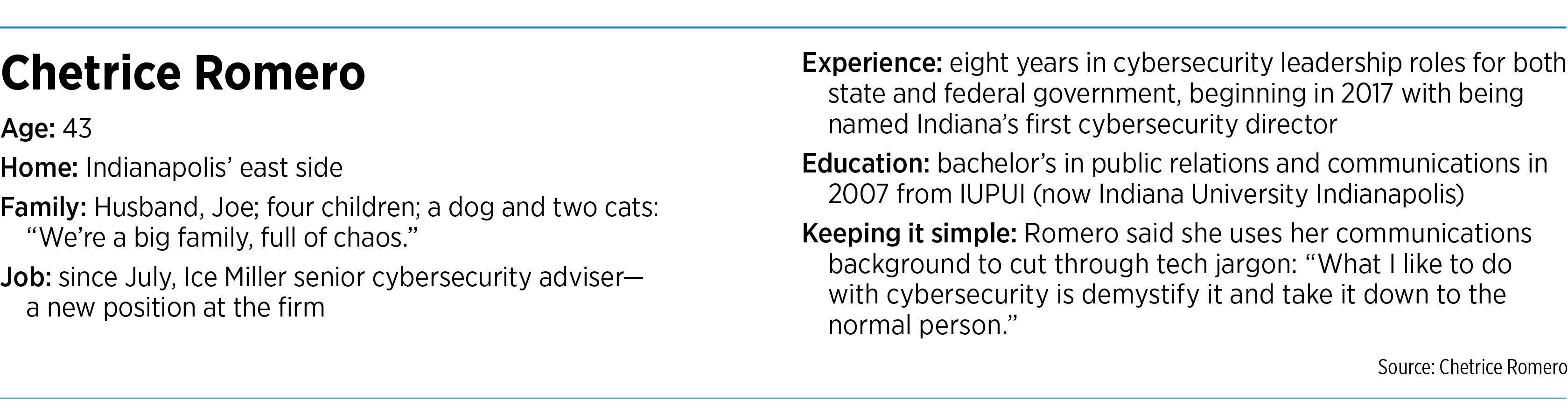
In July, the law firm Ice Miller LLP hired her as its senior cybersecurity adviser—a newly created role in which she works with the firm’s clients to help them with cybersecurity concerns that fall outside an attorney’s area of expertise.
Before joining Ice Miller, Romero built her career in the public sector, including serving as Indiana’s first-ever cybersecurity program director from 2017 to 2023. After leaving that job, she moved on to a similar one with the U.S. Department of Homeland Security’s Cybersecurity and Infrastructure Agency, or CISA.
Romero’s human-centered approach to cybersecurity involves meeting people where they are and explaining things in a way that resonates with them, she said. As an example, Romero once helped a fire station improve its cybersecurity practices. The station had one computer that all the firefighters used, with a password they never changed.
Romero said the fire chief told her changing passwords every 90 days as she recommended would be too much of a hassle. So Romero suggested coming up with a group of new passwords based on the station’s inside jokes. Every three months, the station could roll out a new password—one that outsiders would not be able to guess.
“They started that week, and they’ve been doing it ever since,” Romero said. “And now [the fire chief] is a big champion. He’s like, ‘Well, if that’s cybersecurity, I can get behind that.’”
Romero sat down with IBJ recently to talk about her career path, how cybersecurity led her to emergency response work and about the life-changing experience of working with a federal disaster team at the site of the Surfside condo collapse in Florida four years ago.
This interview has been edited for length and clarity.
You studied public relations and communications in college. How did you end up as a cybersecurity expert?
When I was at the Indiana Utility Regulatory Commission, I was the external affairs director. … That was part of my portfolio, disaster and emergency response. And so cybersecurity has become even more important in the utility realm, and more so around that time that I started at the IURC because that was a time that Russia had attacked Ukraine’s energy [infrastructure]. … It freaked everybody over here out, because [Ukraine’s] energy structure is similar to ours, so it’s like, “If Russia can do it to them, then how vulnerable are we?” So federal regulations came down to energy companies saying, “You have to lock everything down. Everybody has to be at the same high level of cybersecurity.” When that started coming out, I was involved in the education and the understanding of that and special projects. And honestly, once I got involved in it, I was just hooked. I was like, “Oh my gosh, this is so complex. Normal people aren’t going to understand this. Small utilities aren’t going to understand this.” And I think maybe because of my public relations background, I was just intrigued at being a part of a field where it needed probably more PR people than tech people.
So you saw cybersecurity as a professional challenge?
Yeah. And so much of my background in the state government was trying to kind of take things down to the basics so that we can communicate with media, we can communicate with the general public, we can educate. … I’m not technical at all, but I was able to really pick up a lot of things. … I can talk “executive.” I can speak to the public … and I can also speak the tech language, So I think that that combination has allowed me to really grow quickly in this industry, even though I only came into it 10 years ago.
When you think about the broad landscape of cybersecurity threats, what’s your biggest concern right now? Who or what poses the biggest threat?
The two things that kind of worry me the most for people—and their lack of preparedness for it—is China. … They know quite a bit on how to technically get around things and how to get into very critical systems and how to stay there and not be seen, and those things concern me a lot. And I think the second one is artificial intelligence. Now, I’m a big believer that AI is like a double-edged sword. I’m not one of those people who think AI is the devil. But I do think as much as people are using it for good, there are people who are using it for bad, too. … AI is an open model, and it is very knowledgeable and takes things from all over the place. … You no longer need to be a sophisticated bad actor. You just need to be a bad actor who’s willing to learn from a technology that will tell you everything [about how to perpetrate a cyberattack]. And I think that shift is very scary.
Thinking about cybersecurity threats can seem really intimidating—what’s one thing people can do to protect themselves, especially if they don’t know much about technology?
I’ve talked to my mom. I’m like, “Hey, I have a lot of videos out there. AI can easily create something that sounds just like me.” So [she] and I have a secret word that we both only know. It’s not written anywhere or anything. So I said, “If I call you, and I’m asking for money, or I’m saying things that don’t make sense, ask me for the word—and if I don’t have that word, then it’s not me.”
That’s smart! And it’s low-tech.
It’s low-tech, and it’s a people process. And those are things that I would also advise board members and leadership and people who are controlling the money to do. For those business email compromise situations where somebody sounds just like the CEO saying, “Hey, I need you to move millions of dollars to this account right now,” well, that’s the person who signs my check. That’s the person who can authorize that kind of move. It sounds just like him or her. And so why would I not do it? But now, if you use a low-tech process saying, “What’s your word?” now you’ve gotten around these very malicious-intended people who are using us against us.
Moving to a different subject: You were part of a Federal Emergency Management Agency team that deployed to the site of the Surfside, Florida, condo collapse in June 2021. You were actually searching the rubble for objects that could help pinpoint where to look for victims. How did you come to be involved in this effort?
When I was at the IURC, Indiana’s Emergency Operations Center [was part of] my portfolio … of being able to be a resource to them. … That was a very serious responsibility I took on, and I wanted to take that seriously, so I did a lot of emergency management training so I could be best prepared if the bad day ever came. I had been part of it for many years, training, getting ready for that call. And then that call came, and it was Surfside. And it was life-changing. It was a very difficult deployment. … I got on the [rubble] pile; we’re starting to collect things. The first personal thing [I found] was a baby book, and it was the exact same baby book as I used for my son. Boy—that still gets to me.
You used the word “transformative” to describe the impact the Surfside experience had on you. Can you give an example of what you mean by that?
I just remember coming across this really long to-do list [amid the rubble], and this person [who made the list] didn’t survive. This [disaster] happened in the middle of the night, while they were sleeping. And so I think that kind of hit me. I always say I’m a recovering Type A-plus person. I feel like [now] I’m a B-plus, A-minus, depending on the day. Because I used to list everything. Everything had to be on a list. When I got back [from the Surfside deployment], I just realized: So much effort we put into these things, and life is short, and you never know. How much does putting everything on a list matter? … And I think that that’s what I walked away with was this understanding that life was very short. It literally could end in the middle of the night in your home when you would least expect it. And so I hug my kids. It’s been years, and I still hug them tight every night.
Do you still keep lists?
I keep very high-level lists, only if I’m really overwhelmed—to put things down [in writing]. But I don’t keep lists anymore like I used to. … I’m a planner to the core. So to come back from that and realize: I don’t have to be that way. I can be more present with the people I love and prioritize the activities. Not planning everything but just being present—it’s very good for my family and myself and my relationships.•
Please enable JavaScript to view this content.
Editor's note: You can comment on IBJ stories by signing in to your IBJ account. If you have not registered, please sign up for a free account now. Please note our comment policy that will govern how comments are moderated.