
Subscriber Benefit
As a subscriber you can listen to articles at work, in the car, or while you work out. Subscribe Now The time is now for the Indiana Pacers.
I don’t necessarily mean now now, although considering the Pacers are within reach of their first-ever NBA championship, that would be a blatantly obvious statement.
For the first time in their 50 seasons of existence in the league, it feels like Indiana—the typically underestimated, superstar-starved, free-agent-afterthought franchise—is realistically equipped to make a several-season run at winning the whole thing. That’s a statement that would’ve gotten you laughed out of any room not long ago.
Having a legitimate standout like Tyrese Haliburton, who is having a national coming-out party like we’ve never seen from a pro sports star in Indianapolis, is an obvious prerequisite to be a contender in any era. However, beyond that, the Pacers have the attributes and assets to contend in today’s much more open NBA landscape.
One fact that will forever remain the same in basketball: You need to have a true star to contend for a championship. Regardless of where you choose to rank him—and the arguments about this have gone from tiresome to downright asinine—the Pacers undoubtedly have one in Haliburton. The 25-year-old is fresh off consecutive All-NBA selections, something only three Pacers (Reggie Miller, Jermaine O’Neal and Paul George) have ever accomplished.
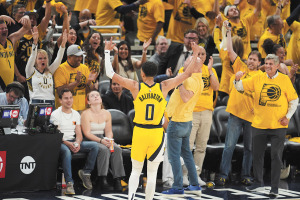
He arguably has a ceiling higher than every member of that trio. Haliburton has already produced a career’s worth of playoff highlights in this postseason alone, scoring memorable game-winning or game-tying baskets in all four rounds, which has solidified his star status. Although he continues to lapse into inconsistency, Haliburton can dominate a game without putting up gaudy scoring numbers and has the enviable ability to make the players around him better—two attributes that many stars over the years do not and have not had.
But, in today’s NBA, it’s no longer just about the star.
Kevin Pritchard and company have paired their franchise player with an All-Star-caliber performer in Pascal Siakam. Aaron Nesmith, playing on perhaps the biggest bargain contract in the league right now (he’s easily worth double his $11 million annual salary), and Andrew Nembhard can harass the league’s top scorers and routinely hit big shots in huge moments. Myles Turner is a versatile offensive player that any team would be lucky to have, with the ability to space the floor on one end and to block shots on the other.
Indiana owns an impressive bench as well, with veterans like T.J. McConnell and Obi Toppin (both of whom signed multiyear extensions last offseason) who are perfectly suited for the essential roles they’re asked to play. And they have a batch of capable young reserves (Bennedict Mathurin, Ben Sheppard, Jarace Walker, etc.) behind them.
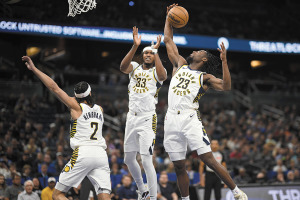
Across the roster, the Pacers have excellent individual shooters and defenders in a league that requires both skills, and their potent and often improvisational offensive attack is extremely difficult to prepare for, much less limit. It’s a group that easily outlasted the thin Bucks, outclassed the Cavs’ heralded depth, and completely frustrated and exhausted the Knicks en route to the championship series.
Not only do the Pacers have the blueprint for success in today’s NBA, they’re executing it in an era when the league has unprecedented parity. A different champion will be crowned for the seventh straight year later this month, which has never happened before in league history. The only stretch that even comes close was 1973-1979, when there were six different champions, including Washington and Seattle. But the NBA was at its nadir. Every other decade of NBA basketball—the Lakers and Celtics in the 1950s, 1960s and 1980s; the Bulls in the 1990s; the Lakers and Spurs in the 2000s; the Warriors and whichever team LeBron James played for in the 2010s—has been dominated by one or two teams.
Shoving big-city and/or dynasty-level teams aside, this new era of NBA parity has led to a small- and medium-market renaissance. No longer is San Antonio an anomaly. Franchises like Indiana and Oklahoma City, as well as Denver, Milwaukee and even the historically woebegone Minnesota Timberwolves, have surged into title contention recently. Breakthrough championships have come for the Bucks (2021) and Nuggets (2023), franchises where an NBA title would have been unfathomable just a decade ago—and both have remained perennial playoff teams.
Many fans in these modest markets can legitimately believe in their team winning an NBA championship, which wasn’t the case throughout most of the league’s history.
Each Pacers player coach Rick Carlisle puts on the floor, from Haliburton to sporadically used Tony Bradley, contributes and has a purpose. You can say the exact same for the Thunder, which routinely deploys nine or 10 players to execute its suffocating defensive scheme. It’s a far cry from the super-team era that dominated most of the previous four decades of the NBA, where two (or even three) megastars got teams to the promised land.
The Pacers never had such a team, causing every blue-and-gold contender to fall short. The 2012-2014 teams had a rising Paul George but were unable to extinguish Miami’s big three of LeBron, Dwyane Wade and Chris Bosh at the apex of their power. Same for the loaded 1998 and 2000 Pacers teams, who had impressive cohesion and depth, but couldn’t quite get over the hump against the likes of Michael Jordan, Scottie Pippen, Shaquille O’Neal and Kobe Bryant.
That era in the league is over. Top-heavy NBA rosters have routinely failed over the past few seasons. Remember the Kevin Durant, James Harden and Kyrie Irving experiment in Brooklyn? Yikes. For more recent examples, you can look at Luka Doncic’s and LeBron’s first-round flameout in LA or the smoldering disaster that was the Phoenix Suns “big three.” Heck, even New York, which pushed in its chips with Karl-Anthony Towns and actually found some success with an outstanding starting five, couldn’t get past the conference finals ceiling with such a short bench.
As stated above, in order to truly contend for a championship, you still need The Guy, and perhaps even a complementary star (a role Siakam nicely fits). But you definitely need an elite-level cast of role players.
The Pacers have all those things and are thriving in an era where the sum of your parts, not the sum of the top end of your payroll, is being rewarded like never before.
An incredible opportunity still awaits Indiana over the coming days, but regardless of this year’s result, these Pacers could be at the championship doorstep for several years to come.•
__________
From Peyton Manning’s peak with the Colts to the Pacers’ most recent roster makeover, Schultz has talked about it all as a sports personality in Indianapolis for more than 15 years. Besides his written work with IBJ, he’s active in podcasting and show hosting. You can follow him on X @Schultz975.
Please enable JavaScript to view this content.
Editor's note: You can comment on IBJ stories by signing in to your IBJ account. If you have not registered, please sign up for a free account now. Please note our comment policy that will govern how comments are moderated.