
Subscriber Benefit
As a subscriber you can listen to articles at work, in the car, or while you work out. Subscribe Now
Abigail Griebelbauer is a newer Indiana Fever fan—one who came aboard during the hubbub of Caitlin Clark being drafted at No. 1 overall in 2024.
After attending every home game last season using single-game tickets, Griebelbauer put down a $50 deposit to join the 2025 season-ticket waitlist. She wasn’t alone. Demand for season tickets has continued to rise on the heels of Clark’s record-breaking season and the Fever’s first playoff appearance in eight years—and so, too, have ticket prices.

But Griebelbauer thought if she could just secure the entry-level season tickets at $50 per game—up from $40 in 2024 and $32 in 2023—it would be worth it because she’d have better seats than her balcony views last year, and she wouldn’t have to rely on the unpredictability of buying seats per game.
Still, she knew it was a long shot. The franchise in January shared that ticket demand was intense. Then in late March, Griebelbauer learned the Fever had officially sold out of season tickets before she’d had a chance to buy.
Even so, she plans to attend as many games as she can to follow the overhauled Fever franchise—and Clark, in particular, whom she began watching during the player’s junior year at the University of Iowa.
“Seeing the amount of people at the games and just how far out you have to buy tickets now really shows the demand for getting to these games, so it’s not a surprise,” she said. “Even last season, it was crazy to see all the signs that said things like, ‘I flew from Australia’ or ‘I drove hundreds of miles’ to be at these games. It really puts in perspective what we’ve got here. I think that excitement is definitely going to continue this season.”
In fact, Indiana Fever games have become arguably the hottest tickets in town, and experts say demand will likely continue to increase with the offseason team rebuild.
The Fever kept several core players—including Clark, Aliyah Boston, Kelsey Mitchell and Lexie Hull. Then through trades and free agency, team management added several high-caliber players, including DeWanna Bonner (six-time WNBA All-Star), Natasha Howard (two-time WNBA All-Star and three-time WNBA champion) and Sydney Colson (two-time WNBA champion).

The team also hired former Fever player and coach Stephanie White, a legendary Indiana high school player, as head coach. And the team’s front office also had an overhaul, with Kelly Krauskopf coming back as president after six years with the Indiana Pacers and Amber Cox joining as general manager.
Additionally, team owner Pacers Sports & Entertainment this year announced plans for a $70 million training facility for the Fever, to open in 2027, on a portion of the former Marion County Jail property near Gainbridge Fieldhouse.
‘Many of them will pay’
But all of that investment combined with ticket demand means the Fever are requiring a higher investment from fans.
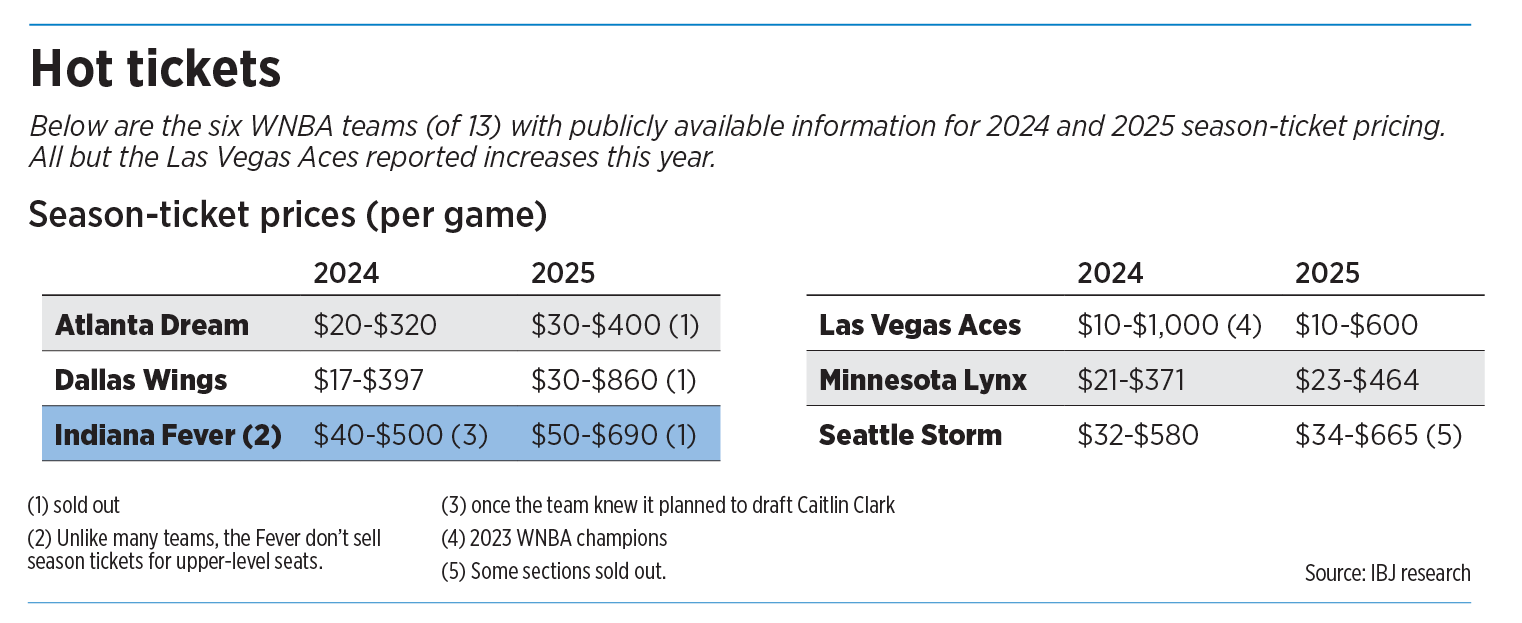
Season tickets range from $50 per game for a seat in the top row of the middle section to $690 for courtside seats that are part of what’s called the Hollywood package and aren’t generally available to the public.
The courtside ticket is up 38% from a year ago. Only six of the 13 WNBA teams make season-ticket information publicly available. Among those, only the Dallas Wings have a courtside ticket price—$860 per game—that is higher than the Fever’s.
Unlike many other teams across the league, the Fever do not sell season tickets for third-tier seats, called balcony sections.

Larry DeGaris, a professor of sports business at Northwestern University, told IBJ increased ticket prices are likely to lead to heartache for some fans who will no longer be able to afford or justify a full season pass. But he predicted that other fans will pay the higher prices, particularly as they see the team investing in its talent, coaching and support systems as well as the game-day experience.
And DeGaris said those who have to give up season tickets or couldn’t get them at all will be trying to buy single-game tickets. Those prices fluctuate by game and demand.
“Most of the fans will gripe and won’t like the increased ticket prices, but many of them will pay,” DeGaris said. “And of course some fans can’t, and that’s one of the drawbacks of the team’s success.”
Griebelbauer said while her biggest barrier to securing tickets was availability rather than price, she understands the concerns some fans have about the increased cost. Still, she doesn’t blame the franchise.
“It makes sense that they would want to make more because there is just more desire for tickets,” she said. “For me, it didn’t change much on my decision [to go after season tickets], because I do feel like they’ve tried to balance between raising prices and not to go to an extreme. That’s just growth, and I think that’s not a bad thing. It’s a good sign for the future to come for women’s sports.”
‘Along for the ride’
Amber Cox is in her first year as chief operating officer and general manager for the Fever after three seasons with the Dallas Wings and stints with several other sports teams and leagues.
She said the Fever organization carefully considers pricing both for season tickets and single games. In particular, the team tries to make sure longtime supporters and season-ticket holders don’t get left out in the cold, Cox said.
“Everybody’s price is going up because the demand is higher, but we are thoughtful about those season-ticket members who have been with us … through the ups and the downs of the team,” she said. “That’s an important piece. We want them to enjoy this along with us as we are growing and new fans are coming out, so the building is packed every night. They certainly deserve to be along for the ride.”

Rachel Isenbarger, 33, has been attending Indiana Fever games since the team launched in 2000, when she was just a kid, and has been a season-ticket holder for eight years.
She and other longtime season-ticket holders told IBJ the franchise has been fair in pricing 2025 renewals, which tend to be less than the price paid by new season-ticket holders. Still, Isenbarger said she’s paying substantially more than she did before the team drafted Boston and Clark.
She said her season-ticket prices jumped by about $100, to $463 for an 18-game season, ahead of last season. She declined to share how much more she’s paying this year.
What’s surprised her more than the price increase has been the boost in demand. She recommended several friends buy season tickets, but they were shut out by a lack of availability or the high prices.
“It was a very, very shocking change for me and some of the other season-ticket holders in my section,” she said. “I had told all my [non-ticketed] friends, ‘This is what I’m paying, and it’s a great, reasonable ticket that’s worth your money.’ Then they’re coming to me like, ‘Whoa, they quoted me something very different from what you pay.’ We were very, very surprised with the change.”
‘They’re trying to do right’

Jud Brown and his friend Jessica Daniel became half-season ticket holders ahead of last season, shortly before the Fever drafted standout Aliyah Boston in 2023. They each paid $250 total for 10 games in seats just a couple of rows behind the Fever bench.
The pair were spared much of a price increase in 2024 but saw a bump to just more than $350 as part of their renewal this year—and moved several rows up. Brown said he considered adding another seat to the package to allow his wife to join for some games, but doing so would have meant moving farther back—or to an entirely different part of the arena.
Even so, the tickets were less than Brown had anticipated.
“I was expecting a bigger increase than what it was, and I think we had some other friends that had their ticket prices go up more,” he said. “I think it’s because we got in when we did, and they’re trying to do right by the people that have been ticket holders a little longer.”
Cox said Fever management keeps a close eye on what other teams across the WNBA are doing with their prices. Of the six teams that advertised season-ticket prices, changes for the best seats fluctuated greatly. Entry-level tickets generally increased about $10.
The Las Vegas Aces did not increase entry-level prices, which are $10 per game. And the team cut the price of its highest-tier seats from $1,000 to $600 per game. The New York Liberty, which won the 2024 championship, have tickets starting at $25 per game for a full-season plan; the team’s full price list is not publicly available.
“We’re taking a lot of things under consideration and trying to be as scientific as we possibly can about it because, at the end of the day, we want the building full and to make sure we’ve got price points for a range of people based on what they can afford,” Cox said. “But we are a business, and we’re in the business of making money, so we need to think about how we can best maximize revenue opportunities, as well.”
Sustained success

Galen Clavio, a sports marketing and media professor at Indiana University, said the Fever’s price increases are a natural response to overwhelming demand.
“I think the Fever [were] probably taken a little off-guard by how much popularity gathered around them so quickly,” he said.
And that’s not just due to on-court action. He noted that Clark has been just as impactful on discussions about the WNBA and women’s sports more broadly.
“It’s hard to price that ahead of time, before she gets on the roster,” Clavio said. “But I think you have to react as a business as soon as you have the opportunity.”
Clavio said the team will need to begin winning consistently to turn new fans—whether they’re season-ticket holders or single-game buyers—into long-term customers.
“It’s a matter of whether [the team] can provide a winning product to pair with that interest,” he said, “because that’s where you get really long, sustained success.”

Jessie Meranda said she purchased a half season of tickets for the lower bowl ahead of the 2024 season because her work and travel schedule made it difficult for her to make use of a 20-game full-season ticket.
This year, she’s paying $1,400 for two seats in the lower part of the arena’s middle section, with the per-game cost working out to about $64. She said she considered looking for spots in the lower bowl, down one section, but the prices there exceeded $100 per ticket per game.
Meranda said she hopes the Fever will continue to find ways to make season tickets affordable and accessible for families with children. After all, she said, the cost of going to a game is more than the price of a ticket; it’s also buying food, drinks and maybe souvenirs.
Isenbarger said the team’s rising fortunes have “changed the market and it changes who can go” to a game.
“Before, you could just walk up and go to a Fever game when you wanted to,” Isenbarger said. “Now, if you’re not buying tickets months in advance, you’re out of luck.”•
Please enable JavaScript to view this content.
Ticket prices are one thing. Fees to buy tickets is outrageous. That’s what needs to be adjusted. No longer family friendly.