
Subscriber Benefit
As a subscriber you can listen to articles at work, in the car, or while you work out. Subscribe Now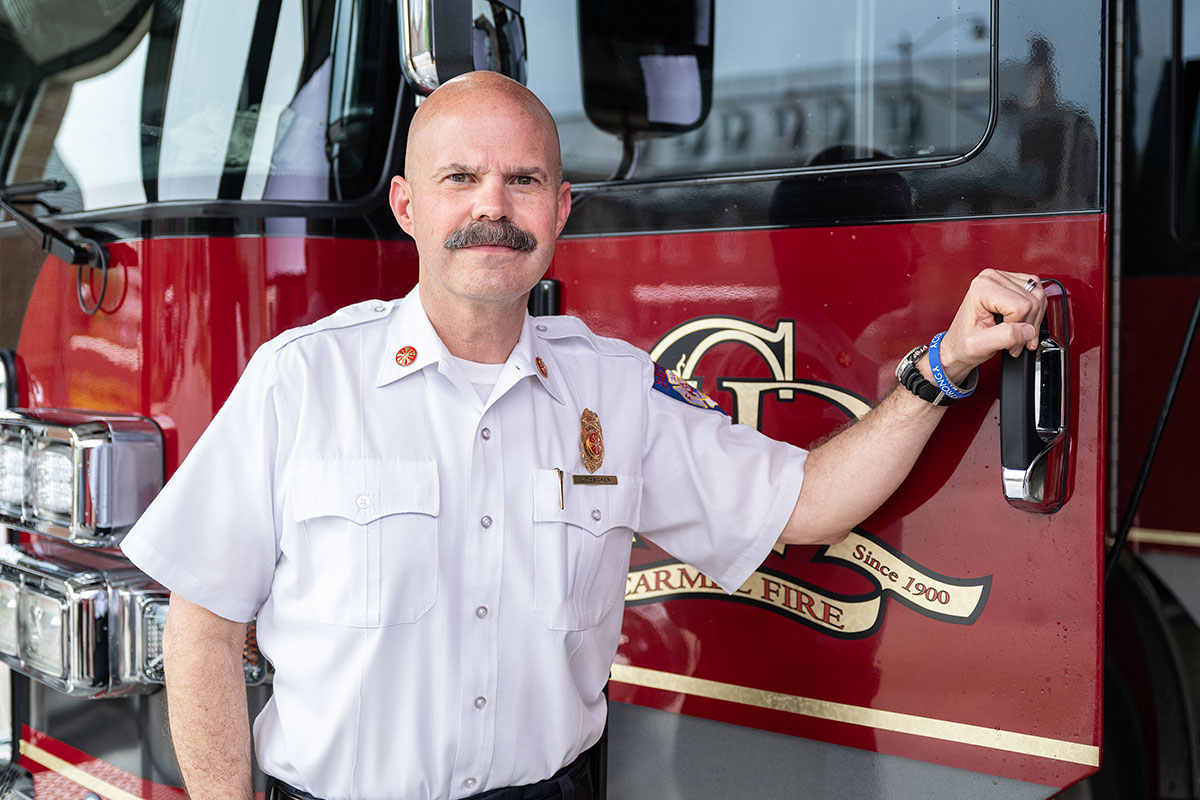
Cities and their fire departments are feeling the strain as post-pandemic wait times and costs for new fire trucks have shot up—due in part to industry consolidation.
Take Carmel, for example. In 2009, the Carmel Fire Department ordered a ladder truck for $990,000 that it received in 15 months. In 2020, it ordered a ladder truck for $1.29 million that it received in 20 months.
Last year, the department placed an order for a ladder truck from Pierce Manufacturing, a subsidiary of Oshkosh, Wisconsin-based Oshkosh Corp. that has sold fire apparatus to several departments across central Indiana. The cost for the new truck: $2.33 million. And the wait time: more than four years.
In total, the Carmel Fire Department has orders out for four trucks—one ladder truck and three fire engines, also known as pumper trucks—with a total cost of $5 million. None are expected to arrive before 2028.
“In just three years, something has significantly changed,” Carmel Fire Department Chief Joel Thacker said. “And in some communities, I think it’s preventing them from purchasing the equipment that they need, and that’s going to negatively impact that community at some point.”
Mayor Sue Finkam said it is now faster to build and staff a new fire station than it is to purchase and receive a new truck.

“If we decided today that we wanted to design and build a fire station, we could probably get it up and operational in conservatively three years and probably under that,” she said. “And, certainly, a year or so to recruit and train and position firefighters in the building. But then we don’t have the apparatus to fill it, and that’s just troubling.”
Most fire trucks are custom-made, bespoke vehicles built to serve the specific needs of individual fire departments.
Fire departments prefer to depend on an engine or ladder truck no longer than 10 to 15 years for active use. Fire engines transport firefighters and carry 500 to 1,000 gallons of water and other equipment; ladder trucks use a 100-foot ladder to reach the upper floors of buildings. After that decade to a decade and a half of active use, trucks are put into reserve use for another five years or so.
However, due to delays in receiving new trucks, departments nationwide are having to depend on those aging, less reliable vehicles. Their replacement parts are also challenging to acquire. The Los Angeles Fire Department struggled to contain wildfires that devastated communities last winter in part due to apparatus shortages, according to multiple reports.
“We’re starting to see issues around the country where trucks are breaking down,” Thacker said. “They’re slowing down on the way to calls, and so that’s increasing response times.”

Fishers Mayor Scott Fadness said delays create a precarious situation for cities, particularly if something happens to a fire truck in active use.
“God forbid you ever get into a situation where your fire truck gets in a car accident and is damaged, and now you’re literally out of that truck,” he said. “Let’s say you total a fire engine. You can’t get a replacement for two years, so there are real, practical implications for that along with just the cost.”
Kevan Crawley, deputy chief of logistics for the Indianapolis Fire Department, said the department has one truck on active use that was produced in 2002 and two others that were made in 2003. IFD has 43 fire engines and 22 ladder trucks in its primary fleet.
Delays in receiving new fire trucks have become more prevalent, and the situation is not improving, he added. Representatives from Pierce Manufacturing told IFD staff last month at the FDIC International conference and trade show in Indianapolis that the company is taking orders for delivery in 2029. Crawley, a 30-year veteran of IFD, plans to retire in about three years.
“If I ordered something right now for the fire department, I won’t ever see it come here,” he said.
Fewer sources
The dual topics of long wait times and escalating costs for fire trucks have drawn the attention of two lawmakers from opposite sides of the aisle in Washington, D.C., thanks in part to the efforts of Finkam and Thacker, who hope to elevate the conversation to a national level.
“In my opinion, this is a national security issue,” Finkam said. “When you hear these departments like LA, Chicago and Atlanta being, I think, collectively, more than 100 trucks short, that’s a problem for everyone else who might need trucks.”

U.S. Sens. Jim Banks, R-Indiana, and Elizabeth Warren, D-Massachusetts, recently sent a letter to Edward Kelly, general president of the International Association of Fire Fighters, seeking information about the impact of private-equity roll-ups of fire truck manufacturers and how consolidation affects firefighters and public safety.
Historically, small, private manufacturers provided fire departments with their trucks. That began to change in the past two decades as those companies struggled and were purchased by larger firms.
In 2006, New York-based private-equity firm American Industrial Partners began acquiring companies that produced fire trucks, ambulances, street sweepers, tactical tractors, motorhomes and travel trailers and created a company called Rev Group.
Over time, Rev Group purchased fire truck manufacturers E-ONE, Kovatch Mobile Equipment, Ferrara Fire Apparatus and Spartan Emergency Response. According to Banks’ and Warren’s letter, Rev Group’s share of the fire truck manufacturing market jumped from 4.6% to 22.6% in 2017 when it purchased Kovatch Mobile Equipment. Today, Rev Group controls the largest share of the fire truck manufacturing market at about 33%.
The industry’s three largest companies, Rev Group, Oshkosh and Austria-based Rosenbauer International, command 70% to 80% of the fire truck manufacturing market share, according to industry estimates.
“The lack of competition in the industry has allowed private equity to hike fire truck prices, restrict fire truck production, and created a dangerous backlog of firefighting equipment,” Banks and Warren wrote.
They added that Rev Group restricted supply by permanently shutting down two of its own manufacturers’ plants in 2021, in Pennsylvania and Virginia. That reduced Rev Group’s fire truck manufacturing capabilities by one-third, despite an increase in demand.
“The loss of manufacturing plants has led to a nationwide backlog in fire truck delivery,” Banks and Warren wrote. “Since 2019, the lead times for fire truck delivery have increased from one year to two to three and a half years.”
In a quarterly earnings call last June, Rev Group reported a $4.1 billion backlog on fire and emergency vehicles in the United States, which CEO Mark Skonieczny said benefits the company.
“With strong backlogs that extend up to 2-1/2 years, these businesses have the visibility and opportunity to drive significant shareholder value,” Skonieczny said on the call.
However, Sean Sutton, president of Carmel Professional Firefighters IAFF Local 4444, said in written remarks that manufacturer backlogs and rising costs are putting fire departments in a difficult position.
“This is not about immediate risk,” Sutton said. “It’s about long-term readiness and ensuring we can continue delivering the high level of service our community expects.”
Busting budgets
City leaders are also having to adjust their budgets, unexpectedly in many cases.
“We try to have a long-term financing plan for items like this,” Finkam said. “And when they double, over a million dollars increase, that’s challenging for any department, including Carmel.”
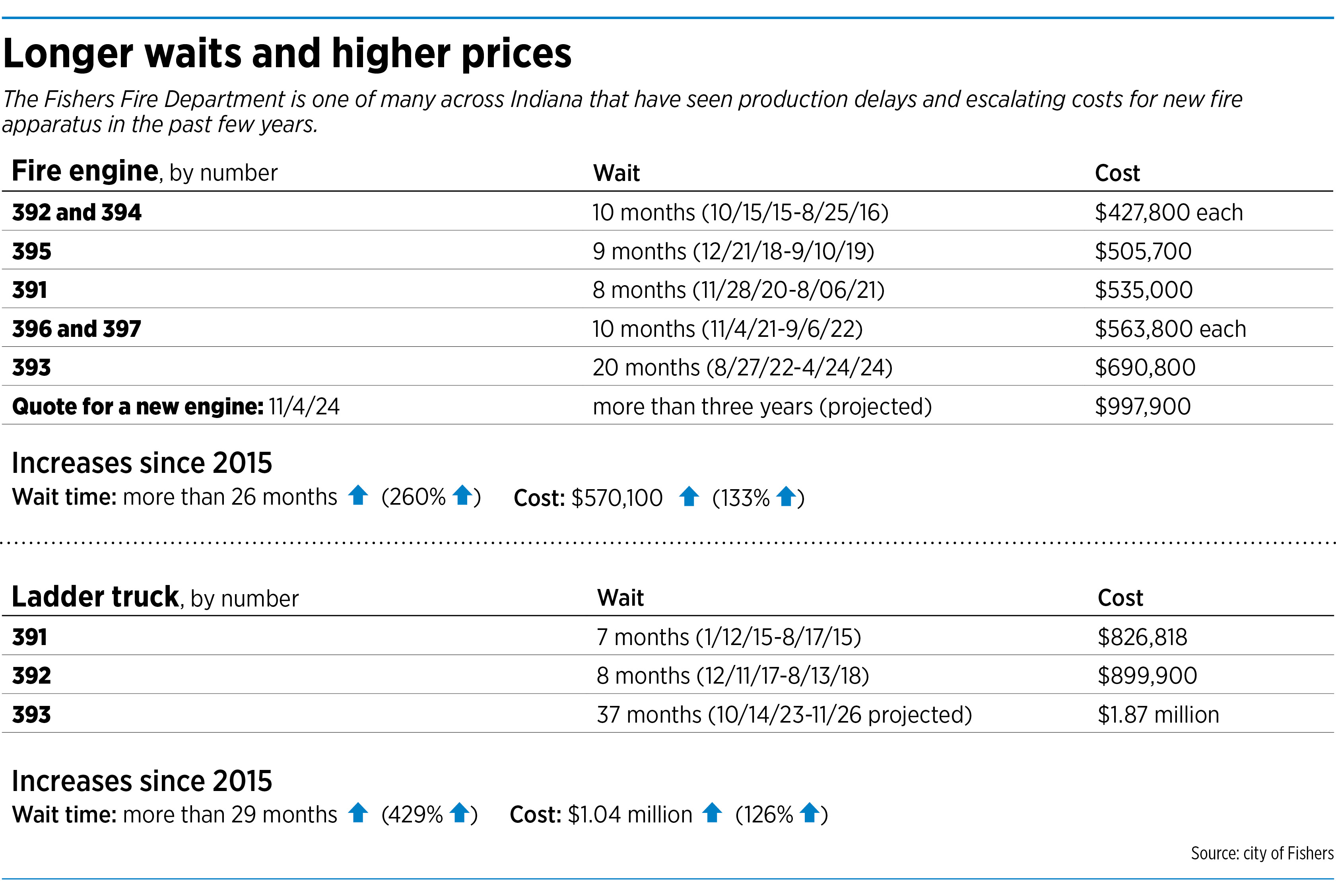
Over the past 10 years in Fishers, the wait time for a ladder truck has increased from seven months to more than three years, while the cost has increased more than $1 million. The wait time for a fire engine has gone from 10 months to more than three years, with a $570,000 price increase. Almost all of that increase has come since 2022.
Fadness said rising costs are not a new story, but in most other areas, costs have plateaued or at least stabilized. Not for emergency vehicles.
“Fire trucks and ambulances both have not achieved that equilibrium, and they just continue to rise in cost and in time without really a great justification,” he said. “There’s never been a lot of players in this market. It’s a pretty specialty product. But outside of people, my No. 1 cost driver right now is fleet.”
In Indianapolis, Crawley said, a fire engine order that was $424,000 in 2014 was $1.1 million last October. He expects costs will continue to increase after new federal emissions standards go into effect in 2027 and 2030.

“The manufacturers don’t even have pricing on it yet,” he said. “That’s a challenge to budget for something that we don’t know how much it’s going to cost.”
Noblesville Mayor Chris Jensen said that when he drafts an annual budget, he is not just thinking about the following year but up to 10 years ahead. But preparing is difficult when the cost of a fire truck can increase by hundreds of thousands of dollars in a short time.
“When something comes in and is a disruptor to that formula, that certainly changes things,” he said. “We can’t handle those type of swings like that investment. That’s not a small dollar amount.”•
Please enable JavaScript to view this content.
How many fires do they put out vs. how many fat people do they pick up to go the hospital?
Bingo
Seriously, this is your take on this? Fat shame much?
If you properly maintain that piece of equipment, it should last forever. Look at over-the-road semis that go millions of miles. Also, how about the used markets?