
Subscriber Benefit
As a subscriber you can listen to articles at work, in the car, or while you work out. Subscribe NowDeana Haworth grew up in a family of entrepreneurs.
Her dad spun through a number of careers—traveling evangelism, flea market enterprises, sports memorabilia. Her mom was the bookkeeper and kept everything on the rails.
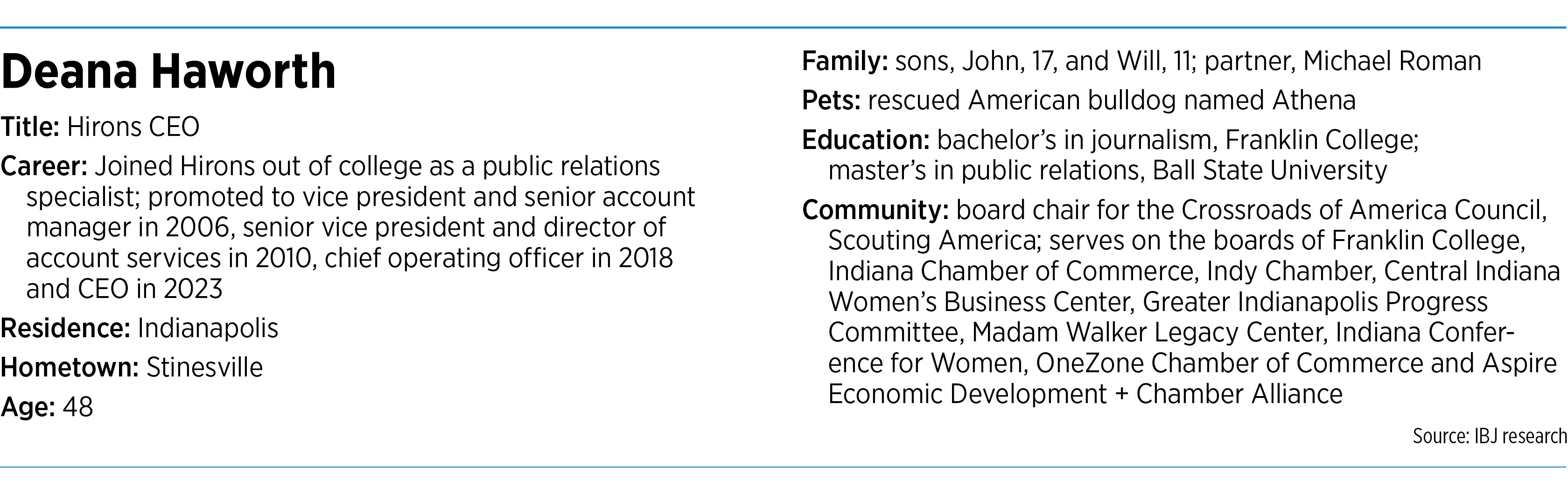
“So I saw small business really up close and personal,” said Haworth, the CEO of Hirons, a public relations and marketing agency with a staff of 42.
But it was the student newspaper at Edgewood High School in Monroe County that led Haworth on a path to public relations. After graduation, she went to Franklin College because of its strong reputation in journalism and nabbed an internship at what is now Franciscan Health.
“Fred Bagg, who was our longtime adviser there, had the interns review request-for-proposal submissions from agencies interested in supporting the hospital’s advertising and public relations activities,” Haworth said. “I’ll never forget walking into this room where he had all of the submissions. It was back in the day when people created boxes and fabricated things and proposals as part of the pitches. … And I thought, ‘Oh, I need to learn more about this world.’”
Today, as CEO of Hirons, Haworth has been able to combine her passion for helping clients tell their stories with the entrepreneurial skills she learned watching and working with her parents.
She helped lead the company’s conversion to an employee stock ownership plan, or ESOP, a retirement plan that gives employees an ownership stake in the company. And in part because the majority of those employees are women, and women lead the company, Hirons has been certified as a woman-owned business in several jurisdictions.
IBJ talked with Haworth about her career in public relations and what it means to be a female leader.

You’ve worked at the same company your entire career, which is more unusual than it used to be. How has that affected the way you lead Hirons?
Well, I certainly did not set out to maybe spend my entire career at Hirons. But I think that it has helped in a number of ways. I certainly have a long memory. My team will tease me that I can basically get to within a year and probably a month or a quarter of when we did a project. And as you can imagine, we’ve done some pretty spectacular work over the last 25 years.
Also, I think in the 25 years I’ve been here, it has been a fast-moving business, which has given me some bravery that maybe others don’t have now. [Founder] Tom Hirons has a much longer tail than I do. We were founded in 1978 in Bloomington, and this was before the advent of desktop publishing, certainly before the internet. I mean, email was basically invented while I was in college. We had one of those bubble Mac computers that was brightly colored when I started in May of 2000, but we didn’t really have social media.
All of those things were introduced over time. So as we look at things like AI and what the implications of AI would be to our business, we’re like, “Bring it on,” because we’ve seen a lot of changes in technology and the way that our clients work, and what our clients expect from us as well.
How do you see AI changing your company and the public relations industry?
Well, we’ve been in the AI space for a long time—before most people were thinking about AI. That’s because we do so much media buying and planning, especially on the digital front, and programmatic media buying has been using AI for a long time.
We have had an AI task force at our agency for a number of years now to really look both in-house at what we need to do to ensure that our employee owners are productive, and they’re educated on new technology, and they don’t have any barriers that are in their way. But we also find ourselves doing a lot of consulting with our clients, because the intersection of AI and marketing and advertising is real.
You have specialized in crisis communications throughout your career. Do you enjoy it?
Well, I love chaos, apparently. So crisis communications is my favorite thing. It’s like the Super Bowl Sunday of our world … .
Communications can look really different for different organizations that are facing crisis. We’ve been doing a lot of work in what we call social-media-generated crisis communication. So these are incidents and things that have no presence in real life. Many times, the facts are completely fabricated, have no truth to them at all. Or sometimes there are shreds of truth, and sometimes, of course, there is a lot of truth to these things.
Can you give an example?
We worked closely with the city of Greenwood on the active shooter and mass shooting incident at the Greenwood Park Mall a number of years ago now. That was something that had certainly a real-life devastating impact on our community. But it was also about handling social media, the misinformation, making sure that the mayor and our public safety officials and others were out with information soon enough to kind of fill that void that is created.
The mayor and I have actually traveled to both PR conferences and professional development opportunities to talk about it. … It was very important for the mayor that he and I did this together and really helped educate elected officials about how to deal with a crisis. It’s not always going to be an active shooter. But regardless, how do you ensure that your team is prepared, that you have those community connections in place, that we can all come together regardless of what the incident is?
What does it mean to love chaos?
What it means to me as a leader is that I have to have a team who likes process and things that are routine. We cannot run a business in chaos. And so having those counterparts who are ensuring that our clients are getting what they need from us, on strategy, on time and on budget, is key.
But for those that work in the crisis communication space, you just have to, like, rise to the occasion and be ready to go. I’m often talking to business professionals on the worst day of their life—certainly their professional life, if not their entire life. And you have to be empathetic but also encourage them to move at the proper speed. …
I also like change, and so one of the ways that I’ve been able to stay at a single employer for my 25 years of my career so far is because every day is different. Every project is different.
Do you have a favorite project that you’ve worked on?
Oh my gosh, that’s like asking about your favorite children—and I won’t tell you that, either!
We’ve certainly had some notable experiences. We were really involved in the Wishard Hospital replacement facility, which is now Eskenazi Health. That was a decade ago that we cut ribbon on that, and it’s been amazing to see how wonderful the impact of the health system is.
Today we’re working on the IU Health downtown campus, and so again, we enjoy seeing some of those really large, impactful projects come to fruition.
You are the first female leader at Hirons. What has that meant to you?
One of the things that I talk about a lot is women in business and women in leadership and the work that we do there. We are in a very female-dominant industry, and so making sure that we have support for women in business and women in leadership is important to us from that perspective.
My two mentors at Hirons are Tom Hirons, who’s our founder, and then Jim Parham, whom I call my forever boss. He was my boss the entire 23 years that he was at the agency and still serves on our board. They were very supportive of women in the workplace.
One of the things that I talk about a lot for women in business is encouraging women to drop what I call the cloak of invisibility. So we are often the ones that are behind the scenes, making everything happen, whether it is in the workplace or in our families. … So making sure that we’re standing up in the workforce, taking credit for the work that we’re doing. And also just making sure that people understand that while we make a lot of this look effortless, it is really hard to keep it all together every single day, regardless of what’s happening, either in your professional life or personal life, or maybe both.
So I just try to be really authentic when talking to women in business and in leadership about the fact that we need to be there for each other.•
Please enable JavaScript to view this content.
Deana’s authenticity, compassion, and commitment to lifting others up remind us that leadership isn’t just about achievement — it’s about empowering those around you.
Thank you, Deana, for leading with heart, vision, and purpose — and for inspiring women everywhere to stand tall and shine.