
Subscriber Benefit
As a subscriber you can listen to articles at work, in the car, or while you work out. Subscribe Now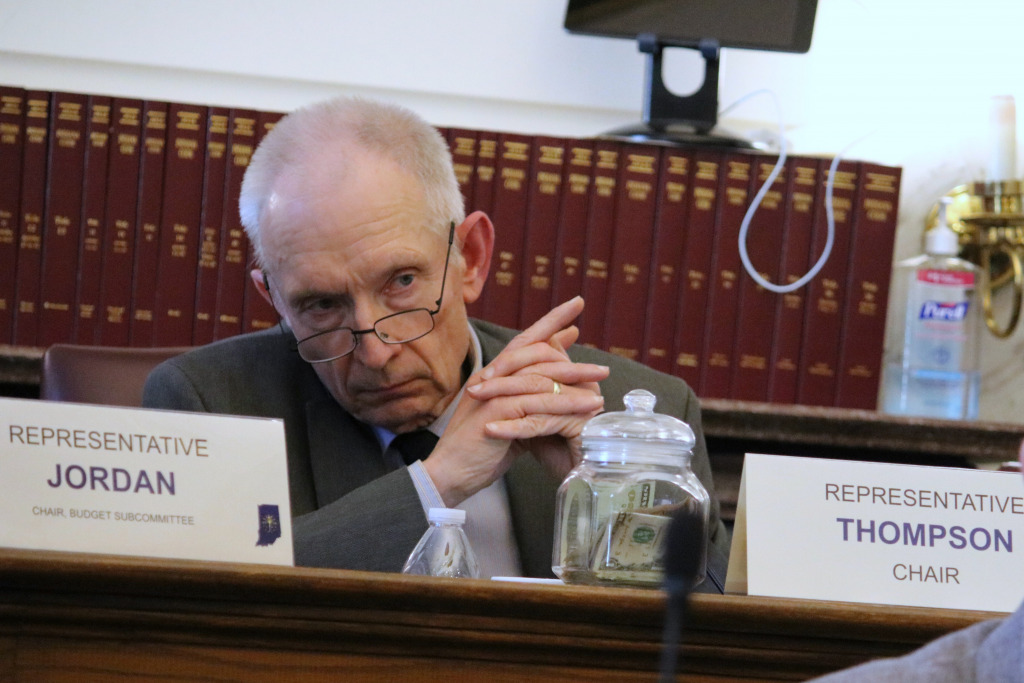
Indiana House Republicans’ property tax reform proposal advanced out of committee Monday morning, as expected, but demands from Gov. Mike Braun and some Republicans for even more relief could complicate the bill’s future.
The House’s plan—which leaders debuted Friday—stripped most of Senate Bill 1‘s language and replaced it with a previously introduced proposal from Rep. Jeff Thompson, R-Lizton, to reform how the state collects property taxes, a new credit for all homeowners and a contentious charter school revenue-sharing bill.
The House Ways and Means Committee passed the Republican proposal 15-8 along party lines. The committee also sorted through more than a dozen Democrat-filed amendments, but none were passed.
The bill moves to the House floor for amendments. Rep. J.D. Prescott, R-Union City, signaled that some Republican lawmakers are still unsatisfied with the plan and foreshadowed that they might push for more intense relief on the floor.
“It’s honestly not everything I would like to get,” he said. “I’d like to see a lot more property tax relief statewide.”
In the current version of the bill, according to House leaders, more than half of Hoosier homeowners are expected to pay lower property tax bills in 2026 than this year, and more than 90% will see some savings under the plan than they would have with no changes.
House Speaker Todd Huston detailed the proposal’s measures last week in an interview with IBJ. When fully implemented and combined with other changes, the local tax rate—with all local governments added together—couldn’t be higher than $3 per $100 in assessed value, Huston said.
“What we’re trying to do is make it a better system, a more transparent system,” Huston told IBJ. “People just want relief, and that’s what we’re aiming to provide.”
A major new addition to the bill is the creation of a 7.5% property tax credit with a maximum impact of $200 on all homeowners’ property tax bills beginning in 2026. A credit reduces a taxpayer’s actual bill, and in this case, it would be applied after the application of the state’s tax cap.
The new credit is expected to be the primary bearer of immediate tax relief. Thompson estimated the average homeowner would land at or around the credit cap of $200.
The plan also incorporates Senate Bill 518, a proposal backed by charter school advocates that has drawn the ire of public school officials. The proposal requires traditional public school districts to share property tax revenue—which is generally earmarked for capital projects, transportation and energy costs—with charter schools.
Without a fiscal analysis published as of yet, it’s still unclear how much less local governments are expected to collect. Thompson said Monday that the revenue drop will be a decrease in the overall increase; local governments would grow at 3% instead of 5.3% to 5.4%.
Braun’s more intensive proposal would strip local governments of about $1.2 billion of expected revenue in its first year and compound thereafter, according to the fiscal analysis. The Senate-passed version would have reduced local government by about that amount over three years.
When asked whether this bill would be enough to satisfy Braun, Rep. Greg Porter, D-Indianapolis, said he was sure it wouldn’t. Braun previously threatened to veto the bill if the relief provided isn’t to his liking.
“I think we’re pretty far away from where the governor wants to be,” he told reporters. ” I don’t think it’s landed where he wants it.”
Please enable JavaScript to view this content.
Editor's note: You can comment on IBJ stories by signing in to your IBJ account. If you have not registered, please sign up for a free account now. Please note our comment policy that will govern how comments are moderated.