
Subscriber Benefit
As a subscriber you can listen to articles at work, in the car, or while you work out. Subscribe Now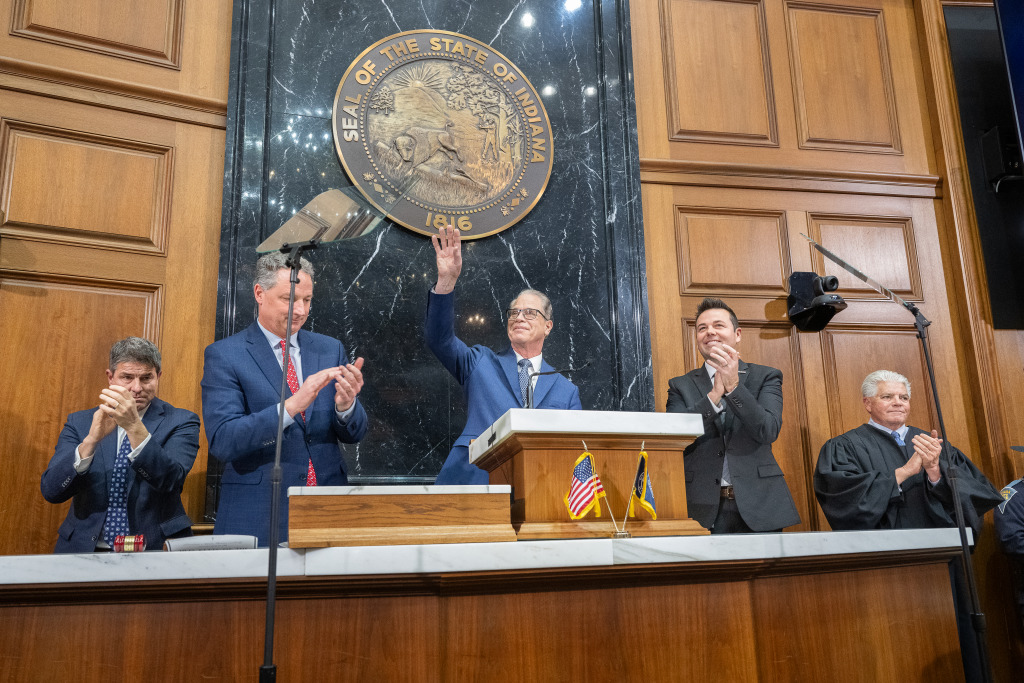
Indiana Gov. Mike Braun, an aligned policy think tank and motivated constituents have been putting the pressure on lawmakers to restore more significant cuts to the Legislature’s primary property-tax relief bill.
And now, a House fiscal committee is expected to amend the high-profile bill, although leaders haven’t said what specific changes will be made, including if it will more closely reflect Braun’s initial proposal.
“Without a doubt, we’re going to see changes to Senate Bill 1,” President Pro Tempore Rodric Bray, R-Martinsville told reporters Thursday. “We knew that.”
While Braun’s plan would have installed growth caps and expanded the homestead deduction, the Senate instead passed legislation last month that would slow property-tax growth and target relief to vulnerable demographics.
Braun has threatened to veto the latest version of the bill if it is not amended to provide more immediate and widespread relief. The Legislature could overrule a veto with a simple majority vote.
The governor has recently held a number of constituent fireside chats and roundtables including in Evansville, Terre Haute and Anderson. Braun also mentioned several taxpayers by name during his State of the State address in January and hosted them during the event.
Beyond the governor, a pair of WIBC 93.1 FM talk-show hosts are planning a property-tax relief rally later this month with Lt. Gov. Micah Beckwith as guest. And the House Ways and Means Committee heard multiple hours of testimony for and against the bill Wednesday afternoon.
“At the end of the day, strong grassroots pressure and contact from constituents to lawmakers is still very effective, and lawmakers are pretty responsive to it,” said Ryan Black, president of not-for-profit Hoosiers for Opportunity, Prosperity & Enterprise, or HOPE.
The organization is running an expanded ad campaign that includes targeted ads toward lawmakers who supported reducing Braun’s proposed tax cuts. He said people should know how lawmakers are voting on the issue.
Black believes lawmakers will find common ground to provide more property-tax relief, especially since it has grown to be a major issue for constituents. He pointed to a poll commissioned by HOPE and conducted by conservative consultant firm Mark it Red. Their survey found nearly 80% of 908 likely Indiana voters felt property taxes were too high and reform to the 2021 level was needed.
“To be really frank with you, we still, comparatively, have low property taxes in Indiana,” said Stephanie Wells, president of the Indiana Fiscal Policy Institute, “But it is an increase from last year and from previous years, so you’re going to notice it and you’re going to feel it. I understand why people, homeowners, are displeased.”
Wells said it might be best for lawmakers to split the issue into a two-session process. There are a number of ways to find relief, she said, but the conversation could need to be a longer process, so that legislators avoid the need to fix any indirect consequences of their changes.
“Slow it down and think deeply about what it is that you’re wanting to get to,” she said of lawmakers’ goals.
They might find a potential solution by installing a cap on the total amount a local government can charge its residents in property taxes, she said. There might be some tweaking needed there, she said, so they can find relief as well as adequate local government support.
The primary hurdle for expansive property tax relief is the ability of local governments to cut millions of dollars out of their budgets. Local leaders warned that Braun’s plan would result in significant cuts to critical services. They said the pared-down Senate bill would still mean noticeable rollbacks to services residents expect.
Bray said the pressure on the caucus is not foreign to the members. He said lawmakers are going home to their constituents and hearing from them as well.
“There certainly is a lot of focus on Senate Bill 1, and our caucus has been talking through it,” he said. “There’s a lot of pressure put to bear on people that are very interested in that bill in particular, but nevertheless, we’re going to craft a good policy for Indiana.”
Similar to Braun, House Speaker Todd Huston, R-Fishers, said representatives are talking with their constituents and gaining their thoughts on property-tax relief.
“We’ll take all that feedback and get to the right spot,” he said Monday.
Please enable JavaScript to view this content.
Stupidity.
Kendall, Casey, and Beckwith all on one stage. All in one place, a compelling case for what happens when you continually cut education funding and educational outcomes get worse and worse.
Everyone wants to pay less in taxes. I want to pay less in taxes. When you explain what it means when you cut taxes, that it’s less teachers and less cops and places that no one will want to live, the attitude changes.
The reality remains that people in Indiana are fleeing the places that are not investing in the future, be that nice infrastructure or nice schools. They are crowding into the places where taxes are high, voting with their feet and their futures. This property tax bill is a death sentence for large chunks of the state. Don’t let some blowhards from a local radio station or a supposed man of God who now seems to worship what he sees in the mirror convince you otherwise.
“[S]urvey found nearly 80% of 908 likely Indiana voters felt property taxes were too high”
“To be really frank with you, we still, comparatively, have low property taxes in Indiana”
This is the problem. 80% of Hoosier voters only know it feels worse than before, but they don’t have the slightest comprehension of what a fair tax policy should be like. How much should we pay for our roads, schools, utilities, emergency services?
We’re clearly not paying enough as a whole, because they’re all crumbling – but who among us should reasonably be paying more?
We all agree, and Braun and House GOP seem to both say that the everyman should owe less. But they’re incapable of delivering.
Who among us should reasonably be paying more?
State law says property taxes must be based on the “fair market value” of the property (i.e., what the property would sell for in a transaction between a willing selling and a willing buyer not under duress”).
Assessment should therefore be based on what similar properties (size, condition, amenities) nearby have sold for. Rises or reductions in sale prices should then reflect the market.
If sale prices increased, then everyone in the area see a corresponding boost in the assessed value of their property. And with that, they have a higher property tax to pay.
For that they should be grateful, as ownership of your home is the greatest wealth builder there is. And for those who can’t afford the higher property tax? They can always sell and celebrate the higher price a buyer will offer them, and move to a less costly place or even rent and escape the costs and burden of upkeep of a home.
One entity that should pay more is those property owners that have argued the “dark store” theory.
Meanwhile, the legislature continues to lower income taxes, which is beneficial to high-income earners but barely noticeable to low-income earners.
Brent, I think you’re hitting on some good points that should be explored.
The rule of “Fair Market Value” is a huge drag on communities where “Land Value” may be a better basis, so that the vacant and decaying lot or big-box parking lot have low “Market Value” and pays less in taxes than a small thriving business or neighborhood right next door, even though they’re both entitled to the same level of city services.
Indiana’s obsession with flat taxes is just as regressive for homeowners as it is for the Income tax.
It’s unfortunate that the current proposals all focus on ideas that do very little to help an average taxpayer, yet so little is done to provide transparency to how those dollars are used to fund our essential (or not so essential) services and get Hoosiers on board with what it takes to run a state or city.
And while most people have most of their wealth in homes, the “greatest wealth-builder” is almost never real estate, which historically has barely grown above the overall inflation rate.
Michael Hicks had a good article illustrating the shift in property taxes away from businesses and toward residential. As far as I’m concerned they haven’t fixed the root cause where a strange housing market since the 2008 crash continues to run up and up. The value and the assessment for businesses hasn’t changed nearly as much.
Looks like the IN government needs DOGED. I’m certain their are other areas that can be cut back without hurting essential services. Get with the program or, get voted out!
As if DOGE has been successful? A better course would be to revisit the Kernan-Shephard report, which details several ways to streamline government – primarily thru consolidation of local taxing authorities, such as townships and school districts. My recollection is the Township fought it because they didn’t want to give up their little fiefdoms (fire departments, etc.) and taxpayers like their local schools.
What Indiana needs is voters who understand that the government is not immune to the same inflationary pressures that everyone else is facing. The last thing Hoosiers with a governor whose attitude is “I’m rich, it’s not my problem.”
“My property taxes went up!” Yeah, and the cost for the government to provide your services went up too. The government doesn’t have a magic wand to provide the same services with the same staffing levels at the same cost.
Mike has the right response. We could streamline a lot of township government at the county level, give them a small bump to pay for managing a larger area, and no one would notice the difference. Leave schools for later … but that also speaks to the disconnect voters have. They like having a local school board, and if you poll them, they like their local school district. They just think all the other school districts are the problem and go defund them. That ain’t how it works, folks. Giving rich people school vouchers means less money for every single school district in Indiana.
So Indiana needs a closer alignment with Russia?
Indiana does not need a group of goofy and immature teenagers with silly nicknames like “Big Balls,” running around in state government under the direction of an unelected foreigner multi-billionaire megalomaniac like Musk.
DOGE has been a complete cluster and a disaster. It’s alleged “savings” have been proven to be mostly false, and it has wrecked havoc on the proper functioning of the federal government with randomly, and unlawfully, firing workers, or to retire them a few days later, and issuing a constant stream of conflicting email directives.
On top of all that, there are all the security and privacy issues with DOGE. Classified information, like CIA agent names, being released and intrusive prying into the tax and employment records of citizens and residents. Elon Musk makes billions of dollars from government defense and space contracts, which is a conflict of interest, and he is *not* an elected official. He has no business getting his greasy oligarch hands on my personal information or the private information of anyone else.
Taxes are necessary for a modern society to thrive. Without taxes we push reliance on private companies which, as we’ve seen, does not allways turn out well. It is not in private companies best interest to do what is in the best interest of the consumers of their services but instead the best interest of the shareholders. The WIBC pundits have admitted they rarely leave the house so of course they aren’t invested in the perks a modern society provides – education, safety, culture, community. People move to Carmel, Westfield, and Fishers because of the perks not because of low taxes. Not saying there isn’t waste but if we don’t invest in what enriches the lives of those in our society our society will collapse under the weight of crime, ignorance, stupidity, and despair – or maybe that is the plan. Cheers!
Why should I have to rent my house from the state government? I don’t understand why we just don’t pay sales tax when we buy a house. We pay a sales tax on everything else we buy. Consumption taxes are the fairest form of taxation. Taxing what I own and what I earn is theft.
You “rent” because the State continues to provide you services forever. You have pipes to and from your home, storm sewers, streets, police and emergency services, schools and teachers, parks, libraries, courts… these costs aren’t one-and-done, and your access to them costs the State more and more each year just like everything else.
None of us gets to free-load, and the burden should be apportioned fairly among those who benefit the most from a functional and healthy community.
Why should you expect any government services for free? If you want roads, parks, police and fire protection, parks, schools, and clean air and water, etc, then *you* need to pay your share for these services and public infrastructure.
If you would prefer to receive a bill at the end of each year with a requirement to pay within 30 days, or be barred from using any public roads, sidewalks, or other public infrastructure, and have your police and fire protection and other services cut off, would you find that to be a better arrangement?
Or, maybe, you could find a desert island in the middle of the ocean and go live there, and provide for everything entirely by yourself.