
Subscriber Benefit
As a subscriber you can listen to articles at work, in the car, or while you work out. Subscribe Now My husband and I went last month to see the Indianapolis Symphony Orchestra’s screening of “Star Wars: A New Hope” at Hilbert Circle Theatre, marking the first time I’ve seen the movie on the big screen since it was released when I was 8 years old.
What a treat! Of course, there’s nothing like seeing any movie with a live orchestra. It’s a fantastic experience, even as you forget partway through the film that the musicians right in front of you are providing the soundtrack. But I also loved seeing the movie again the way it was meant to be viewed—with the action larger than life and the sound surrounding me.
I found myself really watching the droids—C-3PO and R2-D2—who are as important to the movie as the traditional actors (the robots were actors, too: Anthony Daniels and Kenny Baker, respectively).
At the time the movie came out, robots or droids were often severely mechanical—or at least that’s how I perceived them. “Star Wars” (and some shows and movies after them) infused the droids with personality. R2-D2 was essentially a computerized tin can, but somehow his beeps and bobbles imbued him with personality and emotion. You feel happy, sad and scared for him, even though he never says a word and you never see a face.
I was thinking about that this week as I prepared for a conversation with robot expert Sooyeon Jeong, a Purdue University professor who is studying how to use artificial intelligence to ensure that robots can better communicate with humans.
Jeong was one of several featured speakers on Monday at IBJ’s Technology Power Breakfast at downtown’s The Crane Bay Event Center. I interviewed Jeong on stage about why scientists are working hard to give robots the same kinds of communication skills that are valuable for people.
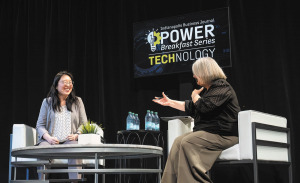
You can watch the event video at IBJ.com/videos for the full conversation. What fascinated me most is Jeong’s description of the way humans try to turn inanimate objects into something animated. “We see faces in everything,” she said. “Like we might see on the power outlet two holes on top and then the prong on the bottom—we see a face.” Yes! I do that.
Jeong said our tendency to try to humanize objects means that if robots are programmed well, they can make connections with people in ways that are useful for health care, therapy and many other applications.
So how do you make a robot more human? Just think about “Star Wars.” C-3PO didn’t just listen and respond to Luke. He turned his head and nodded. There was inflection in his voice. And he could detect when Luke was worried. A real robot can be trained in active listening skills: nodding and saying “uh-huh” to encourage a speaker to go on. The robot might be able to detect when someone’s expression is bored or worried or happy and adjust its responses accordingly.
Jeong and her students are developing AI-driven robots to help people with aphasia, a neurological language disorder that affects a person’s ability to communicate. Overcoming aphasia can require many hours of therapy—more than many health insurance plans will cover or patients can afford. But a robot could fill in the hours between therapy appointments. It won’t ever get bored or frustrated or lose its cool with the patient. Yet, it could learn to recognize when the patient is tired or frustrated and adjust appropriately.
The robot isn’t a replacement for a human therapist, Jeong said. It would be a supplement.
And that’s just one idea. There are so many others. I can’t wait to see what researchers come up with.•
__________
Weidenbener is editor of IBJ and assistant publisher of IBJ and The Indiana Lawyer. Email her at [email protected].
Please enable JavaScript to view this content.
Editor's note: You can comment on IBJ stories by signing in to your IBJ account. If you have not registered, please sign up for a free account now. Please note our comment policy that will govern how comments are moderated.