
Subscriber Benefit
As a subscriber you can listen to articles at work, in the car, or while you work out. Subscribe Now I’ve written about Columbia City-based Sailrite several times, including a Made in Indiana feature about the company’s sewing machines. So knowing this week’s issue of IBJ included a story about tariffs, I thought I’d call Matt Grant, the company’s co-owner, to see how he’s feeling about the trade war.
Sailrite’s heavy-duty sewing machines—which do-it-your-selfers use to make sails, leather goods and more—are assembled in Indiana from parts cast and manufactured in China and Taiwan. Hoosiers also add the motors and tune the machines.
The company also sells hardware, leather, heavy-duty fabrics and other supplies, some of it from China.
So what will the tariffs on Chinese goods mean for Sailrite?
“It’s impossible” to predict, Grant said. But he tried.
First, he disabused me of the notion that the tariff he’ll pay on Chinese imports is 145%. Combined with other existing tariffs and fees, he said, the government will be collecting more like 300% of the cost of what he brings into the country from China—if he brings anything in under current conditions.
So far, the company hasn’t paid anything like that—in part because the newest tariffs have had a bit of a chaotic implementation. First 10%, then 20%, and at some point, an additional 145%.
Sailrite recently received a shipping container for which a 20% tariff was in place. “It’ll take me 300 machines sold just to cover that tariff that I’ve already paid to the government—and that’s just one ship,” Grant said. “We’re talking tens and hundreds of thousands of dollars as these things go on.” Meanwhile, he’s put other overseas orders on hold.
Sailrite machines range from about $1,200 for a base portable Ultrafeed to about $2,300 for a deluxe, table-mounted Fabricator. Grant said that, fortunately, the company has been planning for potential disruptions in the market. It has about a year’s worth of parts in stock .
He’s confident that by the time he orders again, the worst of the trade war will be past. But he’s also confident the result won’t be that the U.S. is fully manufacturing sewing machines again.
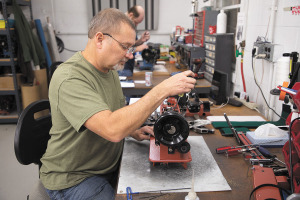
“It’s not an industry that the United States wants,” Grant said. “The market’s not big enough. The product is too complex. Casting things is dirty.”
Grant’s son recently visited a domestic foundry to talk about whether the company could replace its Chinese supplier with an American one. No dice.
But that doesn’t mean Grant is opposed to the Trump administration’s overall trade goals, which include protecting American intellectual property when it’s sent to China for manufacturing. That’s been a particularly big problem for Sailrite, which is constantly iterating products to make them better, only to see cheap knockoffs from China flood the market.
Imposing tariffs “is worth a shot,” he said.
But imposing massive tariffs only to exclude key products like smartphones and computers? That’s frustrating, he said. “The bigger players should bear the pain just as much as the smaller players,” Grant said. “And then, we hopefully get results quickly that at least balance things a little bit more, and we can all go back to doing business.”
Meanwhile, sales are up a bit as DIYers rush to buy before tariffs kick in. But long term? “I’m not optimistic,” Grant said.•
__________
Weidenbener is IBJ editor. Reach her at [email protected].
Please enable JavaScript to view this content.
After reading Matt Grant’s comments on the tariff turmoil, I have to sew much agreement with him, it’s almost stitched into my DNA.
The reality Matt lays out is seam-ingly obvious: while the idea behind the tariffs may be to mend America’s manufacturing and intellectual property woes, the execution has left smaller companies like Sailrite caught between a bobbin and a hard place. When it takes 300 machines sold just to cover the tariff on one container, you can tell the threadbare margins are being pulled tighter than a sail in a hurricane.
I wholeheartedly agree with Matt, it’s high time the fabric of this strategy be woven fairly. Large corporations shouldn’t get to hem and haw their way out of the pain while small businesses carry the full weight of the loom. If the goal is truly to protect American innovation, then everyone, from the big tech titans to the small manufacturers, needs to pull their weight on the same needlepoint.
Matt’s realistic but cautiously hopeful approach, keeping a year’s worth of parts stocked and planning ahead, shows he’s not just sitting around waiting for the winds to change. He’s a straight stitch in a world of knots and tangles, but very few small business can afford or has the space to keep that kind of inventory on hand.
Here’s hoping the trade war doesn’t end up unraveling the hard work of businesses like Sailrite. After all, it’s folks like Matt who help keep the entrepreneurial spirit in stitches, in the best way.