
Subscriber Benefit
As a subscriber you can listen to articles at work, in the car, or while you work out. Subscribe Now If nobody bet on sports, Indianapolis might still have an NBA franchise named the Olympians.
Then again, if nobody bet on sports, the city might not have the Indiana Pacers today. Sounds complicated—even incongruent—but it’s true.
The Olympians were charter members of the NBA when it was formed by consolidation in 1949. The team drew large crowds to Butler Fieldhouse before folding in 1953 after the loss of two all-star players who had been implicated in a point-shaving scandal dating back to college.
The city went without a professional basketball team until the American Basketball Association was formed in 1967. The Pacers were charter members of that league as well but might not have survived their early difficult seasons without Roger Brown, who was a major factor in their three ABA championships.
Brown would have been playing in the NBA when the ABA opened had he not been banned for accepting small favors from a notorious gambling figure before he entered college. Without him, the Pacers—who were losing money even while winning titles—easily could have folded.
A franchise lost and a franchise saved because people like to bet on sports. Now that it’s legal to bet on nearly every detail of a game with a few taps of a phone screen, it should surprise nobody if the city is impacted again.
Some corners of the NBA are feeling it now. The FBI recently arrested more than 30 people as part of its probe into possible illegal activities related to gambling. Most prominent among them are Miami Heat guard Terry Rozier, who is accused of supplying inside information to bettors and taking himself out of a game to ensure the success of a bet related to his performance—aka a prop bet. And there’s Portland Trailblazers coach Chauncey Billups, who is accused of participating in illegal poker games. Both have been suspended by the league without pay. Malik Beasley, formerly of the Detroit Pistons, also is under investigation for irregularities related to gambling.
Last year, the NBA issued a lifetime ban to Toronto’s Jontay Porter for disclosing confidential information about his health to gamblers and for personally betting on games. Most famously, referee Tim Donaghy admitted to betting on games he officiated from 2003 to 2007. He served more than 11 months in a federal prison.
It’s impossible to know how many athletes, coaches and referees have colluded with gamblers over the years or how often the integrity of the games has been compromised. But any game participants who consider adding gambling activities to their professional lives should become familiar with the stories of Ralph Beard, Alex Groza and Brown, three Indianapolis all-stars who paid dearly for their mistakes.
Late-night interrogations
Groza and Beard were the primary stars of the Indianapolis Olympians, a team made up mostly of former University of Kentucky players who had easily won the NCAA championship in 1948 and 1949 and constituted half of the U.S. Olympic team that won the gold medal in London in 1948.
Charter members of the NBA’s first season in 1949-1950, the Olympians won their division and drew some capacity crowds to Butler Fieldhouse. They were less successful on the court when the league was pared down the following season, but they still were popular with fans. The five former Kentucky players each held an ownership share in the franchise, which was turning a profit.
Shortly before the start of the third season, however, Beard and Groza were nabbed by FBI agents while in Chicago to watch a college all-star team play in an exhibition against the Rochester Royals. They confessed to accepting bribes to shave points during their college careers. They were banned from the NBA for life and stripped of their ownership shares.
The Olympians continued for two more seasons but never recovered their fan support after the loss of their two all-stars. They folded after the 1952-1953 season, having finished 28-43.
Groza, a rough-around-the-edges U.S. Army veteran, was by all accounts the intermediary to the fixers. He took payments for shaving points and passed on some of the cash to teammates, including Beard and Dale Barnstable, a reserve and Beard’s roommate. Groza was later learned to have actively participated in a fix in Kentucky’s surprising loss to Loyola of Chicago in the 1949 NIT, when he was outplayed by a lesser center named Jack Kerris.
Beard, who grew up in poverty with a single mother after his father abandoned the family, admitted accepting $300 from Groza but said he immediately sent it home. He also swore “on the lives of my children” that he never failed to try his best in every game, a claim that statistics bear out.
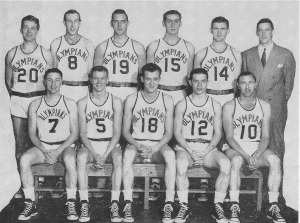
The penalties handed to Groza and Beard were regarded by many as overly severe and the confessions wrongly obtained. They were taken to separate rooms after the game in Chicago and grilled individually by FBI agents. Beard was said to have finally cracked at 6 a.m. They were not offered legal representation and were too naïve to seek it.
Beard, regarded by some teammates and opponents as comparable to Boston Celtics great Bob Cousy, was haunted by his banishment for the rest of his life. He lost his marriage but eventually remarried and maintained a successful sales career in pharmaceuticals. He never shied away from talking about his distant involvement with the fixers.
“I would like some type of vindication in the fact we were not the only ones who were involved, and there are people in the Hall of Fame right now who did the same thing we did,” he once told me. “I guess I’m looking for a utopian situation there that ain’t ever going to happen.”
George Mikan, who considered Groza the best center he played against during his Hall of Fame career, gave Beard and Groza a second chance when he became the ABA’s first commissioner. They were too old to play when the new league began in 1967 but worked for the Kentucky Colonels in the franchise’s early seasons. Beard was a part-time scout. Groza, after coaching Bellarmine College in Kentucky, was an interim coach for the Colonels and later the general manager and interim coach of the San Diego Conquistadors.
Both, however, lost careers that likely would have landed them in the Naismith Hall of Fame.
“You always had people trying to convince you to do something [related to gambling],” Mikan once told me about the atmosphere around basketball in that era. “I always felt bad about the Kentucky players being caught like that, because they all came from homes that were pretty impoverished.”
College careers lost
Mikan also approved of Roger Brown playing in the ABA, saving him from a life working an assembly line.
Brown and Connie Hawkins were two of the premier college recruits in the country coming out of Brooklyn in 1960. They were befriended by Jack Molinas, a game fixer with mafia ties, and a Molinas associate on the area outdoor courts over the summer; they were loaned a car for dates and cash to buy meals. The plan was to groom them for point shaving as college players and to bring other players into the network.
Brown and Hawkins played on their respective freshman teams at the University of Dayton and the University of Iowa, but neither cooperated with fixers. They were given immunity from prosecution for providing information to legal authorities when another scandal broke in 1961, but they were banned from NCAA and NBA competition.
Brown left school but stayed in Dayton and landed a position at Inland Manufacturing, where he was working the night shift and playing AAU ball when the Pacers signed him in 1967. He was 25 years old when the ABA began, young enough to regenerate a professional career that took him to the Naismith Hall of Fame. Still, it robbed him of his college career and three potential seasons in the NBA.
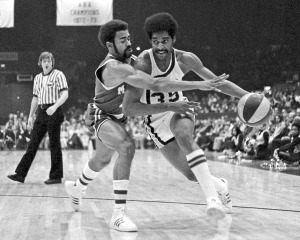
Like Beard and Groza, Brown did not receive legal representation. He said years later he was “scared to death” when ordered to report to authorities in New York City for questioning. Given immunity, he said he “was ready to agree with anything they said” to get out of his predicament.
He and Hawkins both received settlements from the NBA after filing separate lawsuits in 1968. Hawkins played in the NBA, and Brown could have if he desired.
The tentacles of sports betting can run deep, even in a Midwestern city such as Indianapolis. In June 1953, just a few months after the Olympians folded, Indiana’s Mr. Basketball Hallie Bryant received an anonymous threat the day before the state’s high school all-stars played their annual game with Kentucky’s stars at Butler.
The typed note, dropped off at the team’s headquarters at the Central YMCA, warned Bryant not to play in the game because, “I have got a $5,000 bet on Kentucky to win.” It warned that Bryant or a family member would be injured that night if he played but added he would be sent $500 on Monday if he did not play. The author signed off as “A FRIEND.”
The threat wasn’t taken lightly, given the fresh memory of the Olympians’ demise. The Indianapolis Star ran a banner headline in all caps atop the front page of the next day’s edition that read, “HALLIE BRYANT THREATENED.” The team was moved to the safer confines of the Claypool Hotel, and additional police officers were assigned to the game to protect Bryant and his family.
Unfazed, he scored 21 points to lead the Indiana stars to a 71-66 victory.
Nobody should take today’s threats lightly, either.•
__________
Montieth, an Indianapolis native, is a longtime newspaper reporter and freelance writer. He is the author of three books: “Passion Play: Coach Gene Keady and the Purdue Boilermakers,” “Reborn: The Pacers and the Return of Pro Basketball to Indianapolis,” and “Extra Innings: My Life in Baseball,” with former Indianapolis Indians President Max Schumacher.
Please enable JavaScript to view this content.
Editor's note: You can comment on IBJ stories by signing in to your IBJ account. If you have not registered, please sign up for a free account now. Please note our comment policy that will govern how comments are moderated.