
Subscriber Benefit
As a subscriber you can listen to articles at work, in the car, or while you work out. Subscribe Now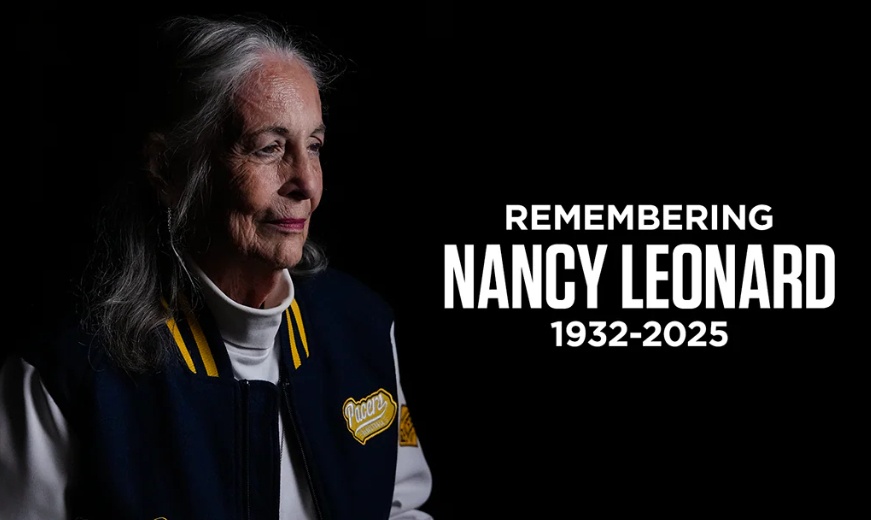
She had been loosened up by a glass of wine or two when she said it, but she meant it.
“I wish I were nicer.”
Nobody who knew Nancy Leonard would agree with that assessment. She could be stern, authoritative and even somewhat intimidating, but that wasn’t even half the story. She also was giving, forgiving and fiercely devoted—to her husband, her five children, the entire Indiana Pacers franchise and to many causes beyond.
Let’s face it: When you’re raising a large family with kids separated by 14 years while running a skeleton crew of about 13 in the front office of a professional basketball team that’s fighting for survival and trying to keep your husband/coach from straying too far out of bounds, “nice” doesn’t always get it done.
And Nancy Leonard, whose death was announced Wednesday morning, knew how to get things done.
The 93-year-old will go down as perhaps the greatest matriarch in Indiana’s sporting history—a woman with an iron fist inside a velvet glove who earned respect from everyone she met. That includes her legendary husband, Slick—she just called him Bob—who admitted to being a little afraid of her but could tear up when asked about their relationship.

“Hey!” he once said from the comfort of a reclining chair in their Carmel home. “She handles everything. Because I don’t want to do it. I don’t write checks and stuff like that. As a matter of fact, if something would happen to her, I don’t know what the hell I’d do. I don’t know nothing about nothing.”
Nancy and Slick had the ultimate yin and yang relationship, which kept their marriage humming for more than 66 years. He was the reckless star athlete and coach who could make friends with nearly anyone. She backed him up with organization and discipline, not to mention bookkeeping.
She was teaching business classes at Taylor High School in Kokomo while he was calling on schools to sell graduation supplies for Herff Jones when Pacers General Manager Mike Storen called and asked him to take over as coach of a floundering team in November 1968. She worked behind the scenes of every business venture he attempted, because he knew “nothing about nothing” and she knew something about many things.
The Pacers’ players certainly knew of her influence. Slick might have driven them hard at times, but she was the one driving Slick. Literally, at times. When he drove home too carelessly for her tastes following a frustrating loss while coaching the Baltimore Bullets in the early ’60s, she told him she would handle the drives to and from games from that point on. And she did, for as long as he attended games as the radio analyst for the Pacers.
“She is a born leader, and he accepted his role,” former Pacers’ center Mel Daniels said several years ago. “She was first, and he was second. One must be able to maneuver in those circumstances.”
Nancy’s relationship with the players, however, was more maternal.
“She was Super Mom to all of us,” Daniels said. “Not in a nagging sense, just little things.”
Daniels also recalled her passion at games. Nancy was the leader of Murderer’s Row, a group of wives who sat in the front row of an end section at the Fairgrounds Coliseum and screamed their lungs out. And if a fight broke out on the court, as it often did …
“I’d see Nancy standing up, like she was ready to come help,” Daniels said. “She was a part of us.”
Nancy found more peaceful ways to be involved as well. She and front office member Sandy Knapp, for example, founded the Pacemates, a dance group that replaced the Pacesetters, who were merely decorative cheerleaders. Auditions and practice sessions were conducted in the Leonards’ basement.
There were parties, too. So many parties.
The Leonards didn’t live like celebrities. Their phone number was listed in the public directory (“We didn’t think we were such a big deal”), and their home was a gathering place for year-round social occasions that included players and stat crew and front office members—and even referees during the season.
One of the more memorable events occurred when stat crew chief Bill York turned 40.
“He was always teasing me so bad,” Nancy said. “When his birthday came up, he didn’t want a party, so I said we’ve got to do something really fun. Let’s get a casket and kidnap him and bring him out to the house. They got him there and everybody there was standing in the yard with a candle. There must have been a hundred people.”
Things got a bit rowdy as the day wore on. When some of the guests were trying to spray the Leonards’ daughter, Terry, with a garden hose, Nancy responded by going inside to an upstairs bedroom, leaning out a window and spraying everyone with the hose.
“I let loose with it,” she said. “I was thinking, ‘If my mother knew I was doing this’ … my nice little quiet mother.”
Nancy’s role and responsibilities became far more serious when she became the Pacers’ assistant general manager as the franchise was entering the NBA in 1976. It was an uncertain time, joining a new league that demanded a more corporate manner of conducting business. As she recalled, the Pacers owners—most of them successful businessmen or corporate executives—weren’t sure how to go about finding someone to navigate the treacherous waters.
Nancy’s father had owned and operated a semi-pro baseball team in South Bend when she was growing up, so she was less intimidated.
“You know guys, this is a great opportunity and finding a general manager is no different than finding a chief executive officer,” she said.
“You find someone to coordinate all the things that are going on. You’ve got marketing, you’ve got ticket sales, you’ve got accounting, you’ve got to do government stuff, you’ve got to do radio and TV. My only recommendation would be not to get somebody who has no athletic experience, because athletes are different. They play under a different kind of pressure for a short period of time. You have to get somebody the players can relate to.”
The room fell silent. For a moment, Nancy thought she had offended the group and managed to get her husband fired. But, as she recalled, someone said, “If you think you know so much about it, why don’t you just do it?”
At which point Bob Leonard stood up and said, “She can do it.”

And that was that. An historic moment in professional sports was born.
Nancy’s leadership ability was put to the ultimate test during the summer following the Pacers’ first season in the NBA. Attendance had gone up but so had expenses. Some front office employees and players had agreed to delays in receiving their paychecks while ends were met. By May, when Nancy and Slick were in Hawaii for a postseason college tournament, word came that the franchise’s owners were ready to sell the team if they couldn’t sell 8,000 season tickets in advance of the season to meet operating costs.
They rushed home and went to work. Nancy enlisted the expertise of Dr. Charles Rushmore, an Indiana Bell executive who had experience organizing telethons for charity, and Elmer Snow, general manager at WTTV-Channel 4.
“These two men gave us a crash course in Telethon 101,” Knapp once said. “Slick was leading the charge, and Nancy was keeping everything documented and under control and on target.”
They all put together a fundraising event in record time, one that aired on three of the four local television stations for 16½ straight hours. The Convention Center donated space, Arby’s donated food, and an endless number of people—players and former players included—donated their time to take phone calls or help produce the event.
Nancy had the honor of tearfully announcing the goal had been met. The Pacers lived on.
“She was amazing,” Knapp once said. “She was very fair, but she was tough as nails.”
The other NBA front office executives learned that quickly enough. Even the Boston Celtics’ crusty general manager, Red Auerbach, showed respect. Auerbach and Slick Leonard had feuded when they both coached in the NBA, but Nancy got along with him well once she established her turf.
That occurred in the Pacers’ NBA debut, on Oct. 21, 1976, when the Celtics came to Market Square Arena. Nancy was sitting underneath the basket in her customary baseline seat awaiting her first game as assistant general manager when a referee approached and said Auerbach wanted the music turned down, that the Pacers were violating a league rule.
It so happened she had read all the rules and regulations and knew better. She pulled out her booklet, handed it to the referee and said, “Take this to Red, and if he can show me where there’s something in there about music, we’ll turn it down.” She then watched the referee walk to the other end of the court and pass along Nancy’s message. He threw down the book with disgust and not another word was said about it.
Her efficient and decisive approach to conducting business also was made clear when the CBS television network decided to sponsor a dunk contest among NBA players in the 1976-77 season. One player from each team was to take part in rounds of face-to-face competition, with the final round at halftime of a game in the NBA Finals.
Most teams conducted an internal competition or let the players decide who would represent. But Nancy marched down to the practice court one morning before the workout began to inform the players of the competition and explain how it would work—and that Darnell Hillman would represent the Pacers.
He won it.
“She was a great asset to the franchise because of her values,” Hillman once said. “She made the administrative decisions in the office based on that. This family tradition that you have in the state of Indiana and the values are not like anywhere else in the country that I’ve been. Certainly, Nancy personified that.”
Again, all while raising five children. As her oldest, Terry, once pointed out, Nancy surely was the only head of an NBA front office who prepared the family’s Thanksgiving dinner.
Her role in the front office ended when Slick was let go as coach following the 1979-80 season. He didn’t return to the franchise until he was hired as a broadcaster in 1985, and from that point on she became a fan while holding down a career in residential real estate. A fan who wanted things done correctly.
That was evident in 2011 when the Pacers played Chicago in a first-round playoff series. In Game 3, Bulls guard Derrick Rose had responded to a heckling fan with a burst of profanities while walking to the scorer’s table to check into the game, all within earshot of Nancy and some small children.
So, at halftime of Game 4 she waited in the tunnel where the visiting players exit toward their locker room and gave Rose a piece of her mind.
She could have been nicer about it, sure. But she had values.•
Montieth, an Indianapolis native, is a longtime newspaper reporter and freelance writer. He is the author of three books: “Passion Play: Coach Gene Keady and the Purdue Boilermakers,” “Reborn: The Pacers and the Return of Pro Basketball to Indianapolis,” and “Extra Innings: My Life in Baseball,” with former Indianapolis Indians President Max Schumacher.
Please enable JavaScript to view this content.
Well written, MM! 🙂 ALL Pacer fans should be thankful for this lady, mom, friend, wife, executive!
Thanks Mark for a great article and inside perspective of a legendary women in Indiana sports history! Peace be with you Nancy Leonard.
RIP, legend.