
Subscriber Benefit
As a subscriber you can listen to articles at work, in the car, or while you work out. Subscribe Now As a board member of Liberty Fund, which produces the “Future of Liberty” podcast hosted by former Indiana Gov. Mitch Daniels, I’ve been fortunate to have a front-row seat to conversations that explore the ideas and institutions underpinning American liberty. Daniels’ recent conversation with Pulitzer Prize-winning political commentator and author George Will is incredibly insightful and hopeful for those concerned about the current state of political discourse in our country.
The podcast discussion centers on executive power, the role of institutions and the civic virtues necessary to sustain a free society. But Will’s insights go beyond politics—they’re lessons in leadership, accountability and the importance of principled action.
A major theme of the conversation is the growth of presidential authority. Will makes the point that this is not a new problem, and it’s something the founders anticipated. He notes that our Constitution was designed to “check ambition with ambition,” but over time, populist pressures, the growth of government and a willingness by Congress to cede authority to the president have expanded the executive branch’s influence. Will cited examples like tariff decisions and the impoundment of funds—actions that are technically within presidential authority but stretch the spirit of institutional balance.
Political parties, Will argues, play a major role in this dynamic. Founding Father James Madison assumed members of Congress would act as independent actors to restrain presidential power. But today’s two-party political system that emphasizes party loyalty over all else has too often turned legislators into blind supporters of their president in power, rather than the checks on presidential power that Madison envisioned. My takeaway from the conversation is that the long-term health of the American experiment is likely dependent on our ability to restore meaningful checks and balances between the executive, legislative and judicial branches of government.
Will notes that the complexity and sprawling nature of government, however, demands that a president be decisive and insulated from certain legal distractions to ensure a functioning government (e.g., immunity from prosecution while in office). At the same time, Congress has tools to define the limits of presidential action, such as budgeting authority and emergency powers. But those tools are meaningless if Congress refuses to use them.
The conversation highlights the importance of civic and moral virtues. Liberty depends not only on laws but also on character. Integrity, prudence and accountability are essential—for leaders and citizens alike. A free society thrives when its leaders act with vision but also respect the rules and norms that keep institutions strong.
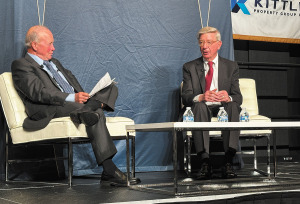
Will helps put today’s challenges in perspective, reminding us that American institutions have weathered political turbulence before. He highlights the importance of citizen engagement, reminding us that it is American citizens and leaders who respect norms, participate actively and hold themselves accountable that ultimately lead to the preservation of liberty over the long term.
The insights shared are valuable for business and civic leaders. In politics, as in business, success requires vision, energy and initiative—but it also requires discipline, checks and adherence to systems that ensure fairness and stability. Leaders who overreach risk long-term, unpredictable consequences. Those who lead responsibly create enduring value.
George Will’s conversation with Mitch Daniels is a timely reminder about leadership, responsibility and the balance between power and principle.
You can listen to the full podcast and find all of the “Future of Liberty with Mitch Daniels” podcasts at thefutureofliberty.org.•
__________
Feltman is CEO of IBJ Media and publisher of IBJ.
Please enable JavaScript to view this content.
Editor's note: You can comment on IBJ stories by signing in to your IBJ account. If you have not registered, please sign up for a free account now. Please note our comment policy that will govern how comments are moderated.