
Subscriber Benefit
As a subscriber you can listen to articles at work, in the car, or while you work out. Subscribe Now
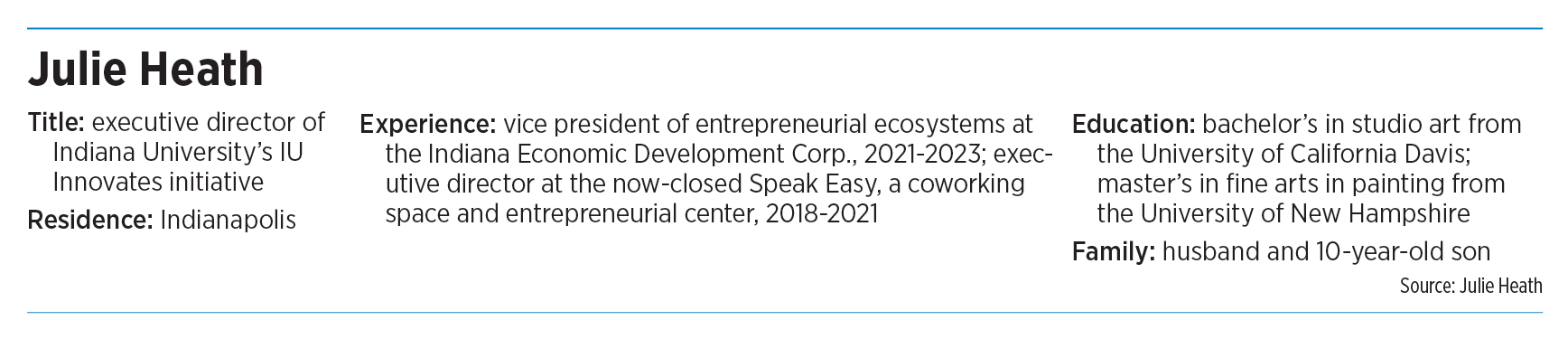
When Julie Heath was tapped to lead Indiana University’s new entrepreneurship and innovation initiative two years ago, she didn’t anticipate how popular it would be.
She thought perhaps 100 students would sign up to be part of IU Innovates, which aims to foster startup formation, innovation and entrepreneurship across the university’s statewide footprint. That turned out to be a lowball estimate—more than 300 students signed up within the program’s first year.
“There’s more demand for this than we expected,” Heath said.
IBJ talked with Heath last week during the Global Entrepreneurship Congress at the Indiana Convention Center—where IU was among the exhibitors, showcasing some of the university’s student entrepreneurs and their startups to a global audience of about 3,500 attendees—to discuss what IU Innovates has accomplished in its first two years and what’s next for the effort.
This conversation has been edited for length and clarity.
What’s the IU Innovates strategy for advancing entrepreneurship?
We do this through three ways. One is by direct support—incubation programs. The second is by sponsoring entrepreneurship activities, which include pitch competitions, seminars, entrepreneurship clubs and entrepreneurship-related classes. The third is through impact storytelling.
What’s impact storytelling?
Each year we do this large coffee table magazine called IU Entrepreneurship. We tell the stories of founders and aspiring entrepreneurs from throughout the university. [The publication is produced by Pattern, an Indianapolis-based organization that supports and seeks to grow the state’s creative economy.]
In the digital age, putting time and effort into a print publication is an intentional choice. Why do it?
I think it’s important to put resources toward storytelling. Because even though we believe it’s important to do this work, we have to communicate to others why it matters in terms of student success and opportunity after college … why it matters in terms of bringing this transformative research and creativity that happens at the university out into the world through products that solve real-world problems. … And we think this work is so important that we want something that represents it well, in the form of a publication [that is] beautiful and noteworthy and a centerpiece that is always within arm’s reach.
Backing up a bit: Why did IU launch this effort in the first place?
President [Pamela] Whitten decided that she wanted to see entrepreneurship and innovation supported across the whole university. It’s always been important in pockets. It’s always been very strong in pockets: in the commercialization office, in the entrepreneurship major in the business school, in the Shoemaker Innovation Center. Entrepreneurship is seeing problems as opportunities as a mindset, which is a really important mindset to have in a fast-changing world if you’d like to solve the world’s hardest problems. The entrepreneurship mindset of seeing problems as opportunities is useful for all of our students.
Building on that thought: What’s the end goal? Is IU hoping to produce more students who launch companies? Or is entrepreneurship training something that the university sees as valuable, even if students don’t end up becoming founders?
Both. … That skill set, that entrepreneurship skill set, often does end up with a startup at the end, and at that point, the student has a new professional path in front of them that they have created. Because most economy-of-tomorrow-jobs [and] net new jobs are started by entrepreneurs. So there’s utility in crafting your own professional path. But it’s also a useful mindset and skill set if a student doesn’t get to that part.
How are you going to know whether IU Innovates is a success?
There are two ways we think about success. One is macro, one is micro. … We look at all of our IU entrepreneurs who are in this journey, and we say, “Who is in this journey? Where are they? Exploring the problem space, building the esthetic prototype, testing the functional prototype with customers?” We look at what problems they’re solving, which industries they’re in or will be in, and we’re very curious about how many of our campuses, how many of our schools have entrepreneurs in this big pipeline. So we can then say with our dashboard, “This is how many undergraduates we have. This is what class they are. This is what school they come from. This is what campus they come from.” So we get a bird’s-eye view of our whole pipeline of IU entrepreneurs. That’s part A. And Part B is, we look at how they move through that journey, because as long as they’re moving through that learning launch journey, we are successful.
Is IU Innovates just for students?
The original mandate was very large: “Advance IU entrepreneurs.” So we had to decide. We have 90,000 students [statewide], so, that’s a lot of people. And so we had to figure out, “Who can we serve first?” So we did start with primarily students, both undergraduate students and graduate students, in Bloomington. And we do have a handful of faculty in the mix. On deck now, we have programming that we’re rolling out at IU Indianapolis. And we also have the seeds of programming at IU Northwest [in Gary]. We have a position that we call founder in residence at IU Northwest.
When did the programming begin at IU Indianapolis?
We began it this past semester with the relaunch of JagStart, IU Indianapolis’ pitch competition, and we will have a space on campus starting this fall.
What’s next?
We will be rolling out support of some type, starting with sponsorship of programs, entrepreneurship, pitch competitions or clubs at all the regional campuses, and we have representation on our internal advisory board from each of the campuses. Usually, this is a faculty entrepreneur or someone who teaches entrepreneurship.
You’ve got a background in art. Do you consider yourself an entrepreneur?
I do consider myself a social impact entrepreneur. I’ve been involved with two startups, both tech startups in the cultural preservation space or the nonprofit governance space. And I also consider myself a social impact entrepreneur because I have done intrapreneurship work inside of large organizations, standing up new centers, new initiatives, new programs. My first job was at the Smithsonian Institution launching new programs and new initiatives within the Smithsonian. … The most noteworthy one was the Lunder Conservation Center. It’s an art conservation center inside the National Portrait Gallery and Smithsonian American Art Museum [two Smithsonian museums that share a building in Washington, D.C.].
Last question: What do you wish I’d asked you about?
I’m interested in the question of, how might we measure the economic impact of supporting entrepreneurs at the regional level? … Working with Carol Rogers and Matt Kinghorn at the Indiana Business Research Center at IU, we have taken a first pass at measuring the GDP driven by young companies and entrepreneurs, not just at the state level, but now at the county level. Ultimately, I’d like to be able to look back and see after five years of doing this work: Have we increased the GDP driven by any of our IU entrepreneurs?
How long before that increase might be meaningful?
I think it could be a meaningful number after five to 10 years.•
—Susan Orr
Please enable JavaScript to view this content.
Hats off to Julie and team! IU Innovates has been a fantastic collaborator and supporter of our high school program at the STARTedUP Foundation!
Great work, Julie! We at Quarles appreciate the enthusiasm, focus, and tenacity that you bring to growing entrepreneurship in Indiana.