
Subscriber Benefit
As a subscriber you can listen to articles at work, in the car, or while you work out. Subscribe NowGeorge Turkette said he sensed confusion among Turchetti’s Salumeria patrons after the business closed as a Fountain Square restaurant and butcher shop last September.
Although Turkette’s era of personally handing salami and pepperoni across a counter to customers ended, Turchetti’s era of being a production facility for wholesale commerce ramped up.
The company launched its production facility in the Bates-Hendricks neighborhood in August, focused on building a nationally recognized meat brand.
If someone asked Turkette when Turchetti’s planned to get back into business, the best answer he could offer was, “We’re open, but we’re not opening.”
“We wanted to figure out which direction we wanted to focus, whether it was going to be a restaurant and butcher shop or the wholesale side of things,” Turkette said. “Without the wholesale side producing all the tasty meats, there’s no Turchetti’s.”
With a goal of placing deli meats in supermarkets across the United States, Turchetti’s Salumeria is seeking investors through a crowdfunding “community round” at online platform Wefunder.
So far, more than 70 investors have pledged more than $124,000 toward Turkette’s goal of $400,000.
On June 22, the public can check out the 3,000-square-foot Turchetti’s production facility at 1801 S. East St. In addition to an office, the building features a raw processing room where the temperature is maintained at 40 degrees, as well as a curing chamber for salami.
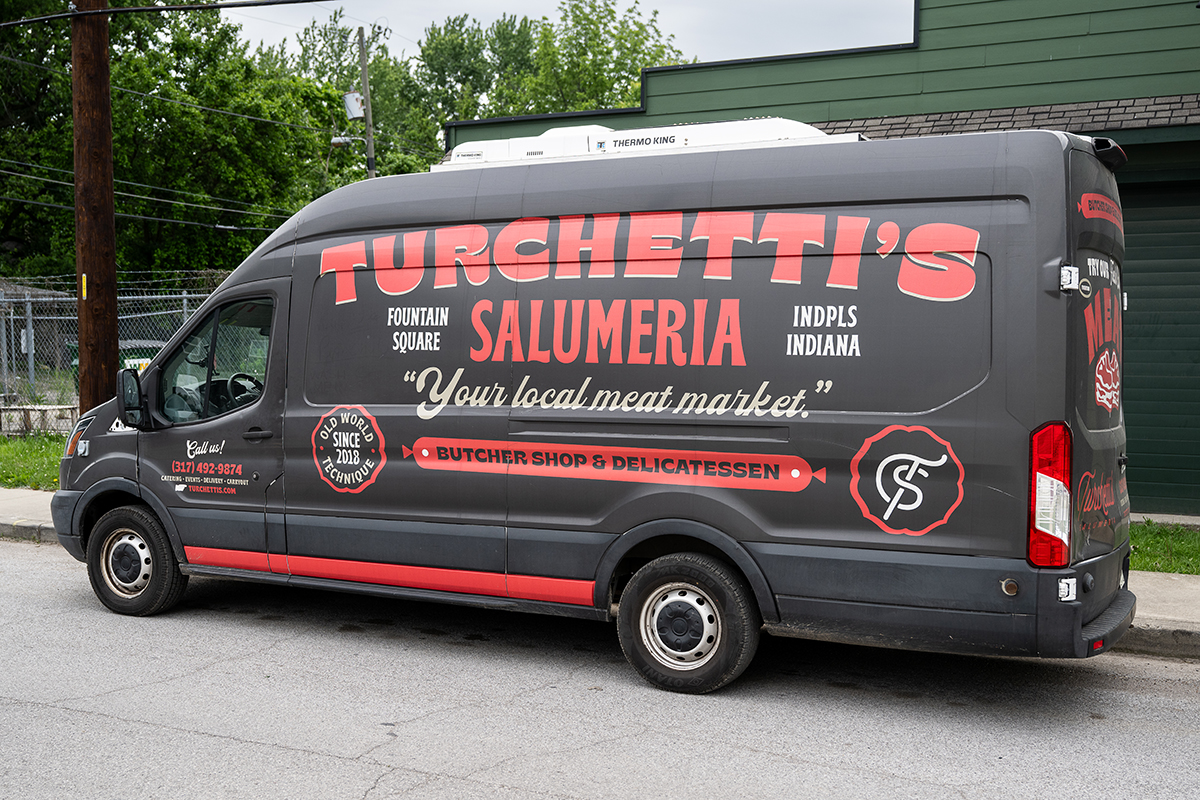
A food truck offering favorites from the company’s menu will be part of the open house scheduled for 10 a.m. to 2 p.m.
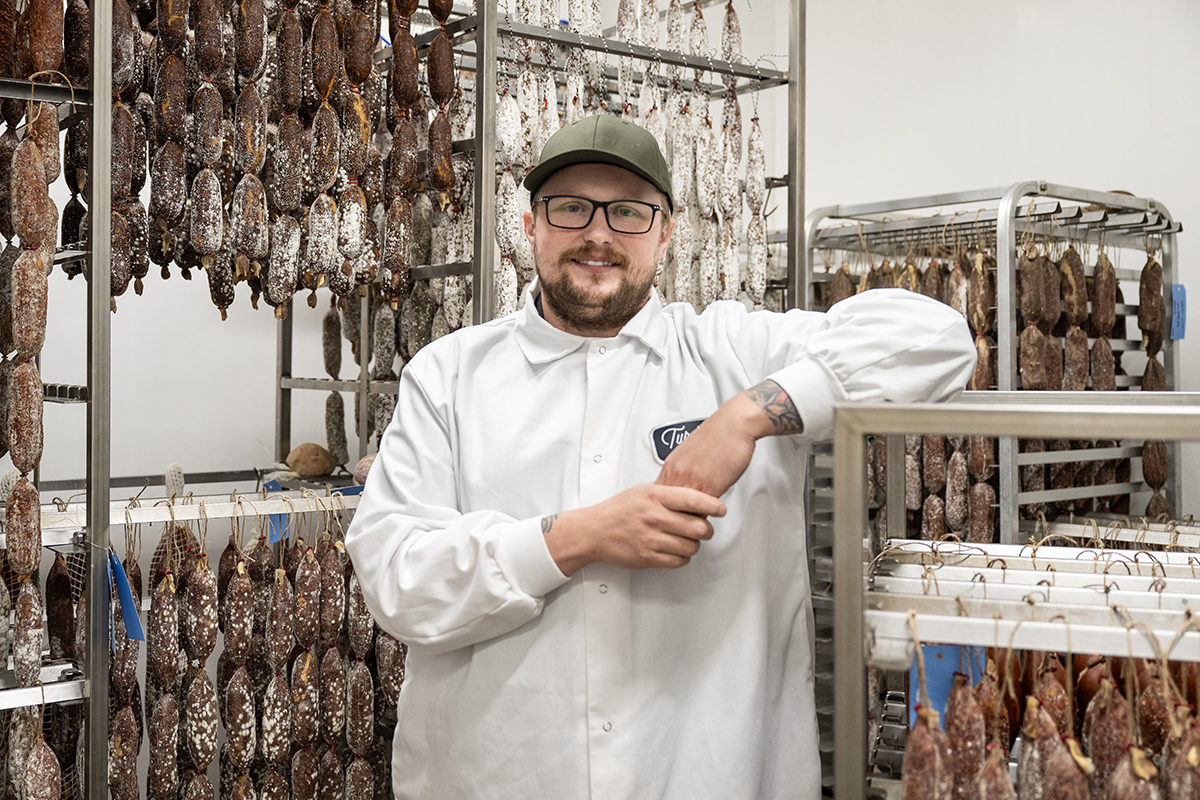
“We’re attacking the salami and deli meat category, which is about a $100 billion market cap right now, and it’s just growing every year,” Turkette said. “I can count on this hand how many other major salami producers I would compete with nationwide, and on this hand, I can count the amount of deli producers that I would compete with nationwide. My category is very small.”
To Turchetti’s advantage, the company became a USDA-certified shop in 2019. The designation allows sales in states other than Indiana.

“[Salami] is probably one of the most regulated, difficult meat products to produce in the United States,” Turkette said. “It is a shelf-stable, fermented product that is not heat-treated. So a lot can go wrong.”
Turkette credits Jake Budler, head of platform and portfolio success for scale-up accelerator Endeavor, for suggesting San Francisco-based Wefunder as a crowdfunding facilitator.
Budler said it’s advantageous to connect with an existing community of supporters.
“Turchetti’s has built an incredibly strong, loyal customer base who are more than willing to say, ‘I’m supporting this brand, and I want to take the opportunity to invest in this brand,’” Budler said.
Raising capital
Turkette learned more about the crowdfunding platform from Brooke Vaughn, the founder of Louisville-based Please & Thank You coffee and cookie chain who grew up in Indianapolis.

Please & Thank You recently raised $680,000, with most of the investments made via a Wefunder campaign.
Vaughn said high-interest capital loans have been the norm for what’s available to similar companies since the pandemic.
“It’s been very difficult to get funding in the food and beverage industry,” she said.
Please & Thank You and Turchetti’s used different strategies facilitated by Wefunder. For Please & Thank You, money was raised through a revenue-sharing format.
Vaughn said sharing her company’s financials on the Wefunder website was a helpful exercise in transparency.
“It completely changed the way I felt about crowdfunding,” Vaughn said. “It made me talk about my business growth out loud, which I realized I had never really done before. It had only been within my team. It made me organize myself in a way and communicate in a way where we attracted a lot of people who are very interested in helping us grow.”
Turchetti’s outlines the following projections as part of its Wefunder campaign (revenue/profit):
◗ 2025: $750,000/$100,000
◗ 2026: $1.5 million/$250,000
◗ 2027: $3 million/$600,000
◗ 2030: $20 million/$5 million
In contrast to a revenue-sharing model, Turchetti’s is issuing convertible notes to its Wefunder investors. According to the campaign, investors receive 5% annual interest, and their investment converts into equity at a future funding event. The maturity date is April 1, 2027. If no priced round happens before this date, the note converts into equity at a valuation cap of $2.5 million.
“The convertible note is enticing for both parties,” Turkette said. “I’m not selling off that equity yet. I still get to manage the company without these equity investors coming in. I get to really boost it for two years on our own, and then it’s not immediately owed back as a loan. From our end, we get the capital in, and we get to work with great partners. But we don’t have to pay it back right away.”

The butcher’s background
Turkette is a fourth-generation Italian American, with 1901 U.S. immigrant Rosino Turchetti giving the company its name.
After growing up in Fort Wayne, Turkette worked as a guitar tech on music tours—including one by Selena Gomez. His food career began in the Ivy Tech Community College Culinary Arts Program, and Turkette worked at Indianapolis restaurants such as Pizzology and Cerulean before Turchetti’s debuted in 2017.
Turkette said the company was built on shelf-stable salami, and Turchetti’s now produces eight flavors of the cured meat.
“Salami is my favorite thing to make,” he said.
In 2019, Turkette’s efforts were recognized with a selection to Forbes magazine’s 30 Under 30 list in the category of food and drink.
Lance Shade is chief operating officer for Moody’s Butcher Shop, which previously carried Turchetti’s products at stores in Indianapolis, Avon, Zionsville and Fishers.
“He’s using only quality cuts,” Shade said of Turkette. “There’s no fillers. There’s no preservatives, no colorings or extractives. It’s really Old-World-style cured meats. I think that resonates with customers.”
Although Turkette was a prominent advocate early in his career for using all parts of an animal, he no longer adheres to a “whole animal” philosophy to processing meat.
With no restaurant business, there are fewer applications for byproducts such as fat used in a fryer. Turkette also said it was unsustainable to have $100,000 worth of byproduct accumulated in the shop’s freezer.
“I was young,” he said. “At 25, I think I was making some decisions for accolades and recognition. I’m 34 now. I’m making decisions for the growth and the health of the business.”
Adding staff
Turkette said the Wefunder campaign will help Turchetti’s hire two to three people to work in the production facility. Since December 2022, Turkette has been the lone production staffer.
“I can spend more money on these people, pay them a higher salary and have career people inside of here in the right positions,” he said. “Early on, it’s going to be tough because I am looking for career-focused individuals. I know nobody is going to have experience in this field, and that’s 100% fine with me.”
Turkette also plans to invest in automation equipment that will help the company compete on a national level.
“There’s something sexy about doing everything by hand, but that’s just not scalable,” he said.
Turkette is hiring Indianapolis-based CODO Design to work on a rebranding of Turchetti’s.
CODO, known for working on visuals for craft beer companies such as Big Lug and Colorado-based Prost, has yet to formally begin the Turchetti’s project.

When asked to predict a plan for catching eyes in a supermarket setting, CODO co-founder Isaac Arthur said it would be logical to anticipate a combination of vibrant colors and Old World aesthetic in the rebrand.
“I know these are two completely distinct ideas, but merging those is probably where the magic is going to happen,” Arthur said.
Popular cuts
Arthur said supermarket shoppers are accustomed to seeing the labels of deli-meat specialists Boar’s Head, a 120-year-old company based in Florida, and Applegate Farms, a New Jersey brand acquired by Hormel Foods in 2015.
“You really just see a handful of commodity brands,” Arthur said. “There’s nothing premium that has a small craftsman’s touch on it, unless you get into specialty shops. I think [Turkette] is eyeing more everyday settings.”
Turchetti’s recently landed a contract with Needler’s Fresh Market in downtown Indianapolis, marking the first retail agreement locally since the Fountain Square restaurant closed.
Smoked turkey breast is the top-seller among Turchetti’s products, Turkette said. Salami, meanwhile, surges at specific times of the year.
“Prepared sliced charcuterie trays that you see in grocery stores are always popular, but they definitely have an uptick during holiday seasons,” Turkette said. “Millennial and Gen Z moms are at home making charcuterie boards and posting photos to the internet—which I love. That only helps what we’re doing.”
Moody’s COO Shade said the time is right for Turchetti’s to pursue growth.
“Specialty charcuterie is continuing to gain in popularity, certainly with my customers and with different cured meats you’re not going to find at a typical supermarket,” Shade said. “Those are the things we look for, and those are the things that Turchetti’s can provide.”
Budler, the executive at scale-up accelerator Endeavor, said premium meat production is an attractive field for growth. As Turkette says, Indiana is home to more pigs than people.
“We have a full history of brands that have come out of Indiana,” said Budler, noting that restaurant chain Texas Roadhouse launched in Clarksville in 1993. “The ecosystem is so complete, because we have producers, we have manufacturers, we have wholesale processors, and then we have consumer brands.”
Turkette’s talent and experience should serve him well, Budler said.
“He’s built a successful company as it is,” Budler said. “Now he’s pivoting to say, ‘On the [consumer packaged goods] side, I see this huge opportunity. I think we’re getting traction here; I’m going to actually go for it and do it.’”•
Please enable JavaScript to view this content.
Editor's note: You can comment on IBJ stories by signing in to your IBJ account. If you have not registered, please sign up for a free account now. Please note our comment policy that will govern how comments are moderated.