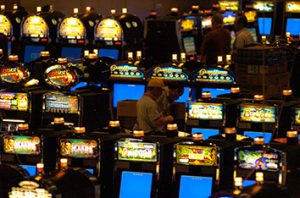
Indiana racinos raise concerns with lawmakers
Officials with casinos at Indiana’s two pari-mutuel horse racing tracks told lawmakers today that taxes imposed on them are
too high and are threatening their viability.
Officials with casinos at Indiana’s two pari-mutuel horse racing tracks told lawmakers today that taxes imposed on them are
too high and are threatening their viability.
Indiana’s share of tax money generated by the state’s 13 casinos is expected to remain relatively flat for at
least the next few years, a state fiscal analyst told Gaming Study Committee members this morning.
Indiana has made billions on gambling in nearly two decades, funding key programs, cutting excise and property taxes, and
avoiding tax hikes. The state has seen more than $2 billion in investment without any government incentives,
and more dollars committed in our history than by any industry outside of steel, power and autos.
In a saturated gambling market, Indiana casinos increasingly rely on expanded entertainment options to
attract patrons. The upshot is that an industry once considered “recession-proof” is asking
the General Assembly for lower taxes and hopes to eliminate expensive regulatory requirements like maintaining engines
and crews.
Indiana’s struggling gambling industry didn’t get the relief it sought during the special session of the Indiana General Assembly. But embedded within the budget bill approved June 30 is a provision creating a gambling summer study committee. Its recommendations, due by Dec. 1, may make or break several of Indiana’s casinos.
When we read that all the Democrats in the House voted against all the Republicans in the House on a given issue, we know independence has been cruelly killed by the leadership of each party. The same applies to the Senate.
The state’s overreliance on gambling, what once seemed like easy money, is becoming a major concern to taxpayers.
Hoosiers’ long ride on the gambling gravy train finally may be coming to an end.
Centaur is lobbying the Indiana General Assembly to let it transfer 500 slots from its Hoosier Park horse track in Anderson
to the Fort Wayne area.
The next few weeks will be critical for the state’s two new racinos, which need to open with a splash to meet their ambitious
projections of drawing more than 3 million visitors apiece annually. Hoosier Park in Anderson will open June 2, and Indiana
Downs in Shelbyville will follow a week later.
Indiana riverboat casinos don’t go up for sale every day. So when one becomes available, it’s bound to spark interest. Hence,
the dilemma facing Centaur Inc., the Indianapolis-based casino developer.
Through persistence and sheer pluck, Rod Ratcliff has become a player in the gambling industry–one many businesses try to
break into, most without success. On Oct. 30, his Indianapolis-based company, Centaur Inc., closed a $1 billion financing
deal that will fund gambling projects in three states.
The high-stakes competition for control of Indiana Downs has entered the homestretch. And South Bend-based Oliver Racing LLC
is poised to win.
During their first half-decade in operation, the state's casino slots machines grew their total sales to $22 billion,
according to Indiana Gaming Commission records. But in the last five years, slot sales grew just 18 percent, reaching $25.9
billion in 2006. That's what business textbooks call a maturing market.
French Lick Resorts & Casino is already struggling, less than four months after its launch. And the casino’s owners are downright
terrified legislators soon will allow both of the state’s horse-racing tracks to become “racinos” and add up to 5,000 slot
machines.