
Subscriber Benefit
As a subscriber you can listen to articles at work, in the car, or while you work out. Subscribe Now
George Floyd’s murder in May 2020 helped shine a spotlight on diversity, equity and inclusion issues—and on the companies and organizations that publicly proclaimed their support for the cause.
But five years later, some of those entities are quietly moving away from DEI.
Whether out of fear of losing federal funding, a desire to avoid litigation or a reluctance to seem political, organizations are changing the way they talk about diversity—if not outright cutting back on their pro-diversity efforts.

On Jan. 20, his first day back in office, President Donald Trump ordered federal agency heads to “take immediate steps to end Federal implementation of unlawful and radical DEI ideology.”
Local consultants say they’ve been busy with DEI-related client queries ever since.
“Anybody who’s a federal contractor, getting any type of federal funds at all, are completely eliminating” the words diversity, equity and inclusion, said JoDee Curtis, founder and owner of Carmel-based human resources consulting firm Purple Ink LLC.
And even if they don’t receive federal funding, companies might choose to move away from DEI language because they don’t want to be perceived as making a political statement, Curtis said.
“‘Diversity,’ now, I think that word will forever be linked with Trump as something he doesn’t like,” Curtis said.

Indianapolis attorney Doneisha Posey, who specializes in civil rights and immigration law, said her clients are also changing their language in response to the current political climate. Posey is founder, owner and CEO of consulting firm Impacto Strategies.
Clients that previously talked about their DEI or diversity efforts might now be talking about those same efforts with words such as “community” or “strategic engagement,” Posey said. “What we are seeing is a change in language, a change in how they are presenting publicly, but continuing to do the work that they’ve been doing.”
Curtis said some companies that never really bought into the concept of diversity might drop those efforts now that public sentiment has cooled.
But others, she said, will continue the work. Curtis noted that her firm is still fielding queries from companies interested in what they are now calling civility training or cultural sensitivity training. “I think that there are other words [besides diversity] that companies are using.”
New language
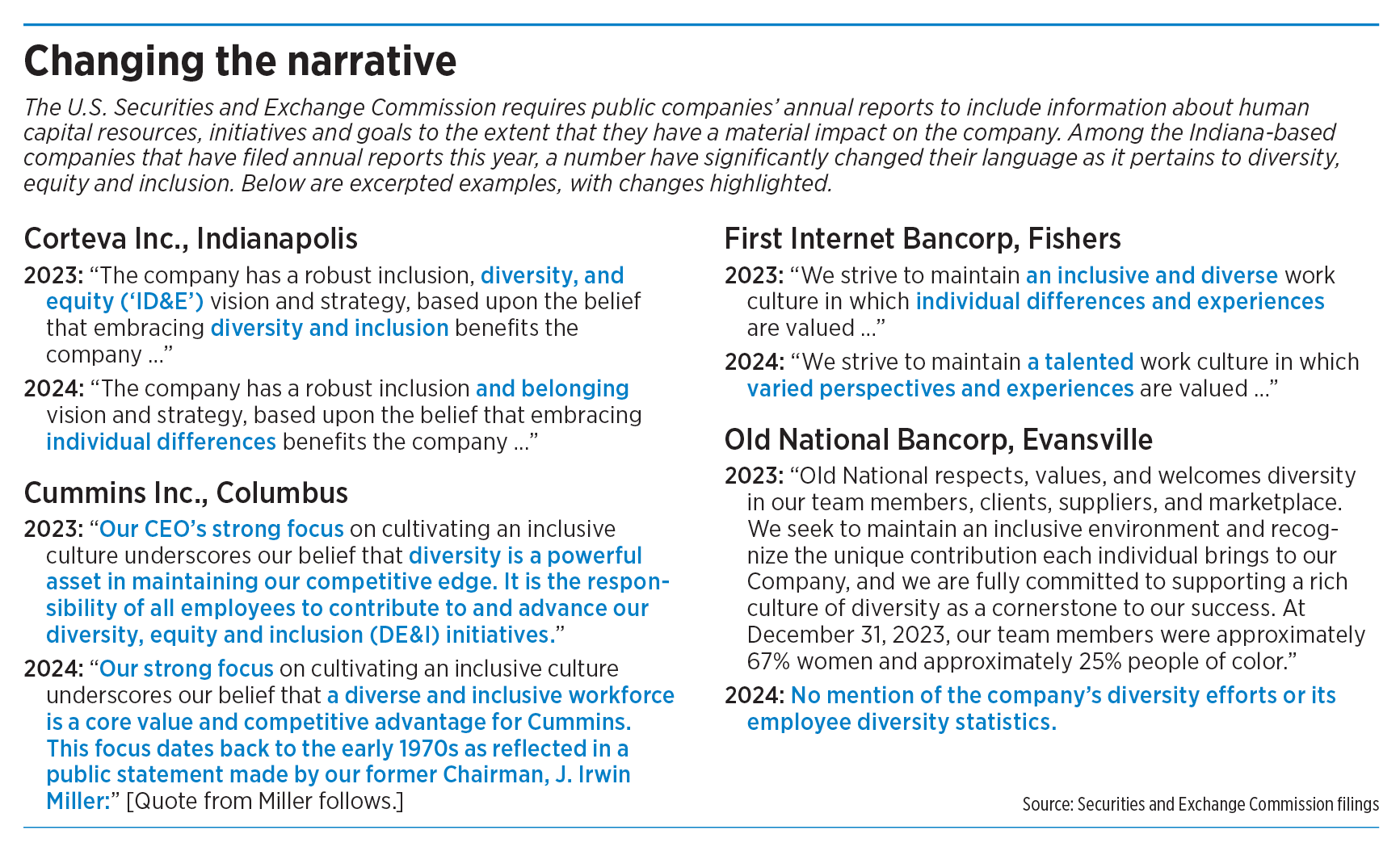
This shift is also evident among Indiana-based public companies, some of which have made noticeable changes in how they talk about DEI-related matters—or whether they talk about them at all—in their annual reports.
Indianapolis-based Corteva Inc., for instance, said a year ago in its 2023 report that it had “a robust inclusion, diversity and equity (‘ID&E’) vision and strategy.” In its 2024 annual report, released Feb. 14, the company said it had “a robust inclusion and belonging vision and strategy.”
Columbus-based Cummins Inc. changed its wording more dramatically over the past year.
In its 2023 report last year, Cummins used the phrase DE&I multiple times, detailed the gender and racial diversity of its board and senior leadership team, and mentioned an employee-led initiative “which seeks to dismantle institutional racism and foster systemic equality.”
The company’s 2024 annual report, released Feb. 11, did not use the phrase DE&I, nor did it mention its leadership’s diversity or the employee-led initiative. Instead, the company framed its commitment to diversity and inclusion in historical terms: “At Cummins, our commitment to inclusion dates back more than a half-century and continues to be core to our fabric and continued success.” The company underscored this point by including a quote from former Chair J. Irwin Miller, who served in that role from 1951 to 1977.
“Character, ability and intelligence are not concentrated in one sex over the other, nor in persons with certain accents or in certain races or in persons holding degrees from universities over others,” the quote from Miller said. “When we indulge ourselves in such irrational prejudices, we damage ourselves most of all and ultimately assure ourselves of failure in competition with those more open and less biased.”
In this section of the 2024 annual report, Cummins also included a statement affirming its commitment to following the law, including “U.S. and global laws and regulations related to civil rights and anti-discrimination.”
Corteva, Cummins and several other companies contacted by IBJ declined to detail why they had made these changes.
“We regularly evaluate all our business strategies and practices, including those relating to people and culture, and adjust where appropriate to ensure they reflect customer feedback and current business conditions,” Corteva spokeswoman Caroline Ahn said via email.
Cummins spokeswoman Melinda Koski said via email that the company updates its reports annually “to include changes to awards, activities and language that are specific and pertinent to that year—and that help us best share our story.”
‘Lots of questions’
Posey said she began getting diversity-related questions from corporate clients in mid-2023 following the U.S. Supreme Court’s ruling that colleges and universities could no longer consider an applicant’s race when making admissions decisions.
She said the volume of diversity-related client queries picked up late last year after the election, and she saw another bump once Trump and Republican Gov. Mike Braun took office in January. One of Braun’s first acts as governor was to order the closure of Indiana’s Office of Equity, Inclusion and Opportunity, which had been part of the Governor’s Office.
Posey said a lot of her work right now is coming from nonprofit clients that rely on federal funding—either directly from the government or indirectly from sources that rely on federal funding.
“They have lots of questions,” she said.
Corporate clients, Posey said, are more concerned about the risk that they could end up on the receiving end of a DEI-related lawsuit.
To mitigate their DEI-related risks, Posey said, clients are asking her to assess their policies and procedures. She’s looking at everything from the words and images on a client’s website to the language in their job descriptions, employee handbooks and diversity statements.
The work is complicated by the fact that the rules of the game aren’t clear, Posey said.
“Both at the state level and the federal level, the conversation about DEI has been vague,” she said. “It’s only been eight weeks of this new administration, and we’re just seeing things happen very quickly and without much guidance.”
‘Pick a lane’
Jennifer Dzwonar, a partner at Indianapolis-based marketing communications firm Borshoff, said the current air of uncertainty is also sparking a lot of conversations at her firm. Borshoff’s areas of expertise include crisis communications and issues management.

“As the new administrations on the state and federal level have come into office and started making significant changes, we have been asked many times in the last few weeks and months [about] how to respond to the fluctuations,” Dzwonar said.
As Dzwonar sees it, organizations have five response choices: Make minor changes to their diversity-related language but no change to diversity activities; make major language changes but no change to activities; make no changes to language or activities; keep diversity-related language while overhauling diversity activities; or overhaul both the language and the activities.
Different approaches will make sense for different types of organizations, she said, and each approach has its risks and benefits.
A nonprofit, for instance, that declares it is not changing its DEI strategy might pick up some new donors while losing others. In contrast, a public university might decide it needs to change its language and suspend its DEI activities because it doesn’t want to risk losing state or federal funding.
Dzwonar said the most important thing is for an organization to decide on an option and stick with it.
“Pick a lane and be clear about your lane, and don’t drive all over the highway,” she said. “Don’t switch all over the place, because that’s when you create chaos.”•
Please enable JavaScript to view this content.
Impacto Strategies isn’t linked in this article.
What is MAGA’s problem with inclusion?
Basically MAGA feels that too much attention was put on ones race or gender to automatically qualifies you for a job. So if your company has four openings you had to make sure you reached your quota to show the previous administration that you did your part in hiring a minority. This has later been viewed as reckless policy that didn’t always guarantee you would pick the best person for the job. Companies were just picking someone simply because they were a minority or a woman just to meet the demands of the government. A lot of times even the blk person wasn’t picked and so DEI wasn’t exactly the best way to get the best person for the job. It should be based of your merrits and not your race of gender. It makes for a more competitive pool and a better workforce to pick from. Skills, talent and over all academic test scores dont lie
If you think we have ushered in a new era of hiring that doesn’t look at race and gender and instead hires based on “merit, excellence, and intelligence”, I think you will be very underwhelmed. I mean, the initial rollout at the federal level has shown to be a total disaster, as Nancy pointed out.
I think it will be interesting when more white women realize that the push to get rid of DEI is a push to “put them back in their place”.
If MAGA was truly committed to jobs based on merit, it would not be using the TLI (Trump Loyalty Inclusion) method as the main qualification when to hiring cabinet members etc. Particularly for positions where the life and death of Americans are at stake ie, Defense, Health and Human Services and on and on.
Any time that you consider race, gender, etc in the hiring decision, that is by definition (look it up) DISCRIMINATION. They are moving away from it b/c it’s wrong.
TLI is not a consideration, it is the #1 requirement regardless of qualifications.
Companies and public sentiment are shifting because the Federal and State Republicans have weaponized the idea of DEI and made it toxic. At this point the Federal Government is going so far as to punish anybody that receives federal dollars if they even mention DEI. I’m sure if I had millions of dollars at stake I could shift my attitude pretty quickly. You could try to sue the Federal Government on 1st amendment grounds, but good luck with finding a law firm that would take your case because of punitive actions by the Trump administration.
It’s amazing how fast “sentiment” shifts under the thumb of an authoritarian regime.
Diversity = No white men.
Equity = Desired outcomes that specifically disfavor white men.
Inclusion = Exclusion of white men.
Seems completely fair. Can’t see why anyone would have a problem with this policy continuing for all time.
What a sad victim mentality. DEI is a framework for decision making to ensure organizations aren’t being blindly led by the biases of their entrenched in-groups, which historically have favored white men.
“When someone is accustomed to privilege, equality feels like oppression.”
(This is coming from a white man in a highly-diversified sector, by the way.)
Exactly. You are so right. White men can never be victims. Just as black people cannot be racist.
“No one is seeking to exclude or give any white man any less of an opportunity than their non-white, non-male counterparts.” – So true! No one at all has ever implemented DEI in an anti-white racist manner. There are zero examples of this. Completely agree. Great points.
You can only beat a dead horse for so long, then it’s time to bury it.
Too often, the concept of DEI gets misrepresented in the media, turned into a political talking point rather than what it truly is: a smart and necessary workforce strategy. The narrative gets twisted, and people are left with the impression that DEI is about unfair advantage, when in reality, it’s about expanding opportunity—for everyone. Employers across industries are struggling to fill open roles. While many job seekers focus on white-collar positions and feel overlooked—like they deserved that one accounting role—there are countless openings where employers simply aren’t getting enough qualified candidates. Only one person gets the job, and unfortunately, disappointment can quickly turn into blame. But as someone who has spent over 20 years in recruiting and career coaching, I’ve never seen someone get passed over because of a “quota.” There are always multiple factors at play. A solid DEI strategy isn’t about lowering the bar. It’s about widening the lens. It’s about going beyond the usual channels—attending job fairs for military veterans, partnering with organizations that support individuals with disabilities, considering qualified candidates who are re-entering the workforce after involvement with the justice system, and tapping into the over 55 workforce. It’s about creating apprenticeships, mentorships, and outreach programs for skilled trades and engaging early with high schools and community groups. It’s fair for companies to reassess their DEI strategy—to rename it, reshape it, and realign it with their culture, industry, and values. But the data is clear: more diverse teams lead to better decision-making, more innovation, and higher profitability.