
Subscriber Benefit
As a subscriber you can listen to articles at work, in the car, or while you work out. Subscribe NowOne of the most interesting things we read this week was an op-ed column in The Indianapolis Star from Oklahoma City Mayor David Holt headlined “I’m the OKC mayor. Copying Indy’s sports strategy brought us to the NBA Finals.”
Holt writes that in the early 1990s, Indianapolis and Oklahoma City competed vigorously for a United Airlines maintenance hub that had promised some 7,000 new jobs. Indy won the deal (although those jobs didn’t last), which left Oklahoma City seeking information about why.
United officials told the Oklahoma officials that Indianapolis had won in part because it offered a thriving central city. So then-Mayor Ron Norick got on a plane to learn more about Indianapolis and found that where Oklahoma City had been “hollowed out by urban renewal, an oil bust and a banking crisis,” Indianapolis had a vibrant downtown and major sports teams.
“Indianapolis—previously ourfoil—was now our inspiration,” Holt writes.
Oklahoma City launched an initiative focused on quality of life with an emphasis on revitalizing its downtown. It approved a temporary sales tax to fund construction of nine projects, including the arena its NBA team now plays in. It has since been on the upswing with low unemployment, major developments consistently coming online, new restaurants and entertainment districts, and more.
Holt writes that the fourth iteration of the city’s original revitalization plan—this one backed by $1.1 billion in spending—is being implemented now.
Many of those same attributes can be said of Indianapolis. There are major projects underway downtown—including a new Indiana University Health hospital campus, an overhaul of the City Market block and the old city hall block, and a complete rethinking of Circle Centre Mall. Unemployment here is also low. Major sports events are on the calendar.
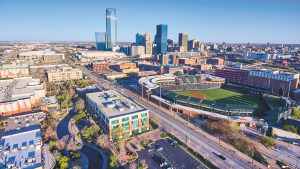
But reading the Oklahoma City story makes us wonder whether there’s more work to be done in developing an updated overall strategy for the city and for downtown, in particular.
We don’t mean to imply the city is rudderless. Mayor Joe Hogsett has a Downtown Resiliency Strategy, which was introduced in 2022 and was meant to guide post-pandemic recovery. The city’s website lists the strategy’s goals, but it doesn’t provide any updates on the plan’s progress.
Still, it is in motion. In March, for example, the Department of Metropolitan Development announced the start of construction on the Cole Motor adaptive reuse project, an $84 million redevelopment of a former jail building. City officials described the project as “one of the signature ventures” of the resiliency plan.
Last fall, the Indiana Sports Corp. unveiled 2050 Vision, a framework intended to boost the state’s efforts in landing big sports events, becoming a women’s sports hub, and promoting sports business, technology and academic opportunities.
We know Indy Chamber has been looking at long-term planning options for the city, as well.
There might be behind-the-scenes talks about how to bring all of these discussions together into one long-term strategy. If not, there certainly should be. The opportunities are tremendous—and we don’t want to let our competitors get too far ahead of us before we act.
Maybe this Pacers-Thunder series is just the inspiration we need.•
__________
To comment, write to [email protected].
Please enable JavaScript to view this content.
Indy can be and, in my opinion, should become a modified, “Nashville-North” with more than a country music focus. There are segments of the city that lend themselves to the development of many different music genres. ie, the Indiana Avenue area lends itself to blues and jazz as a natural bow to 100 years ago and Wes Montgomery and others. The south-side of downtown might lend itself to country and maybe Broad Ripple to Rock and pop. Lastly, this will only work if the Mayor and Prosecutor get control of violent crime.