
Subscriber Benefit
As a subscriber you can listen to articles at work, in the car, or while you work out. Subscribe Now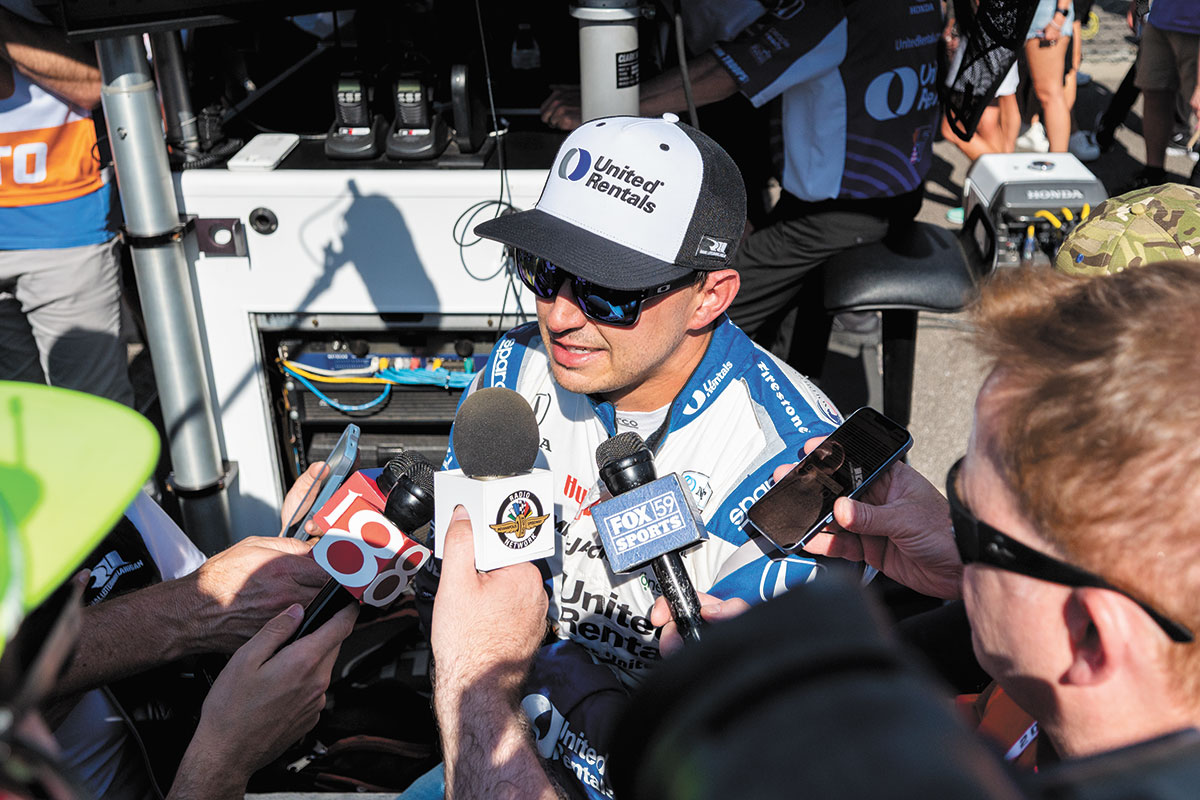
For IndyCar driver Graham Rahal, the need to secure sponsors never ceases, especially in the run-up to the Indianapolis 500, one of the biggest weekends in motorsports.
Rahal, one of three drivers for Zionsville-based Rahal Letterman Lanigan Racing, has been in racing since he was 11 and in IndyCar since he was 18. He grew up around the sport, watching his father, Bobby, on the track.

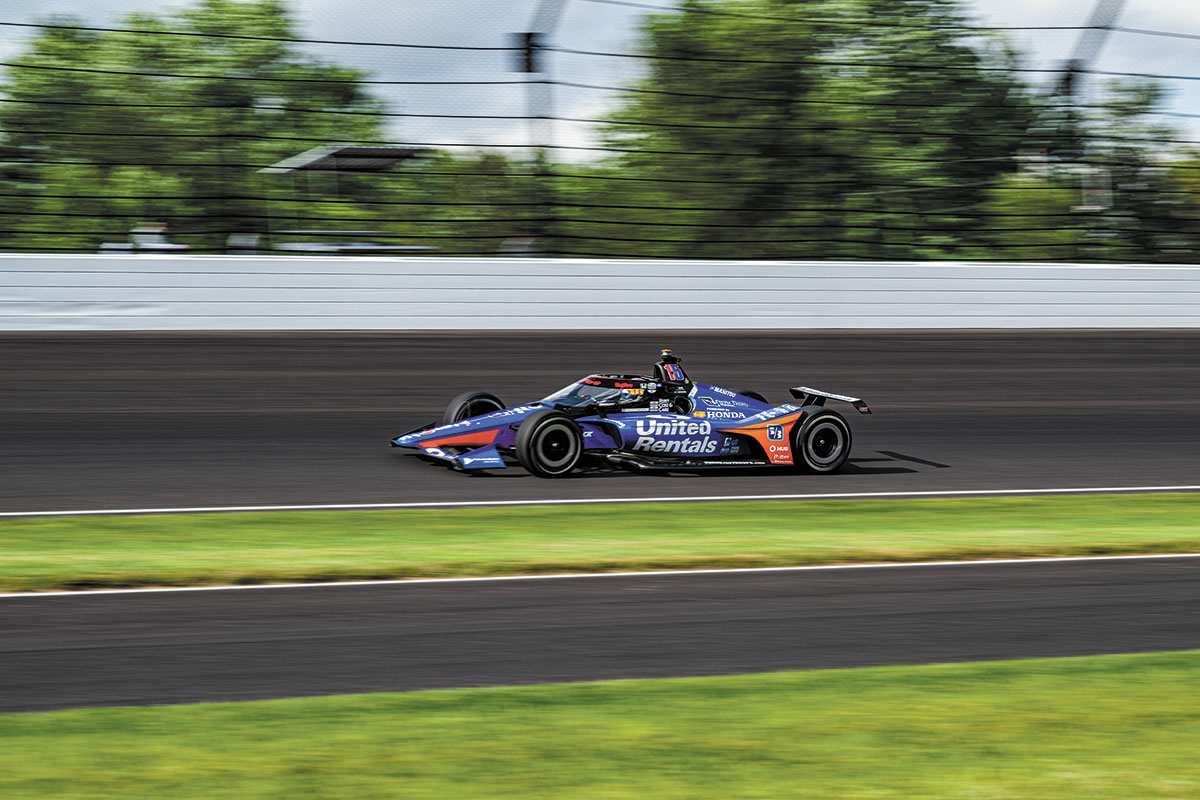
The 36-year-old has had the same primary sponsor—United Rentals—since 2016. But putting a car on the track requires dozens of sponsors. In fact, Graham Rahal said his IndyCar season lives and dies by those partnerships.
“The difference with IndyCar racing [from other sports] is that if United Rentals or Fifth Third Bank or Mobile One or any of the others don’t sponsor me, I don’t go racing, period,” Rahal said. “As a driver, I take that to heart in every single regard. So I think we’re way more engaged in what’s going on and in trying to make sure that sponsors are coming in because our livelihood 100% depends on that.”
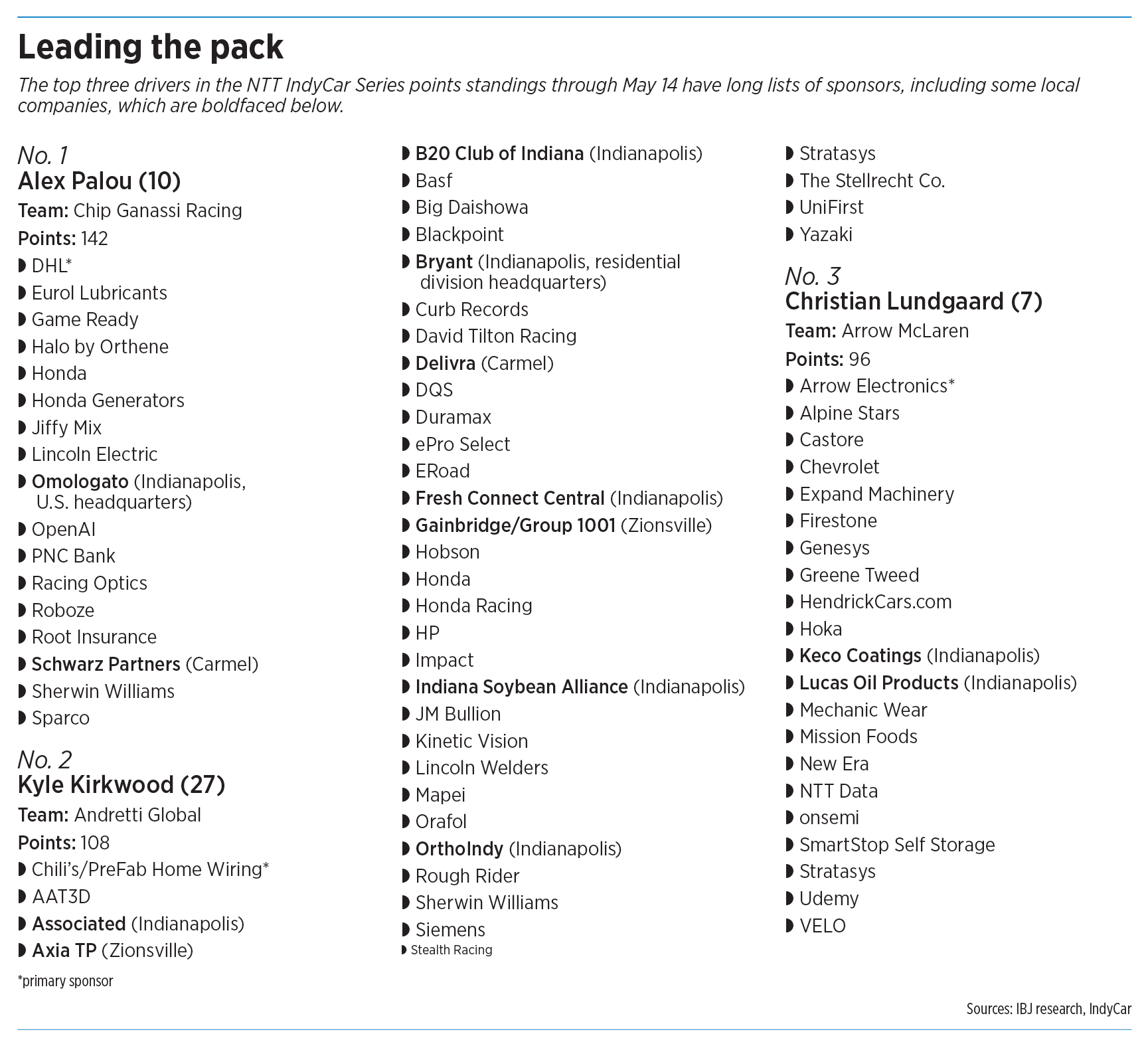
Rahal isn’t alone. Teams across IndyCar and all motorsports depend on support from corporate partners, typically in exchange for placement of logos on their cars and racing suits as well as other perks like driver access and the use of hospitality suites.
A wide range
Rahal and representatives of other teams declined to tell IBJ how much sponsors pay to put their logo on the front of cars or on the arm of a racing suit. Teams keep their pricing models close to the vest, in part to give them more negotiating power.
But the most successful teams and most popular drivers can secure significantly more lucrative deals than those who are new to IndyCar or who are driving slower cars.

Rick Cuellar, vice president of commercial services at motorsports marketing firm Right Formula, said some smaller teams might price a season-long, primary sponsorship deal at $3.5 million to $4 million per car, while larger teams can generally fetch as much as $10 million.
Entry-level sponsorships also range widely, from tens of thousands of dollars on the low end to multi-millions of dollars for premium placements on the car of one of the league’s leading drivers.
And the precise placement on the car greatly influences the cost. The sides of the car (generally reserved for a season-long, primary sponsor, such as Rahal’s United Rentals), the wind flaps and even the car’s protective aeroscreen command the highest investments from sponsors, experts said. That’s because those spots get the most visibility during television broadcasts and online replays.

Ken Ungar, president of Zionsville-based Charge, which helps athletes secure sponsorships and works with Honda on its IndyCar deal, said teams on average seek about $6 million to $7 million in total sponsorships per car per season. But he said that amount can vary widely depending on a team’s prominence in the sport.
“With a premium team, you’re going to have premium pricing,” he said.
In addition to the side of the car and the aeroscreen, ads inside and around the cockpit—on the side mirrors and the steering wheel—have become increasingly popular, Ungar said.
Sponsorship packages typically include patches on a driver’s uniform. But placement matters there, as well. An unexpectedly popular spot is the underside of the arm, which is visible when drivers are getting in and out of their cars or celebrating a victory.
“You have to take a look at what the angles are from cameras that are being used at any given time in any given race, and you react accordingly,” said John Olguin, executive vice president of business operations for Chip Ganassi Racing.
He said teams focus on finding new and potentially lucrative placements to incorporate into the packages—called “programs” by motorsports teams—that they offer to current and prospective sponsors.
“It makes sense to take advantage of what you can to get more branding for your partners or give yourself more opportunity to sell new areas that you weren’t selling before,” Olguin said.
And while most sponsors sign on with teams, drivers sometimes have sponsorship deals of their own. But displaying those logos can mean drivers must purchase space on their car. In other cases, teams might allow a driver to put a logo on a helmet.
The Indy 500 gamble
Most drivers and teams are looking for sponsors that will help them pay for a season of races. But to fill the Indianapolis 500’s field of 33 cars—and take advantage of the season’s largest purse—many teams add another car just for the Memorial Weekend race.
That can cost at least $1.5 million per car, money that sometimes comes from companies that only want to advertise during the biggest race of the year. Cuellar said, in fact, that some sponsors wait until just a few weeks before the race to commit to a team, hoping they can nab a prominent place on a special-entry car for as little as $500,000.
Even if that car doesn’t make the race (typically at least one or two drivers are bumped when the field fills up), sponsors still benefit from exposure during qualifications, practice sessions and other on-track activities throughout May.
Arrow McLaren, whose IndyCar team is based in Indianapolis, plans to run a fourth car in this year’s Indianapolis 500 driven by Kyle Larson, a NASCAR champion who is planning to attempt what’s known as “The Double.” That means he’ll race in the Indy 500 on May 25 before flying later in the day to Charlotte to race in NASCAR’s Coca-Cola 600.
Lauren Gaudion, vice president of marketing and communications for Arrow McLaren, said the additional car provides an opportunity to “bring in more partners and create another marketing buzz that we’re able to sell and market throughout the month” of May. And the Larson car could be especially attractive to sponsors, as the TV broadcast is likely to pay special attention to his progress.
Arrow McLaren—who’s regular drivers are Pato O’Ward, one of the league’s most popular names, as well as Christian Lundgaard and Nolan Siegel—also works with its existing sponsors to consider making a bigger splash during the Indianapolis 500 weekend.
The cars are “on track for two weeks, versus just two extra days that you have with other race weekends,” she said. “So, we’re able to add a bigger price tag to that, just because of the size of the event in whole.”
In 2023, Graham Rahal was bumped from the Indianapolis 500 by a teammate, which meant that his stable of sponsors would miss out on what Cuellar said is typically millions of dollars in exposure value from the race itself.
But when Dreyer & Reinbold Racing/Cusick Motorsports’ driver Stefan Wilson was injured during a practice, Rahal was given the opportunity to race in his stead—in Wilson’s car. Typically, that would leave Rahal’s sponsors out of luck, given that the car they had sponsored didn’t make the race.
But Rahal Letterman Lanigan Racing worked out a compromise with the Dreyer & Reinbold team that allowed some of Rahal’s sponsors, including United Rentals, to have logos on the new ride while still keeping CareKeepers and Sierra Pacific Windows as the car’s primary sponsors.
“Ultimately, it worked great,” Rahal said.
But he acknowledged that if he hadn’t been able to include his key sponsors in some way, he probably wouldn’t have accepted Dreyer & Reinbold’s offer to drive the car. “It probably just wouldn’t have been a fit for us,” he said. “But all of those things kind of came together in a hurry but worked very effectively.”
Navigating a new landscape
Cuellar said that although sponsors that back IndyCar teams—or the series itself—generally consider their investments in the sport to be hefty, companies would actually pay much more to be a sponsor in another major sport.
That’s because IndyCar ratings just aren’t as high as for the NBA, NFL or other professional leagues—something IndyCar is trying to improve through a new broadcast deal with Fox that put all 17 of the season’s races on network TV in 2025.
Five races into the season, the viewership numbers are better than last year.
“The exposure given back to partners has been a slight challenge for IndyCar, and that maybe has prevented some of the other more commercial brands from jumping in,” Cuellar said. “A lot of things feed off of what the TV numbers are, and that’s an evolving landscape in itself with streaming and all of the ways fans consume sport. But TV is a big one.”
Longtime IndyCar driver Ed Carpenter, whose eponymous race team also rosters Alexander Rossi and Christian Rasmussen, has leaned heavily into sponsorship deals as the only current owner-driver in the league. In September, he made a deal with the owner of Heartland Food Products Group to not only buy a stake in the team but to be the chief sponsor of the team’s liveries.
The deal put Carmel-based Heartland’s Java House brand onto new team member and former Indy 500 winner Rossi’s car in a sleek black-and-orange color scheme. It also further cemented another Heartland brand, Splenda, as the primary sponsor for Rasmussen.
For Heartland owner Ted Gelov, the move has gone far beyond just putting the brands on the side of the car and the driver’s uniforms and is a far more immersive effort to intertwine the team and the food companies’ marketing.
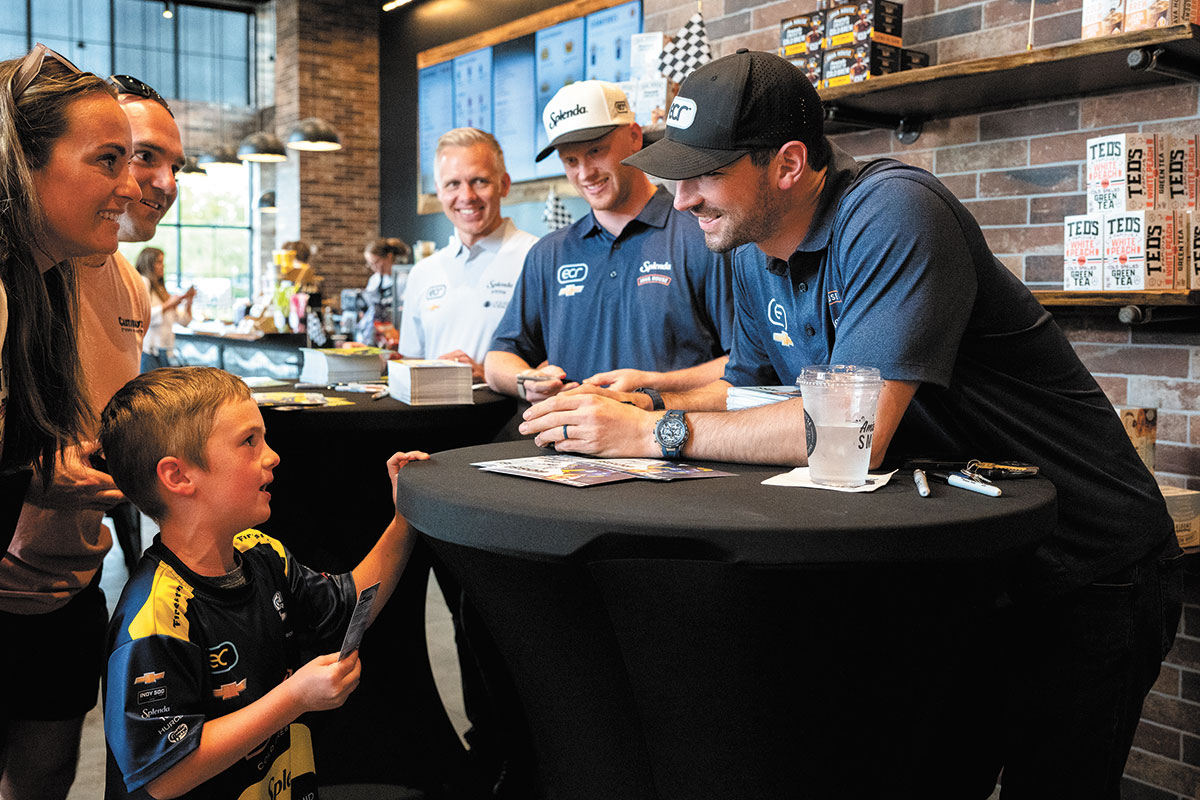
On May 12, the first of what’s expected to be several meet-and-greets with Ed Carpenter Racing drivers occurred at a Java House in Zionsville, with a line that wound through a portion of the building and out the door into the parking lot.
While drivers took photos with and signed memorabilia and placards for fans, they also sipped from signature Java House drinks that are advertised on menu screens behind the counter at every one of the coffee chain’s locations throughout central Indiana.
Gelov said while driver engagements are nothing new as part of sponsorship deals—drivers have made appearances and promoted products for decades—he considers the effort being made by Ed Carpenter Racing to be more immersive. Java House also has a presence at various fan activities during Month of May activities tied to the race, giving away thousands of samples on a given day.
Multiple commercials will also air throughout the month promoting the Heartland brands alongside the drivers, he said, including one that will debut during the Indianapolis 500 broadcast and replay.
“We’re integrating our brands into ECR platform, and that was a key motivator” for the deal, he said. “It’s a partnership that allows for direct consumer engagement and increased brand visibility within the motorsports arena. These are personalities that extend outside [the track], so we generate a lot of benefit from how the drivers interact with fans. We’re having a lot of fun and really amplifying the team and its connections with Java House.”
The sponsor’s perspective
Local investment platform Invst is sponsoring driver Jack Harvey’s car this year in the Indianapolis 500 as part of his entry with Dreyer & Reinbold Racing and Cusick Motorsports. The move marks one of the first of its kind deals for the financial advisory’s CEO, Scott Jarred, but it’s unlikely to be the last.
Jarred told IBJ he views the sponsorship as a tool to build connections between businesses while also helping bring in prospective clients. He structured the sponsorship through a separate limited-liability company he oversees that also includes investments from others in his circle.
“I don’t look at it as a cost, but rather I look at it as an investment to the clients that we serve,” he said. “More importantly, [I think about] how we can all share in something together to help everyone’s business grow.”
Jarred said he is optimistic that the sponsorship will create inroads for future business dealings at Invst and help build connections to the product.
“Some people think it’s a great idea. Most think it’s probably pretty insane and bad, but I just look at what the other people are doing and … I just really want to try to help Jack Harvey,” he said.
Brandon Bernstein is director of partnership marketing for Indianapolis-based Lucas Oil Products, which has been a longtime sponsor of Arrow McLaren and its drivers. He said the company has changed its model to go beyond placing a decal on a car and focus more on creating immersive opportunities to work with drivers through television and social media packages.
“We’ve had to revamp our deliverables and make sure that these teams are doing special pieces and things during the week with the drivers by getting them on social media and going out to the race track,” Bernstein said. “It’s way more in-depth now.”
Lucas Oil has placement on Arrow McLaren’s aeroscreens—which are essentially small windshields—as well as the fin behind the cockpit. It also is exploring other opportunities for sponsorship of the vehicles.
Bernstein said the deal with the Arrow McLaren team, which is being renegotiated for an extended term ahead of the current deal’s expiration later this year, includes both a sponsorship component and research and development. The deal also includes hospitality spaces for major races, including the Indianapolis 500.
“We’re paying a lot of money for these sponsorships,” he said. “And it needs to get some eyeballs on them, because that’s what we’re here to do. We’re here to sell oil.”
Even so, the Arrow McClaren sponsorship accounts for just 5% of Lucas Oil’s entire sponsorship portfolio and budget, he said.
“These days, we are pretty diversified,” Bernstein said. “We’ve got the Colts, the [Dallas Cowboys], Major League Baseball, NHL and even the country music” through the Academy of Country Music Awards.
A broader approach
Charge’s Ungar said digital media has created more avenues for sponsors to get in on the action, regardless of where their name might be on a driver’s ride.
“There’s so many different ways that you can promote your sponsor relationship, that it’s a substantially different modality than we saw, say, 20 years ago, before the advent of these technologies,” he said. “You don’t have to [rely on] TV and radio as hard because you have so many different options for exposure.”
Olguin, with Ganassi, said there’s been a marked shift in how sponsors determine the value of their support for racing teams.
“The days of the 200-mile-an hour billboard are waning,” he said.
He said Ganassi executives work with their sponsors and other prospective partners closely to determine the priorities that a company has in considering whether to throw its weight behind a driver.
“I’ll tell you this: I think now we ask far more questions of our partners, and we probably listen more than we ever have, because we have to understand what’s important to them and how we make it important to us to make a deal work,” Olguin said. “It’s got to be a more all-encompassing program that helps them meet their business goals.”•
Please enable JavaScript to view this content.
Editor's note: You can comment on IBJ stories by signing in to your IBJ account. If you have not registered, please sign up for a free account now. Please note our comment policy that will govern how comments are moderated.