
Subscriber Benefit
As a subscriber you can listen to articles at work, in the car, or while you work out. Subscribe Now Imagine a time when a 15-year-old girl could write a letter to the commissioner of a professional sports league to persuade him to make a major policy change, simply by tugging on his heart strings.
For that matter, imagine a time when a professional sports commissioner had heart strings that weren’t attached to corporate dollars.
Terry Grembowicz can. She wrote a letter to Jack Dolph, overseer of the American Basketball Association, in October 1971 after learning the league would be playing games on Christmas Day that year. One of the games included the team her father coached, so she asked that the schedule be changed.
And it was—eventually.
Grembowicz’s maiden name was Leonard. As in “Slick” and Nancy Leonard. She is the eldest of their five children, the only girl. With four younger brothers, one 14 years her junior, she was often charged with adult responsibilities to help maintain order in the household. Naturally nurturing, her primary motive for asking that the Pacers’ game against the Utah Stars in Salt Lake City not be played on Dec. 25 was that her youngest brothers, Tommy (4) and Timmy (7 months), would be missing Dad on an important holiday.
She wrote out her thoughts and enlisted the help of Lynne Risley, a 1971 Carmel High School graduate who helped the Leonards by performing part-time secretarial duties. Risley, now living in Florida as Lynne Martin, typed the letter, dated Oct. 20, and mailed it to Dolph at the ABA headquarters in New York City.
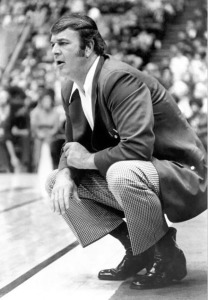
Single-spaced, the plea ran a page and a half. It was polite but firm. After identifying herself as Pacers coach Bob Leonard’s daughter, she made her case.
“I don’t believe anyone has the right to take a father away from his family on this religious holiday unnecessarily,” she wrote.
Terry went on to describe the family’s Christmas Day tradition of going to church in the morning and the thrill her youngest brothers would get when coming home and seeing that Santa had arrived. She said she understood her father had a job to do and that he enjoyed it, but playing on Christmas Day “is going a little bit too far.
“Christmas is a time for families, and you will destroy Christmas for many families if you keep this game scheduled as is,” she added.
Although she now is sensitive to the fact that not everyone celebrates Christmas and that games are played on other religious holidays, she closed by pointing out the spiritual meaning of the day.
“Do you actually think that Christmas is a time for screaming fans, locker rooms and strange, lonely hotel rooms?” she asked.
“I hope you will decide to re-schedule this game. If you do, you will make a lot of people very happy.”
She signed it “Respectfully yours,” and added “Daughter of Pacer Coach Bobby Leonard” under her name.
‘I don’t recall what got into me’
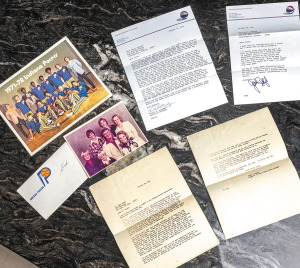
Such a letter likely would be quickly discarded today. It might not even get past a commissioner’s administrative underlings. But Terry received a quick reply. Two, in fact, both mailed to her in care of the Pacers’ office at 638 E. 38th St.
The first, dated Oct. 27, came from Thurlo McGrady, the ABA’s executive director, who was responsible for the schedules. Writing at the request of Dolph, McGrady explained the need to schedule some games on that holiday, mentioned two other games also were being played that day and pointed out the same consideration would have to be given for other religious holidays if they did not play on Christmas.
Two days later, another letter arrived for Terry, this one from Dolph himself.
“I’m really sorry that your Dad won’t be home for Christmas but I think you ought to remember that he is one of the best basketball coaches in the country and being a coach means he has to be away a lot more than he wants. Don’t forget though that after the season he’s home a lot more than most dads.”
Dolph closed by acknowledging Terry had a valid point and promised to give “careful consideration in the future” to avoid scheduling games on Christmas.
And he did. The ABA had played at least one game and as many as three on Christmas Day through its first five seasons but had none in 1972 and 1973.
Dolph, who had begun his reign as commissioner in October 1969, resigned in July 1972, likely after the upcoming season’s schedule had largely been determined. The ABA did have one Christmas Day game in 1974, between Utah and San Diego, but none again in 1975 during its final season.

Chad Williams)
Today, Terry, a retired elementary school teacher who lives in Elkhart, is rather amazed at her own gumption but is equally impressed by the responses she received from the ABA’s highest office.
“I’m just thankful Dad didn’t get fired,” she said. “Here you have a child writing into the league about when they should have their games. … That tells you what kind of a family situation the [ABA] was at that time.”
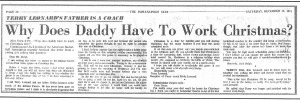
Terry’s letter somehow got into the hands of a United Press International reporter, presumably from someone in Dolph’s office, if not Dolph himself. Terry was as shocked as anyone when lengthy articles about it began appearing in newspapers across the country, including The Indianapolis Star.
On newspapers.com, a website that publishes the back issues of hundreds of newspapers, stories about it can be found in at least 25 papers, including six in Indiana. A couple of columnists outside the state referred to it and offered agreement. A few newspaper reporters called the Leonards’ home—the family had a listed number—to follow up and speak with Terry. Nancy Leonard expected her to cooperate, but Terry uncharacteristically defied her mother’s request and begged off. At 15 years old, she had no idea what to say to an adult reporter and was embarrassed by all the attention she was getting.
She hadn’t told her parents about the letter beforehand.
“I don’t recall what got into me,” she said. “We had to be very respectful of not going around them with anything.”
They weren’t angry, though.
“There was no negativity about it in our house,” she said. “Dad was kind of shocked I had these feelings about him and was able to express them. I think he was moved by it, actually.”

The game that separated Slick Leonard from his family on that Christmas Day did not go well. The Pacers lost to Utah, 150-129. And while it would be easy to chalk it off as a case of homesickness on a holiday, it continued a trend. It was the fourth loss in their previous five games.
“I don’t know what’s the matter with Indiana, but they can’t keep playing like that,” Utah center Zelmo Beaty said. (They didn’t. They went on to win the championship that season.)
Neither Bill Keller nor Darnell Hillman, players on that team, recall the game today. Nor do they remember how or whether they celebrated the holiday in Salt Lake City. Keller, however, remembers the team usually stayed at a Travelodge hotel there.
“Those people were always so good to us,” he said. “Maybe they had a Christmas dinner for us.”
‘It’s part of our jobs’
The Pacers next played on Christmas in 1981, losing at Washington, 115-98—not an unusual circumstance for the 35-win team. Twenty years later, however, Christmas Day games had become prestigious because they were broadcast on national television before a captive audience. The Pacers played one in both 1999 and 2000 based on their accomplishments in recent seasons. They got to play at home, too, and won both, defeating New York in 1999 and Orlando in 2000.
That doesn’t mean they had to like it. Before the game in 1999, Pacers coach Larry Bird said, “You don’t like it; it’s a special holiday. But I’ve done it before [as a player] and got through it. It’s part of our jobs, so we’ll go out and play.”
Pacers veteran Sam Perkins was more succinct. “It’s —-. I’m going to be frank. It’s not a good feeling to be playing on a day everybody enjoys.”
Perkins would have appreciated having a Terry Leonard in his corner. He apparently shook off his disappointment, however, because he scored 14 points off the bench, hitting all five of his shots, in the victory over the Knicks.
The Pacers likely would be playing on Christmas Day next week if not for Tyrese Haliburton’s season-ending injury in Game 7 of the Finals last season. They are the first defending conference champions not to play on the holiday since 2018.
The Colts have played on Christmas Day just once in franchise history, defeating the Arizona Cardinals, 22-16, in 2021.
All these years later, Terry is equally amused and proud of her letter. She realizes there’s no going back now, that the revenue from the network games on Christmas is too great to turn down and that the religious element of the day doesn’t apply to everyone. But, in a sense, she was taking a stand for everyone who has to work on a holiday that’s meant to keep families together, not just professional athletes and coaches. And she apparently did play a role in keeping everyone in the ABA home on Christmas three times.
“As an adult, I think it was a very worthwhile thing to do,” she said. “Sometimes the rest of us don’t stop to think there’s a lot of kids who don’t get to spend Christmas with their parents. Anytime you get people thinking, that’s a good thing.”•
__________
Montieth, an Indianapolis native, is a longtime newspaper reporter and freelance writer. He is the author of three books: “Passion Play: Coach Gene Keady and the Purdue Boilermakers,” “Reborn: The Pacers and the Return of Pro Basketball to Indianapolis,” and “Extra Innings: My Life in Baseball,” with former Indianapolis Indians President Max Schumacher.
Please enable JavaScript to view this content.
Yet another reason to think less of the NBA. Nobody, repeat NOBODY needs basketball on Christmas Day, nor any other athletic pursuit for that matter.