
Subscriber Benefit
As a subscriber you can listen to articles at work, in the car, or while you work out. Subscribe Now Just a year ago, after a Sept. 8 loss to Minnesota, some New York Giants fans were so fed up with quarterback Daniel Jones they waited outside MetLife Stadium to boo him as he walked to his car.
This year, given Jones’ sparkling performances amid a 3-0 start, Colts fans would happily hire a limo to take Jones home—and line up along the way to cheer him on.
Jones is the latest example of the once-promising athlete discarded as damaged goods by a franchise that didn’t have the resources or patience to enable him or her to succeed but found peace, love and happiness at the next stop. The Giants’ pariah is the Colts’ Superman—one who has the power to cool the seats of his general manager and head coach and perhaps extend their employment beyond this season.
The seventh-year pro isn’t merely off to the best start of his career; he’s been a revelation. He’s completed 72% of his passes for three touchdowns, run for three more, thrown no interceptions and has a career-high passer rating of 111.7. It’s early, OK, but Jones showed enough in New York even amid his intermittent breakdowns to offer strong evidence that this is more likely a resurrection than a fluke.
Colts coach Shane Steichen wasn’t guilty of hyperbole following Sunday’s 41-20 victory at Tennessee when he said, “He’s playing frickin’ really good right now.”
Jones got off to a great start with the Giants as well, replacing Eli Manning as the starter in his third game as a rookie and completing 23-of-36 passes for 336 yards and two touchdowns while leading a comeback from an 18-point deficit against Tampa Bay. In Week 16, he became the first rookie in NFL history to throw for 300-plus yards and five touchdowns with no turnovers in a victory at Washington.
But without adequate assets surrounding him, he often struggled. He was benched last season amid choruses of boos, asked to be released and was. Minnesota signed him to its practice squad, a humbling place for the former sixth overall draft pick, before the Colts took a chance on him.
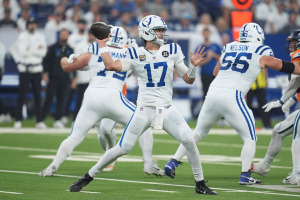
He didn’t suddenly become good this year. He just found the right fit, with a solid offensive line and set of receivers and a creative coach who can strategically exploit his strengths. If it continues like this, Jones will be assured of membership in the select group of reclamation projects who have boosted the city’s sports teams over the past 40 years—players who were drafted high, failed to rise to expectations and were regarded as disappointments or flops until granted a new life here.
Recycling scrap
Former Pacers General Manager/President Donnie Walsh had a special talent for identifying scrap heap opportunities, most notably in trading for Detlef Schrempf, Jalen Rose and Jermaine O’Neal in what turned out to be one-sided deals that hugely benefited the Pacers.
Walsh did it by bucking the former trend of seeking players who fit a specific slot rather than valuing versatility, by ignoring biases related to image and by exploiting jittery win-now mentalities. And while some executives looked down on players who expressed frustration or asked to be traded, Walsh understood.
“The NBA doesn’t have patience,” he said. “If you think about it, if you could do everything and you’re in a place where you’re allowed to do only one thing, at some point you’re going to be thinking, ‘I’ve got to get out of here.’”
Schrempf, the eighth pick in the 1995 NBA draft, languished on Dallas’ bench for 3-1/2 seasons behind established forwards, averaging just 8.2 points. Walsh had become well acquainted with his game before the draft and was ready to pounce when the situation became uncomfortable for all concerned. He offered up eighth-season veteran Herb Williams for Schrempf and got a second-round draft pick as well in February 1989.
“I think he can be a player who can blossom in a different situation,” Walsh said at the time of the trade, pointing out Schrempf’s versatility.
Williams had once averaged 19.9 points and 9.1 rebounds for the Pacers, but his performance was in decline. He wound up playing until he was 40 but averaged barely more than six points the rest of his career. Schrempf averaged 17 points—18.7 in the playoffs—in 4-1/2 seasons with the Pacers during which he was voted Sixth Man of the Year twice and to the All-Star team once. He was then traded to Seattle for Derrick McKey and made two more All-Star appearances.
“I knew Detlef’s agent,” Walsh recalled recently. “And I knew he was really good. He was big, and he could do everything.”
By the way, that second-round draft pick who came with Schrempf in the deal? It brought Antonio Davis, a vital member of the Pacers teams of the 1990s.
Walsh pick-pocketed Denver in 1996, trading veteran point guard Mark Jackson for Rose. The Pacers also swapped first-round draft picks and moved up 13 spots. Rose, drafted 13th overall, had averaged 10 points and a team-high 6.2 assists in his second season with the Nuggets but was suffering from whiplash. He had played for three coaches as a rookie and bounced back and forth between point guard and shooting guard the second season. Mostly he played shooting guard, which would prove to be his third-best position.
The Nuggets had just finished 35-47, the sixth season out of the previous seven in which they failed to achieve a winning record and were growing desperate. Jackson brought the potential for immediate relief.
“We need people now that will make us a better basketball team,” coach Bernie Bickerstaff said at the time. “It was about an immediate need.”
Walsh, meanwhile, took the long view. He saw through the rebellious image Rose and the Fab Five had presented at the University of Michigan and didn’t stereotype him.
“I don’t know what happened in Denver, but he was a can’t-miss player,” Walsh recalled. “There were ideas floating around that he was hard to deal with, but I didn’t see him that way. I was looking for a guy who could play. If he wanted to wear baggy shorts, I didn’t care.
“He had an unusual game. He could play point guard, but where he was really devastating was, he could post up, and he was a good passer.”
As an added bonus, Walsh retrieved Jackson midway through the following season with another one-sided deal motivated by the Nuggets’ desire to shed salary. He essentially acquired a major contributor in Rose for the bargain price of loaning Jackson to the Nuggets for half a season.
Rose came to the Pacers with renewed motivation.
It didn’t quite work out that way. Rose’s first season was another exercise in frustration as he didn’t mesh with coach Larry Brown. But when Larry Bird arrived, it clicked. Bird called Rose soon after taking the job to express confidence in him and to promise to help him improve, and Rose responded with three productive seasons under Bird. He was voted the NBA’s Most Improved Player in the third season when he was the leading scorer on a team that reached the NBA Finals in 2000.
Rose also gave credit to assistant coach Rick Carlisle for investing time in helping him improve. He had found a home in a stable organization where he played his best position, small forward, but was surrounded by veteran talent and allowed to display his versatility.
“As a young player, being part of a good system can change your career,” Rose wrote in his autobiography, published in 2015. He said Bird’s hiring “gave me a new lease on my NBA life.”
Frustrated and motivated
Walsh pulled off another steal when he traded Dale Davis for Jermaine O’Neal in the summer of 2000. O’Neal, drafted straight out of high school with the 17th overall pick, had been riding Portland’s bench for four seasons behind established players—much like Schrempf’s situation in Dallas. The Trail Blazers were in a win-now mode and weren’t willing to invest time in developing him.
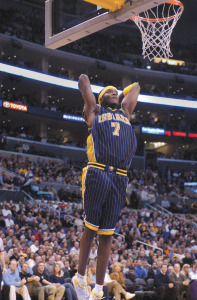
Walsh, however, saw the raw talent and gave up Davis, who was coming off his only All-Star season in the NBA but had turned 30.
“I knew he was a special talent,” Walsh said of O’Neal.
O’Neal did, too.
“My best comment for you guys and for [Portland coach] Mike Dunleavy is, just watch me play this year,” O’Neal said at his introductory press conference asa Pacer.
“I’ve hidden the anger inside of me a few times the last four years. Now it’s time for me to go show people what I can do.”
O’Neal was selected to six All-Star teams with the Pacers—most of any player in franchise history—and was third in the league MVP voting in 2004. His eight years with the Pacers were by far the highlight of his career and brought generational wealth when he signed a contract for more than $127 million.
Those three transactions provide a template for general managers looking to acquire a future star for pennies on the dollar. Look for the players drafted high who are underperforming because they are stuck behind veteran players or aren’t being used appropriately. Pluck them out of the weeds, replant them, add some nourishment and watch them bloom. They will come to you frustrated and motivated and with the bonus of having some experience, as Schrempf, Rose and O’Neal were for the Pacers.
And now like Jones for the Colts. He arrived with the potent combination of experience, flashes of brilliance and a deep hunger to prove himself, and they are reaping the benefits.
Jones is working on a one-year contract, but if he keeps this up, the Colts will want to sign him to a long-term deal. That would lead to a 99.9% chance of backup Anthony Richardson wanting to tap out of the franchise. A former No. 4 pick in the draft who has received limited opportunity isn’t going to want to waste the youthful seasons of his career watching from the sidelines.
It could wind up embarrassing for the Colts if Richardson excels elsewhere, just as it was for Dallas, Denver and Portland after Walsh fleeced them. It would mean they made the classic mistake of “giving up” on a young player too soon. The difference here is, the Colts already have what they need—a player shining in the sunlight of a second opportunity.•
__________
Montieth, an Indianapolis native, is a longtime newspaper reporter and freelance writer. He is the author of three books: “Passion Play: Coach Gene Keady and the Purdue Boilermakers,” “Reborn: The Pacers and the Return of Pro Basketball to Indianapolis,” and “Extra Innings: My Life in Baseball,” with former Indianapolis Indians President Max Schumacher.
Please enable JavaScript to view this content.
Editor's note: You can comment on IBJ stories by signing in to your IBJ account. If you have not registered, please sign up for a free account now. Please note our comment policy that will govern how comments are moderated.