
Subscriber Benefit
As a subscriber you can listen to articles at work, in the car, or while you work out. Subscribe NowFeatured Issue:
Given the federal government’s reclassification of marijuana to a Schedule III drug, is now the time for Indiana to legalize medical marijuana?
Late last year, President Donald Trump issued an executive order aimed at increasing research on medical marijuana, and in the wake of this decision, the federal government is moving to officially reclassify marijuana from a Schedule I controlled substance to Schedule III.
By reclassifying marijuana as a Schedule III controlled substance, marijuana would be recognized as having an accepted medical use and a lower potential of being abused compared to Schedule I or II drugs — neither of which are true of marijuana.
Although proponents tell us that marijuana can be helpful in a medical setting, a recent study from Smart Approaches to Marijuana, or SAM, shows the increased use of marijuana among Americans is creating more problems than solutions, including negative effects on health and youth development and an increase in Cannabis Use Disorder.
With marijuana use increasing, it is no surprise that we are seeing more marijuana-related emergency room visits.
Insights on the health risks posed by marijuana use are also becoming clearer. SAM’s study found that marijuana is tied to staggering increases in health risks, including a four times higher risk for psychosis, a 25% increased risk of heart attack, a 42% increased risk of stroke and a minimum 300% increased risk for neck and head cancers.
When Hoosiers visit their doctor, they expect the medicine they are prescribed to help them — not increase the risks of cancer, cardiovascular disease and psychosis associated with marijuana use.
Young Hoosiers would also be caught in the crossfire. SAM found that Massachusetts teens were twice as likely to purchase marijuana than tobacco and found youth marijuana use is tied to lower grades and a lower likelihood of obtaining a diploma or attending college. Marijuana use by teens also doubled the high school dropout rate.
Additionally, SAM found a link between youth marijuana use and a larger loss of IQ points in adulthood compared to those who never used marijuana.
Recognizing the negative effects on youth is part of why I authored Senate Bill 250 this year, so Hoosier youth would not be able to purchase products containing THC, the psychoactive compound found in cannabis.
Beyond marijuana’s medical and developmental impacts, Schedule III drugs are seen as having a lower likelihood of being abused, which is simply not true of marijuana.
In states where it’s legal, children aged 12 to 17 have seen a 25% increase in Cannabis Use Disorder, and nearly 18 million adults suffered from Cannabis Use Disorder according to the 2023 National Survey on Drug Use and Health.
Among the 18 million adults dealing with Cannabis Use Disorder, over half of them have developed a mental health disorder. At a time when addressing mental health issues is critical to our nation’s future, legalizing medical marijuana in Indiana would only add to the issues we are experiencing now.
The list of issues associated with marijuana use goes far beyond the points I have raised here, and it’s my position that medical marijuana has no place in Indiana.
From increased risk of cancer, cardiovascular disease and psychosis to poor youth development and increases in Cannabis Use Disorder, there are many warning signs against legalizing medical marijuana, which is why I don’t support it.•
__________
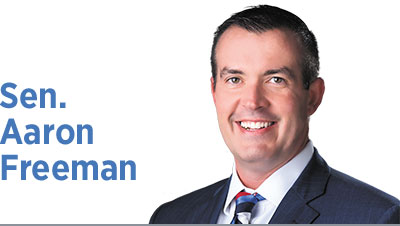
Freeman, R-Indianapolis, represents Senate District 32, which includes portions of Johnson and Marion counties. He is chairman of the Senate Committee on Corrections and Criminal Law. Send comments to [email protected].
Click here for more Forefront columns.
Please enable JavaScript to view this content.
Editor's note: You can comment on IBJ stories by signing in to your IBJ account. If you have not registered, please sign up for a free account now. Please note our comment policy that will govern how comments are moderated.