
Subscriber Benefit
As a subscriber you can listen to articles at work, in the car, or while you work out. Subscribe Now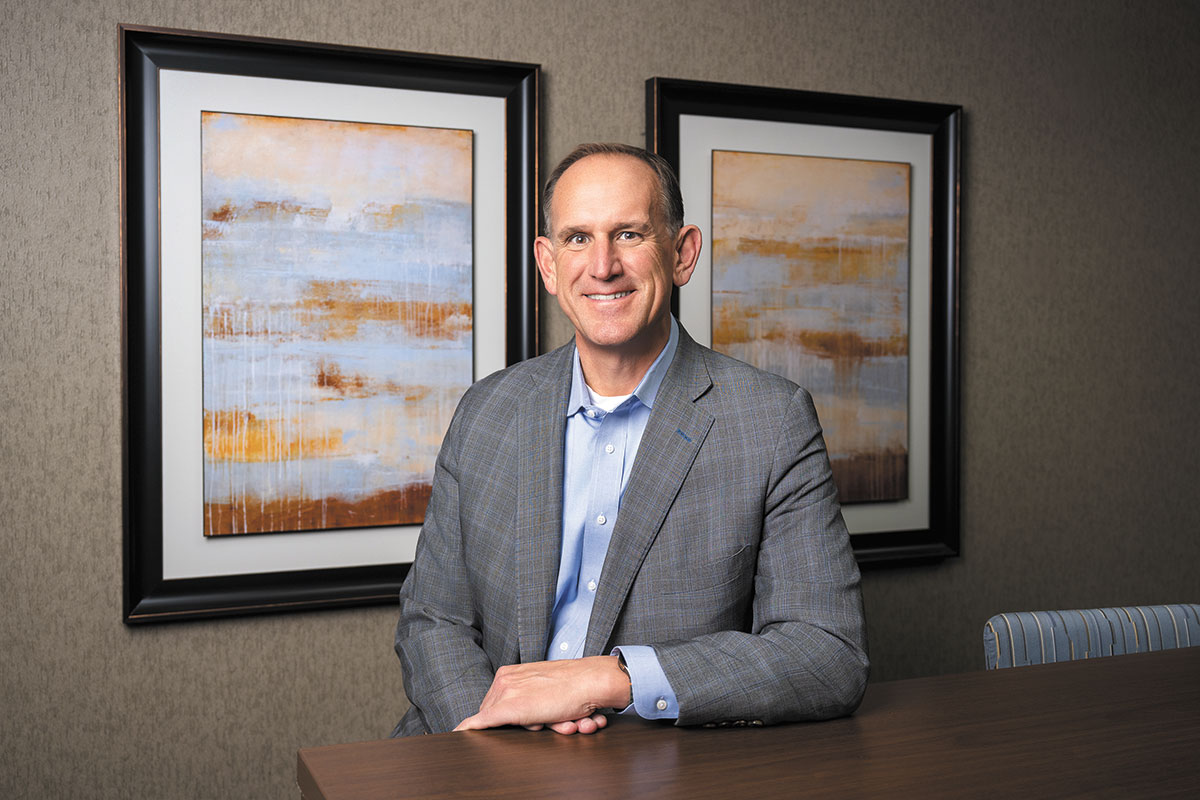
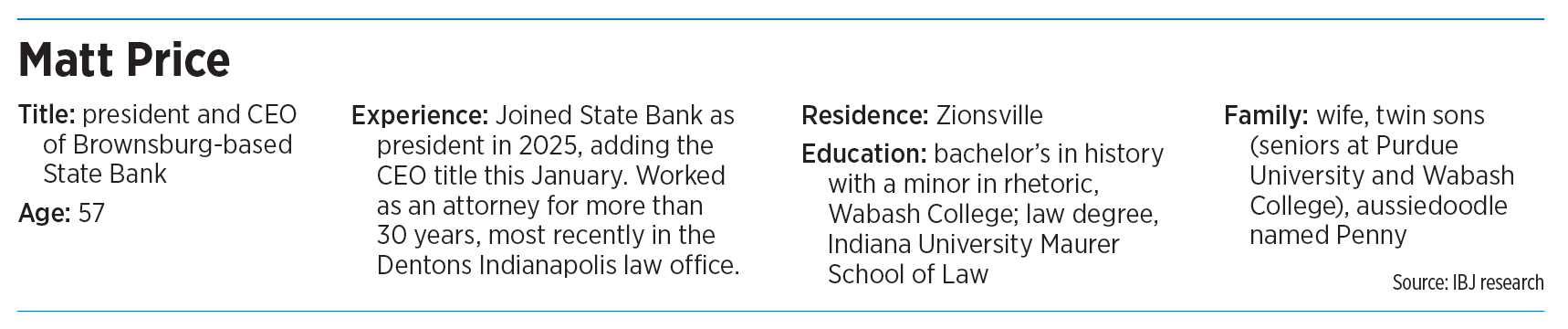
As CEO of Brownsburg-based State Bank, Matt Price has a somewhat unusual career history: Rather than climbing the ranks within banking, he spent 30-plus years as an attorney before joining the bank last year.
But Price said the transition from law to banking was smoother than you might assume.
As an attorney, he specialized in business and real estate transactions, especially in complicated cases that involved glitches like zoning complications, environmental concerns or a messy title history.
“My passion was always to use the law as a tool for executing a business strategy and helping a client make the most of their resources, allocate their capital in the best way,” Price said.
Banks, especially community banks, play a similar role, he said. They help clients find solutions that enable their businesses to prosper. Once he came to realize that, shifting into a bank leadership role seemed like a natural move.
He joined State Bank’s board of directors in late 2017 while still working full time in the Indianapolis office of the law firm Dentons. When Price joined the board, the bank was based in the Hendricks County town of Lizton, and its name was State Bank of Lizton. In 2020, the bank moved its headquarters to Brownsburg and dropped “Lizton” from its name.
Price joined the bank as president last April and succeeded CEO Mike Baker upon Baker’s retirement at the end of the year.
Price sat down with IBJ recently to talk about his career transition and to offer advice for others who might be pondering a shift of their own.
This interview has been edited for length and clarity.
Why did you join State Bank’s board? Did you see it as a way to segue from law into banking?
Not immediately. I had come to the bank as a customer originally. I had some personal business interests outside of the practice of law that also involved real estate. And one day, I was in a fair amount of worry over needing to secure financing on a project where another bank had concluded that the transaction … was just too complex in terms of some of the development aspects of it, or what they were viewing as impediments to development to go forward with the financing. And I turned into the driveway [of] what was then the State Bank of Lizton on Whitestown Parkway in Whitestown. I walked in the door not knowing anybody, and I stepped into the loan officer’s office there and sat down with them and explained my problem, and he was able to come up with a solution for me.
So your thought process was, “Hey, it’s not going to happen with Bank X. Here’s another bank. I’ll try this bank?”
It really was. … This is going to sound maybe a little weird, but the name of the bank was State Bank of Lizton. And growing up in Boone County and living in Boone and Hendricks counties as a kid, I was very familiar with the town of Lizton. It felt approachable to me … somewhere I just thought I could come into this place, be real about my problem, and somebody would take the time to listen to me, and they did … and provided the financing. And I immediately kind of fell in love with State Bank. … I went on to recommend that bank to my circle of friends and business associates, my family, and that’s how we started our business relationship.
I then got to know many of the individuals inside the bank, including my predecessor, [former bank CEO] Mike Baker. And Mike approached me one day about joining the board, and I was really flattered to do that. … Later on, as I experienced the bank more and more, my mind did start going to potentially running the bank someday. It’s not something I articulated to anybody, but it was something I thought about a lot about my life.
One day in January of 2024, Mike Baker and I were in the boardroom by ourselves, and he looked at me and he said, “Have you ever thought about running this bank?” And I said, “Mike, I have.” And he said, “We need to talk.” And that’s how we started the conversation about me joining in the current role.
Dentons bills itself as the world’s largest global law firm. What’s it been like going from a huge organization to a community bank with 115 employees and fewer than a dozen branches?
There’s more in common than you might think. … Dentons always referred to itself and its attorneys as being of and from the communities where they lived. And so there was, I would say, an intense focus on having local knowledge and local expertise. And the business model that Dentons adopted was being able to have a global enterprise that could provide that local knowledge.
Certainly, the scale and scope of State Bank is not global, but it shares that same intensity with regard to that local knowledge and being of and from the communities where we operate.
Making a significant mid-career shift can seem daunting. As someone who has recently done it, what would you say to someone who might be considering such a change?
For me, it was that each step kind of made sense as I progressed towards my current role. I don’t know that I could be in this current role without what I had done before, and so I think my advice would be to keep an open mind and follow opportunities where they present themselves. Because that may, indeed, be the very path that you should be on.
Now that you’ve taken the reins as CEO, should customers or employees expect to see any changes at the bank?
We have a growth mindset inside the bank, and so one of my focuses that I’ve brought to the bank is making our employees central to our growth strategy. And so we want to have a place where employees have an opportunity to continue their education, seek skills enhancement, develop a career path for themselves. That’s been a real central focus of my leadership since being here. There’s a real hunger and appetite for that.
We’re in a business where we succeed in what I call high-information lending, meaning that we succeed when other institutions find something too complicated, too messy, too much work to dig into. We need to be the alternative to that, where we have individuals who are experts in their fields, can roll up their sleeves and get messy, dig into the information and find the right solution. And so when we elevate our employee experience, we also elevate our opportunity for the bank and create more positive outcomes for our clients. So that’s a central, really a central part of our business strategy.
What’s the timeline for this?
It’s being rolled out. It’s very comprehensive. Some of it relates to technical skills, things that relate to core, what I would call, business acumen. Other parts of the educational opportunities relate to management, growing management expertise, cultural alignment, including providing help to individuals in planning their career, almost a form of what I’d call coaching.
So it’s making clear to our team members that we want to invest in you, and by investing in you, we grow our bank and serve our customers better.
You just said something that surprised me. I would have assumed that a little bank can’t handle complicated situations as well as a big bank can. What allows a small bank to wade into a challenging situation and potentially figure out a solution that bigger banks either can’t or don’t want to take on?
It’s really the essence of our local knowledge. I feel like State Bank is at its best when we’re using the knowledge that we learn on the street about a property.
I’ll give you an example from commercial real estate. … When we know about a property, that property’s history, the goal of the community for that property, the developer’s vision for that property, the character of that development, the developer, the history of that developer in terms of their portfolio — when we can bring that body of knowledge to bear in evaluating a particular opportunity, it gives us the insight to be able to provide credit in a safe and sound way where another lender may be relying on an algorithm or an application, and not really prepared to dig into the weeds of a particular transaction. And so, for us, that’s really our bread and butter. We want to have situations that are more complex, because that’s when we can provide the most value.
You used the word “algorithm.” So you’re pointing out, there’s often a difference between what a person knows and what the numbers say?
Yeah, exactly. We sometimes say, “We’re not relying on the cloud for our information. We’re getting our information from Main Street.” And there’s a personal aspect to that. That is where we thrive. And that’s part of the joy I get from coming to work every day … that it gives me an opportunity to use the same legal skills that I’ve developed over the past 30 years in a fresh context of evaluating allocations of capital.•
Correction: The version of this story that ran in the March 13 print issue of IBJ included the incorrect name of the bank. The name is State Bank. See other corrections here.
Please enable JavaScript to view this content.
A+
Matt is such a quality person and has all the important qualities of a top-notch leader. Congratulations to State Bank for the vision in choosing Matt as your President and CEO and best wishes to you all for many successful years to come.