
Subscriber Benefit
As a subscriber you can listen to articles at work, in the car, or while you work out. Subscribe Now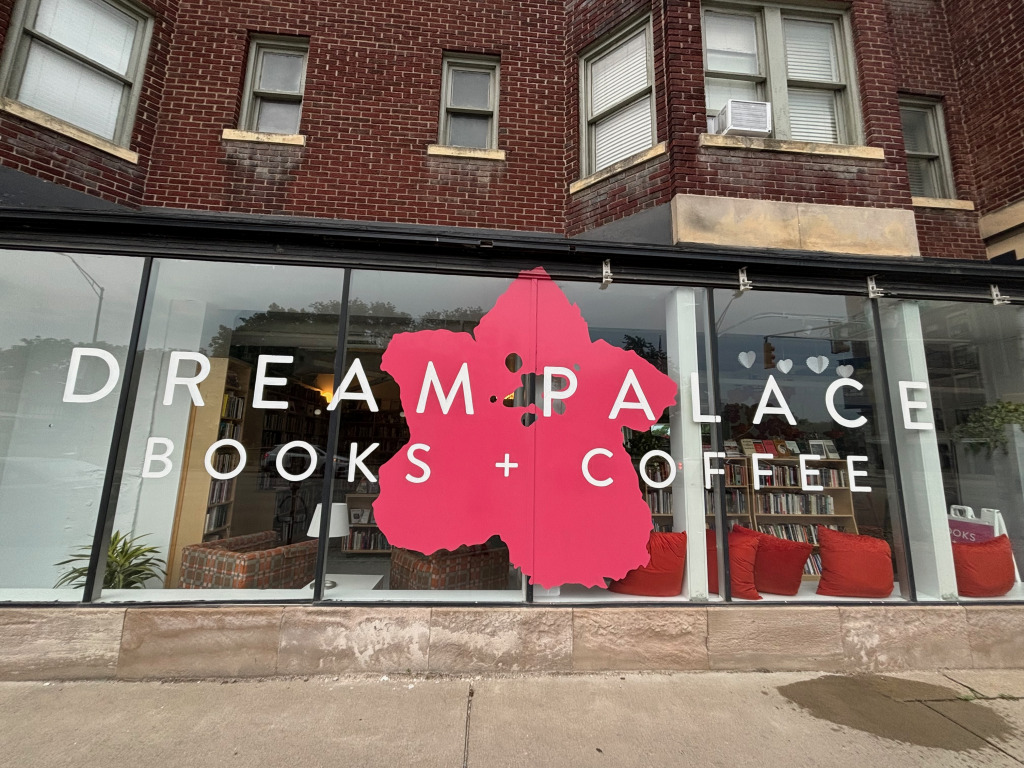
Dream Palace Books & Coffee, one of five independent bookstores to open in Indianapolis between April 2023 and April 2024, is set to close this month.
Co-owner Taylor Lewandowski announced July 26 as the shop’s closing date in an Instagram post.
“To the regulars, the strangers, the organizers, the impeccable staff and anyone who was a part of Dream Palace, thank you,” he wrote. “While this was not the ideal outcome, we are honored we had the chance to create an alternative space in Indianapolis.”
Lewandowski, who co-owns Dream Place with his father, Robert Lewandowski, and grandfather, Dean Gifford, told IBJ the business wasn’t sustainable.
“While we’ve created a significant impact on the literary and coffee community, we felt we could no longer expend the necessary investment as owners in the business,” he said. “This comes at a great loss and disappointment, but we know this is the correct choice.”
Dream Palace Books & Coffee opened in October 2023 at 111 E. 16th St., across the street from Herron High School—where Lewandowski works as an English teacher.
Dream Palace was part of a boomlet of new independent bookstores in the city, which launched with the opening of Tomorrow Bookstore, 882 Massachusetts Ave., in April 2023.
In September and October 2023, customers were welcomed at Loudmouth Books, 212 E. 16th St., Golden Hour Books, 5208 N. College Ave., and Dream Palace.
The Whispering Shelf, 414 N. College Ave., opened in April 2024.
Dream Palace occupies 1,430 square feet on the first floor of the Penn Arts building. The Thirsty Scholar coffee, beer and wine bar operated in the same space from 2013 to 2018.
Please enable JavaScript to view this content.
Wholly predictable.
People taking chances in business – something that should be encouraged. Most people can and will be a critic, but never have stepped beyond their own comfort zone to try something. Kudos to them for trying this out and recognizing when pivots were needed to be made. Hopefully it can be a smooth transition for another business to take its place.
Agreed, well said.
Exactly.
Wise words!
Sad, but somewhat predictable. Indy needs a new playbook. It’s super hard for a shop to thrive as an isolated one-off. The city should focus on developing cultural blocks and modest village-like retail corridors or small districts of shops. We need to improve our streetscapes strategic in locations where small businesses can actually thrive.
Yes, but the best ones usually grow organically. Mass Ave, for example, wasn’t “developed” initially so much as it grew out of inexpensive spaces. Once the cluster grew, development took (deserved) over. 16th & Penn not a bad bet, actually. High-density population, wide range of income, other shops nearby, certainly walkable. Since Pennsylvania is one way south, it’s possible that it was missing some evening “going home” traffic. Parking for non-area residents is also sometimes tricky. Sorry to see this go.
I agree with GB. This is hardly a bad area for this sort of stuff to grow. This is not my area of specialty, but it would be nice to see some developers do something with the west side of Pennsylvania south of 16th (huge vacant lot that probably has some nasty stuff in the soil), or to purchase those very suburban McDonald’s, White Castle and Walgreens properties and build upward.
Appreciate your perspective GB, and agreed that organic growth can be powerful. But the conditions that allowed Mass Ave to “grow organically” don’t exist in most of Indy today. cars outnumber neighborhood pedestrions about 100 to 1, clustered move-in ready retail spaces are rare. Pedestrian traffic is thin and supportive clustering is haphazard at best. Intentional supportive streetscape improvement and targeted retailer isn’t a substitute for authenticity. But it can set the stage for it. We need to build the soil in which “organic” can actually happen again.
*streetscape improvements and target retailer support…
I went a couple of times. It was a nice setting, with great coffee. But it wasn’t a big enough floor space for it to do everything it wanted to do. When I was there, I bet it carried about 200 books total, so you couldn’t exactly go there seeking out a specific book you had wanted to buy, like you would at Barnes & Noble. About half the space was lounge for the coffee drinkers to read and work, which gives a nice vibe but I can’t imagine brings in the $$$. Books may be hit-or-miss as a product (not a lot of people come and just buy tons off the shelves), but at least they have a great profit margin.
Either Dream Palace needed to use the space exclusively to be books and have a very limited coffee carryout space that occupied about 10% of the floor area instead of 50%. Or, if it wanted that 50/50 balance, to offer more of a niche book collection (e.g., nonfiction or mystery). I also saw some nooks that didn’t get used–too bad, since the space was already clearly limited.
I know it’s to be the armchair critic, but these were things I contemplated when sitting at their armchairs asking, “How long this place would last?” It was the right business for this neighborhood, but the space required a lot of strategy.
There’s an inverse relationship between speed limits and retail store performance, particularly at the mom & pop level. I’m on E. 16th a fair amount and am consistently alarmed by how rapidly the traffic moves, particularly eastbound. If the speed limit were 5 mph lower and the lane in front of that space was repurposed for parking, that space would perform far better and that district would feel a lot more like a place to walk and shop. (Not suggesting that helping one retail property by changing traffic and parking patterns should necessarily be the city’s priority – just pointing out the tradeoff and consequence of streets being maximized for traffic throughput rather than neighborhood considerations will continue to produce these results.)
Mass Ave has enough scale to offer real synergy as a retail district; 16th & Penn is fundamentally a commuter traffic/institutional/special use area wherein even a conspicuously placed cool business just can’t find enough of the indispensable retail trade area characteristics – parking, abundant daytime population, synergy with other businesses, etc, to thrive.
One of Indy’s most unfortunate characteristics is that it is super spread out and, compared to other midwestern cities, far newer. Older towns – particularly when constructed around navigable rivers – generally have more idiosyncratic, less grid-based development patterns wherein the needs of the populace would naturally manifest over time into relatively balanced nodes of commerce to support most neighborhoods, rather than the several massive big box retail nodes per suburban township we have here.
Louisville, Cincy, Cleveland, Chicago, St. Louis, Nashville, et al have vastly superior old neighborhood retail districts (and, not coincidentally, more live music venues per capita). Alas, businesses serving a thoughtful, brainy demographic in this city need to be extra careful about where they set up shop.