
Subscriber Benefit
As a subscriber you can listen to articles at work, in the car, or while you work out. Subscribe NowHouse Republican leaders unveiled a plan Friday that aims to rework Indiana’s property tax system to make it more transparent and creates a new tax credit to provide immediate relief to homeowners.
The proposal—which is to be amended into Senate Bill 1 by the House Ways and Means Committee on Monday—would provide homeowners with $1.1 billion in relief over three years, Speaker Todd Huston said.
More than half of Hoosier homeowners would pay lower property tax bills in 2026 than they are paying this year, he added. And House Ways and Means Chairman Jeff Thompson said 93% of homeowners will pay less under the House plan than they would have with no changes.
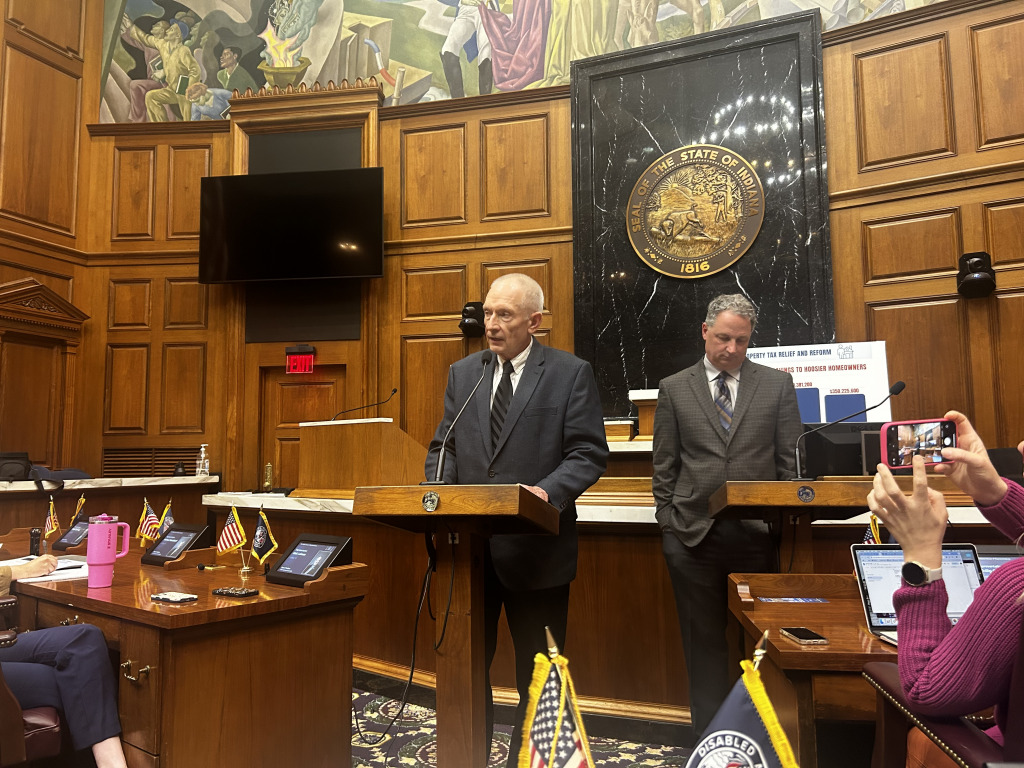
“What we’re trying to do is make it a better system, a more transparent system,” Huston told IBJ in an interview. “People just want relief, and that’s what we’re aiming to provide.”
To achieve immediate tax relief, Huston said the plan would create a 7.5% property tax credit with a maximum impact of $200 on all homeowners’ property tax bills beginning in 2026. A credit reduces a taxpayer’s actual bill, and in this case, it would be applied after the application of the state’s tax cap. That cap limits a homeowner’s bill to no more than 1% of the property’s assessed value, unless voters have agreed to pay more.
For example, if a home’s assessed value is $400,000, the 1% tax cap already ensures the homeowner’s bill won’t exceed $4,000 (plus an additional tax rates approved by voters). The new $200 tax credit would reduce that $4,000 tax bill to $3,800.
Homeowners whose bills don’t reach the tax cap would also see their bills reduced by up to $200.
The goal, House leaders said, is to ensure that all homeowners receive immediate property tax relief.
In addition, the proposal would change a $150 property tax deduction for seniors and a $250 deduction for disabled veterans into credits. The difference can be significant. A deduction reduces a taxpayer’s assessed value before the tax rate is applied; a credit reduces the actual tax bill.
The Ways and Means Committee plans to vote on the plan Monday, and it’s expected to pass the House, where Republicans are in control. The plan would then move to the Senate, which passed a much different property tax plan. The Senate could accept the House plan or send the bill to a conference committee where fiscal leaders would try to work out a compromise.
In addition to the immediate relief, the House proposal would put in place a multi-year schedule for changing how Indiana’s property tax system works. The existing deduction for homeowners—now set at a maximum of $45,000—would become a deduction worth two-thirds of a homeowner’s assessed value in 2031.
For example, under the current system, a home assessed at $400,000 would receive a homestead deduction of $45,000, reducing the assessed value for taxation to $355,000. Under the House proposal, the assessed value would drop to about $132,000.
When fully implemented and combined with other changes, the local tax rate—with all local governments added together—couldn’t be higher than $3 per $100 in assessed value, Huston said. As a result, the owner of that $400,000 home with the new net assessed value of $132,000 would have a tax bill that equaled about $3,960. That’s roughly the same as the tax bill the same owner would pay based on the existing 1% cap, but officials say the system would provide provide more transparent and be easier for taxpayers to understand.
“The bigger point of this entire experience has been that we need long-term reform to the system,” Huston told IBJ. “It allows us to really get to a better place long term, to have the type of property taxes some Hoosiers can understand.”
In addition, a one-third deduction for assessed values of residential properties where the homeowner doesn’t live full time (a second home or a rental home, for example) and farmland would be phased in through 2031.
And the legislation reduces farmland assessed values, which will save farmers more than $55 million in 2026 and more than $140 million over three years, House Republicans said.
The House property tax plan also incorporates Senate Bill 518, a proposal backed by charter school advocates that has drawn the ire of public school officials. The proposal requires traditional public school districts to share property tax revenue—which is generally earmarked for capital projects, transportation and energy costs—with charter schools.
Currently, charter schools receive state funding (largely from income and sales taxes) for each student they enroll, but property tax revenue stays within the traditional school district in which it was paid.
“Obviously, we believe money should follow the child,” Huston said. “That’s what this bill does.”
The new House plan is based largely on Thompson’s proposal to reform how the state collects property taxes. Huston said the goal is to transition it from a levy-based system, meaning one that is determined in large part by how much local governments are seeking to generate from property taxes, into one that’s based on tax rates that are easier to understand.
“We want to move to a to a better, more rate-based system in which there’s more transparency for Hoosiers,” Huston told IBJ. “Right now, your rate can go up and you can pay less. Your rate can go down, you can pay more. It doesn’t make sense.”
Huston said he couldn’t provide an estimated average savings for Hoosiers under the House plan because the current system is not consistent or predictable.
But Republicans said Friday that the plan puts stronger controls on local government debt, requires referendums that will lead to higher property taxes to be voted on during general elections when more voters come to the polls and puts new requirements on the language of those referendums to make their impacts clearer to taxpayers. The plan would also requires the creation of a property tax transparency portal that allows taxpayers to see the impact of proposed changes on their bills.
The issue of the session
Gov. Mike Braun and Republican leadership prioritized passing property tax relief this session, following an animated campaign season with many constituents raising concerns over high tax bills.
Homeowners have felt the pinch after property tax bills spiked thanks to market-driven assessed value increases during the pandemic-era housing boom. In 2023, tax bills increased by an average of 17%, according to an analysis by tax expert Larry DeBoer.
A few hundred protestors staked out at the Indiana Statehouse last month to demand the Legislature pass widespread property-tax reform and threatened to vote out lawmakers who don’t deliver. Braun joined their rally later in the day.
Before Friday, three vastly different proposals—from Braun, the Senate and Thompson—have offered varying levels of homeowner relief and local government impact.
Braun advocated for a plan that would institute growth caps and expand the homestead deduction, but the Senate instead passed legislation last month that would slow property-tax growth and target relief to vulnerable demographics.
The House’s plan would overhaul both the state’s property tax system and how municipalities collect local income taxes, which is a key revenue replacement solution Republicans have said could make up for property tax cuts. The House proposal would allow counties to raise their income tax rates (although many local governments aren’t using the maximum rate they’re allowed now) and lets cities implement a local income tax as well.
On Friday, Huston told reporters that he believes the proposal is “a better system overall” for local governments and that he’s had “fruitful” conversations with local leaders.
House leaders did not detail in advance of Friday’s announcement how much local government revenue would change under the House plan.
“In some instances, some [local governments] will collect more in ’26 than they did in ’25, but they aren’t going to collect as much as they” would have, Huston said. “But we feel like that’s acceptable because they’ve had a pretty strong set of years.”
Thompson said Friday that local governments overall would see a 3% increase in property tax revenue in 2026. That’s instead of the current projected 5.6% increase.
Next steps
The House proposal still needs to clear three major hurdles before being enacted into law.
The bill could still change after the committee’s approval. Members of the House will be able to offer amendments when the bill reaches the House floor.
Once the House passes the bill, the Senate will consider the changes. When asked if the Senate is expected to agree to the House proposal, Huston said he feels very good about where the Senate is after conversations among legislative leaders.
“Unbelievably good conversations,” Huston said. “Strong alignment.”
Braun must then decide to sign the bill or veto it, which he has threatened to do if the relief provided isn’t to his liking.
Huston said he’s had many meetings and conversations with the Governor’s Office. He said officials there continue to provide ideas and suggestions.
When asked if the veto is still on the table, Huston said, “That’d be up to Gov. Braun.”
IBJ reporter Taylor Wooten contributed to this story.
Please enable JavaScript to view this content.
$200.00 credit compared to original proposed 21% + reduction in the original bill is a huge disappointment. This watered down version is not real property tax relief for homeowners especially seniors. Lobbyist always win over the hard working homeowners.
Thanks for nothing!
Many business property owners are paying three times the amount of homeowners, as their cap is 3%, where homeowners’ cap is 1%. Business owners do not have the ability to vote on proposed referendums unless they live in the same area as their business location. With this proposes legislation, it will force more referendum votes for the finding lost by the reduced homeowners’ taxes. There should be an amendment stating that businesses do not pay referendums approved by the voters. Or, at least, cap all taxes including referendums at 3%. Otherwise, we are going to tax our businesses out of business.
Recent studies how that commercial property assessments have not increased at anywhere near the same rate as residential properties. Business owner are getting a gift right now as tax burdens shifte to homeowners.
This seems pretty regressive. Up until the invention of the debunked “trickle down economics” theory that Republicans have embraced since Regan, the American tax system was geared toward taxing the people with the most ability to pay, the highest taxes.
This is the exact same thinking that got us into this situation where the tax burden shifted from Commercial properties to average homeowners. Several recent studies have shown that assessment increases hit lower priced properties way out of proportion to high value properties.
Another outsized tax break for the rich guys!
I am also still amazed that Republicans CAN NOT see what is happening with the Trump Administration. They are taking huge chunks of Federal tax dollars from Hoosiers. These cuts are NOT insignificant. Loss of tax dollars is going to be felt at every level in the state, and yet here we are still cutting local taxes!
Welcome to Kansas 2.0 where services and infrastructure crumble as we watch.
I wonder how these wizards are going to replace the revenue the property tax reductions will cause.
They’re not, by design.
Property taxes don’t go to the State but to local government entities (cities, counties, townships, schools, libraries, etc.), which are things the super majority legislature doesn’t really care about. They’ll just paint with the same broad brush, repeat that government is bad, and tell the locals to do more with less, while trying to manage the same cost increases hitting all facets of the economy – health care, raw materials, inflation, etc.
The article does not reveal how much this will cost the state and local governments in revenue, but we can assume the $1.1 billion in tax savings to homeowners would probably be the amount. Factor in the cancellation of federal dollars to state and local governments, and you are staring down meager times ahead for Indiana. Thanks to the Republican super-majority in the state legislature and a Trump-wannabe as governor, we will be known as “A State That Formerly Worked.”