
Subscriber Benefit
As a subscriber you can listen to articles at work, in the car, or while you work out. Subscribe NowNelson’s got a pretty good gig.
He’s young, energetic and outgoing. He’s in the office some days, attending meetings. He has insurance and even discounted medicine. Nelson is so popular with the barista at the office Starbucks that she gives him freebies and posts about him on TikTok.
So who is this guy?
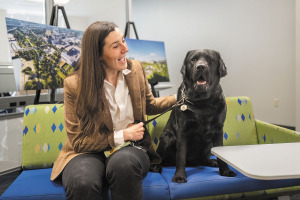
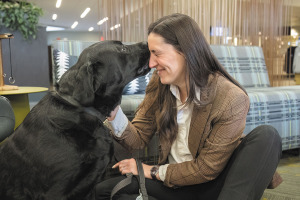
Nelson is a 2-1/2 year old black Labrador retriever. “He’s a bit of a goofball,” owner Lee Thomas admitted.
Thomas and her lucky Lab are part of a growing trend in which companies and employees are more closely integrating work life with home life, particularly when it comes to socializing with and caring for pets.
“He is my Elanco puppy,” said Thomas, senior director of finance and ESG communications at Greenfield-based Elanco Animal Health. “I didn’t have him before coming to Elanco. It was actually [Elanco’s] pet pilot program that enabled us to get the puppy and to convince my husband to have one.”
Elanco, which makes animal medicines and health care products, is rolling out more pet-friendly policies for workers, including offering pet insurance and also allowing workers to bring their dogs to work and offering rebates on Elanco products.
And this trend is true beyond just animal-focused companies like Elanco.
More employers, especially since the stay-at-home days of the pandemic, are looking for ways to keep workers happy and in the office. Companies in recent years have stepped up offering more voluntary benefits along with health coverage and 401(k) plans. These include life insurance, supplemental health coverage, ID theft protection and—among the fastest-growing employee-paid benefits—pet insurance.
The North American pet insurance industry reached a record $4.27 billion in total premiums sold in 2023, according to the North American Pet Health Insurance Association. The total was an almost 22% increase from the year before. It also marked the fifth straight year that the North American market grew more than 20%.
The rise of pet insurance and pet-friendly workplaces comes amid wider societal changes with health benefits experts citing people waiting longer to have children and increasingly treating pets as part of the family.
“Pet insurance has definitely kind of jumped off the radar since COVID,” said Amanda Gilbert, vice president of Gregory & Appel, an Indianapolis-based benefits firm. “A lot of pets were adopted during that time. It was a popular benefit before that, but the trend has really increased significantly.”
Gilbert said that at the companies she represents offering pet insurance, roughly 20% of employees buy the coverage. She added that pet insurance policies are popular with multiple generations of workers.
 “The pricing depends on the breed, the age of the dog or the species of the animal,” she said. “You can get pet insurance on everything from dogs to cats to iguanas, too. There’s coverage for all different species.”
For dogs—by far the most insured pet—monthly U.S. premiums averaged $56.30 in 2023 for accident and illness coverage, according to the pet insurance association. Premiums for cats average $31.94 a month.
Accidents include ligament tears, poisoning, foreign body ingestion and motor vehicle accidents. Illnesses include cancer, infections and digestive problems.
Carmel-based CNO Financial Group’s Optavise brand—a provider of employee benefits services—offers customers voluntary benefits, including pet insurance. According to Optavise’s 2025 Benefits Broker Report, which surveyed 63 U.S.-based health insurance brokers, about 27% of brokers said their clients added pet insurance in 2025, up from 23% in 2024.
CNO Financial Group, which provides insurance and financial services, has offered its own 3,500 employees the option to buy pet insurance since 2022. That year, 63 participated. In 2025, 105 chose the benefit.
Making connections
David Kinard, Elanco’s executive vice president of human resources, said the company’s pet benefit offerings were part of a broader effort to connect its mission and products—which are focused on animal health and companionship—with its workforce.
“Not everyone gets to work at a place where there is pet insurance, probably even fewer at a place where you can bring your dog to work,” Kinard said.

He said Elanco’s pet insurance offering, which covers dogs and cats, is in its third year. The company offers employee discounts on its pet and farm-animal products. And it’s adding a dog park to the headquarters it’s building in downtown Indianapolis.
Elanco’s bring-your-dog to work policy is structured. Employee dogs must be registered and then be certified by a company vet to ensure they have the temperament to be in the office. The employee then signs up to bring their dog into work, with a limit of 10 canines a day.
Thomas said bringing Nelson helps her connect with more people in the office, even if they just stop by her desk to give the Lab a quick pat.
“He comes to meetings. He comes to the cafeteria. He meets and greets,” Thomas said. “He really is a great tool to meet and network with people throughout the organization and really connect in meaningful ways.”
Thomas said she purchases pet insurance for Nelson as well as for her 13-year-old cat, calling it “peace of mind.”
Voluntary benefits like pet insurance are a way for employers to demonstrate they are in touch with worker lifestyles and priorities.
Employers are generally offering pet insurance as an employee-paid option, said Paul Ashley, vice president and consultant of corporate benefits for insurance broker NFP. And companies, he said, “are doing the due diligence to seek out and make sure it’s a quality product being offered.”
Right disposition
Vets are getting used to dealing with pet insurance.
Dr. David Carter of Carter Veterinary Medical Center in Carmel said he typically gives customers two copies of the receipt, one for them to keep and another to send the pet insurance company.
Dogs, he said, are more often covered by insurance because they typically require more care. “They just seem like they have more maintenance than what you see with cats,” he said.
Having been in practice for more than 40 years, Carter views pet insurance as another evolution of his field, like flea treatment going from frequent sprays and dips to an effective monthly pill.
As for bringing dogs into work, Carter tells customers to make sure their dog has the right disposition for the office.
“I tell folks, terriers can be little terrors,” he said. “I say that jokingly, and that always gets a laugh.”
Carter said he asks questions to match a person with the best dog for them: “I always ask people, you know, ‘Tell me about your lifestyle and tell me what you want out of your dog.’”
Increasingly, people want a dog to care for and be around, home or work. And employers are responding.•
Please enable JavaScript to view this content.
Sorry – bringing your dog, cat, or pet monkey to the workplace isn’t a good idea…