
Subscriber Benefit
As a subscriber you can listen to articles at work, in the car, or while you work out. Subscribe Now
The first two editions of the Indiana Creative Economy Summit included a learning curve, according to Polina Osherov, the event’s organizer and co-founder of Indianapolis nonprofit Pattern Inc.
After devoting events in 2023 and 2024 to highlighting the financial impact of industries such as design, fashion, marketing, film and architecture, this year’s gathering aims to promote the creative economy as an asset for Indiana cities and towns.
“I hope we are going from just explaining to people what the creative economy is and why it’s important to providing actionable steps on how to bring it into your community and incorporate it into your economic development and tourism strategies,” Osherov said.
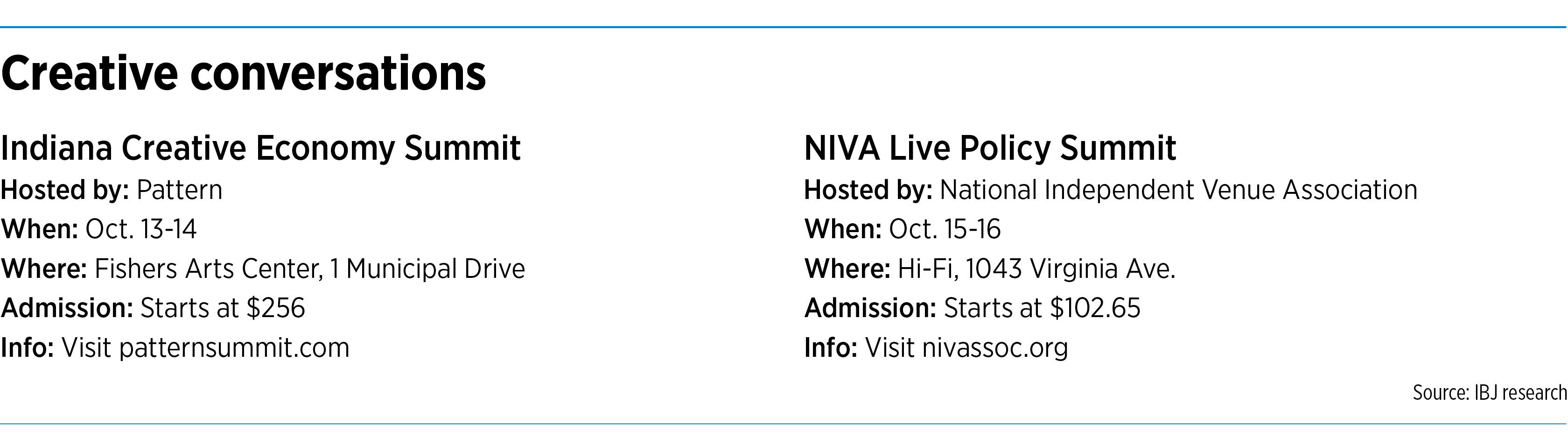
The Indiana Creative Economy Summit is scheduled for Oct. 13-14 at the Fishers Art Center. A music-themed partner event, the NIVA Live Policy Summit hosted by the National Independent Venue Association, is scheduled Oct. 15-16 at Fountain Square’s Hi-Fi venue.
Four days of focusing on art and commerce will make a statement, Osherov said.
“Visibility is important,” she said. “We want to start penetrating the general consciousness as to this being a real issue, something that is a tool our economic development, tourism and real estate leaders can use to bolster their own profits.
“This is not charity,” she said. “None of the creative economy conversation is about charity at all. An untapped, massive financial windfall for Hoosiers could come out of this.”
Arts and culture contribute more than $877 billion to the U.S. economy, or 4.2% of the gross domestic product, according to the U.S. Bureau of Economic Analysis. In Indiana, arts and culture support more than 80,000 jobs and generate $9.3 billion annually, according to the Americans for the Arts Action Fund.
The 5-year-old National Independent Venue Association published its first national economic impact study in June. While independent venues contributed $86.2 billion to the U.S. economy in 2024, 64% of concert stages were not profitable. Ohio-based research firm TEConomy Partners conducted the economic impact study, billed as “The State of Live.”
In Indianapolis, the venue association plans to explore ways to influence legislation that establishes financial support for venues. Regulation of resale tickets is planned as another major topic of discussion.

Stephen Parker, executive director of the National Independent Venue Association, said lawmakers can take steps to help venues and concertgoers.
“We hope that policy makers will attend,” Parker said. “We would love for city council members, the Mayor’s Office and Indiana state legislators to attend. We will welcome them with open arms. We are happy to learn from them. At the same time, we’d love to talk to them about a few things.”
The speaker lineup at the Indiana Creative Economy Summit includes Vince Kadlubek, co-founder of immersive art experience company Meow Wolf. Since opening an installation in a former bowling alley in Santa Fe, New Mexico, in 2008, Meow Wolf added locations in Las Vegas, Denver, Dallas and Houston.
Catlin Whitington, executive director of ArtPrize, is another speaker on the bill. The 2025 edition of ArtPrize, a sprawling art competition in Grand Rapids, Michigan, is scheduled Sept. 18 to Oct. 4.
Osherov, who leads Pattern in its mission to mentor and connect creative entrepreneurs, said case studies appeal to conference attendees.
“It’s easier to perhaps extrapolate or imagine what something might look like here,” Osherov said. “Meow Wolf is an excellent example of what happens when artists create a new, innovative way of showcasing themselves. It can become a multimillion-dollar enterprise that creates hundreds of jobs and adds an air of mystique or cool to the city hosting such an entity.”
Statewide scope
Osherov said she views members of the creative economy as lining up with Gov. Mike Braun’s vision for “Main Street entrepreneurs.”
In July, Braun launched the Office of Entrepreneurship and Innovation to support small businesses.
“Who are creative entrepreneurs? Look at Main Street in your rural town,” Osherov said. “I’m going to say probably 70% of those folks could be considered creative entrepreneurs. It’s your bookstore, your gift shop, your tattoo parlor, your gallery and it goes on and on. I know Main Street entrepreneurs are a big focal point for Gov. Braun. You need to realize that most of these people that you’re trying to help are actually creatives.”
Braun’s predecessor, Gov. Eric Holcomb, created the Regional Economic Acceleration and Development Initiative, or READI. In 2024, Holcomb announced Lilly Endowment Inc.’s grant of $250 million for READI 2.0.
For 15 geographic regions in the state, the funding designated $185 million to blight remediation and redevelopment projects. The funding designated $65 million to arts and culture projects.
Consultants working on the arts and culture projects will provide updates during the Indiana Creative Economy Summit, Osherov said. Representatives from Ohio-based Designing Local and Bloomington-based Sara Peterson Consulting are scheduled to attend.
‘Fight or flight’
The National Independent Venue Association is made up of 1,500 members representing 650 ZIP codes.
“All too often, an independent venue is the first business that comes into a community that was not desirable for businesses to come into,” Parker said. “It’s a place where revitalization can start, and it’s a place where community can come together.”
The national venue association was formed around the same time as the Indiana Independent Venue Alliance. Both organizations emerged in 2020 as efforts to support venues during the pandemic.

The Hi-Fi, 1043 Virginia Ave., is owned and operated by MOKB Presents, a concert company led by Josh Baker, who serves as executive director of the Indiana Independent Venue Alliance.
Baker said he organized the state venue alliance out of necessity.
“It was fight or flight,” he said. “We had to do something. I was just thankful that I could help get everyone together.”
The Indiana Independent Venue Alliance is made up of more than 50 venues, including the Butler Arts Center, the Vogue and The Jazz Kitchen in Indianapolis as well as the Bluebird in Bloomington, The Clyde Theatre in Fort Wayne and the Morris Performing Arts Center in South Bend.
County music bar Duke’s Indy, 2352 S. West St., recently announced plans to permanently close in November, which will be a rare instance of a venue alliance member ceasing operations.
In a social media announcement, the Duke’s team cited “more competitors with much deeper pockets in the market,” a building in need of renovations and economic challenges as reasons for the upcoming closure.
Although Baker characterized the Duke’s news as disappointing, he said it spurs alliance members to “want to keep working harder.”
Calling on lawmakers
The National Independent Venue Association led the pandemic-era Save Our Stages campaign, which encouraged lawmakers to establish the $16.25 billion Shuttered Venue Operators Grant program.
In 2025, the group is pursuing other forms of public policy to “make sure these venues can continue to be around and be strong,” in the words of Parker.
Specifically, NIVA wants state legislatures to follow the example of Texas and Tennessee, where laws have been established to support music venues.
In Texas, Gov. Greg Abbott signed the Texas Music Incubator Rebate into law in 2021. The rule allows qualifying music venues and festival promoters to receive up to $100,000 each year in a tax rebate associated with alcohol sales.
In Tennessee, a 2024 statute created a Live Music Fund for providing grants to venues, promoters and performers. To date, no money has been allocated for the fund.
Nevertheless, Parker said he’s encouraged by progress in Tennessee and in California, Illinois and Ohio, where funds to support venues have been proposed by state lawmakers.
“We believe these funds should be common in every state,” Parker said. “We believe they can be funded creatively. They can be funded through appropriations from the governor and from the state Legislature. They can be funded through tax rebate programs, or they can be funded by taxing resale platforms that give nothing back to the music ecosystems that they continue to extract from.”
Resale platforms, or ticket brokers, are not popular among independent venues. Parker and Baker said patrons inadvertently purchase counterfeit tickets on the secondary market and also buy marked-up tickets when face-value tickets remain available for purchase.
Parker points to a new law in Maine that bans resellers from adding more than 10% of the original ticket price as a positive for independent venues.
But not everyone in Maine is a fan. Brian Hess, executive director of the Sports Fans Coalition, told WCSH-TV, an NBC affiliate in Portland, Maine, that the law that goes into effect this month may drive ticket brokers out of the state.
If that happens, Hess said, “the only place fans will have for the high-demand shows to go is Craigslist, Facebook Marketplace and the street corner, where they have no refund guarantees, they have no transparency protections.”
Meanwhile, members of NIVA are monitoring a lawsuit filed by the U.S. Department of Justice and 40 states (including Indiana) against Live Nation Entertainment Inc. and its subsidiary, Ticketmaster LLC.
The litigation accuses Ticketmaster of monopolization and failing to provide “better choices at lower prices” for concert attendees.
Among sponsors for the NIVA Live Policy Summit are four ticketing platforms seeking relationships with venues that don’t work with Ticketmaster: Etix, Eventbrite, Tixr and Indianapolis-based Opendate.
The event’s primary sponsor, Tixel, is an online resale marketplace that bills itself as a portal for buying and selling tickets “at fair prices.”
Regardless of how the ticketing competition plays out, Parker applauds venue owners for their tenacity in a challenging era.
“These entrepreneurs still do this,” he said. “Many are breaking even and some of them are losing money. But all of them continue to stay in this because they’re not trying to enrich shareholders across the world.
“They’re not doing this so their stock price keeps going up,” he said. “They’re doing this because they want to bring the bands they’ve discovered and the comedians they’ve discovered to their community so other people can see them, too.”•
Please enable JavaScript to view this content.
Editor's note: You can comment on IBJ stories by signing in to your IBJ account. If you have not registered, please sign up for a free account now. Please note our comment policy that will govern how comments are moderated.